Are we Winning or Losing?
I've asked this question in a lot of plants, to a lot of people. The answers are almost always the same. Not wrong. Not evasive. Just untethered from anything you could verify in the moment.

I have asked it to operators who are experts on their line, people who have run the same equipment for years, sometimes decades, who know it the way you know something you have spent a long time with. Not through a manual. Through instinct, repetition, and hard experience.
The answers are almost always the same. Not wrong, exactly. Not evasive. Just untethered from anything you could verify in the moment.
We're running. We're on track. We'll hit the numbers.
The confidence is genuine. The evidence behind it is not.
They know the sound it makes when the label web is tensioned correctly. They know which sensor gives false readings when the temperature drops in winter. They know exactly where the upstream feed rate has to stay to avoid a jam at the second station, not because anyone wrote it down, but because they found it themselves, shift by shift, over years.
They are, by any honest measure, the most knowledgeable person in the building about the behaviour of that line.
Ask them what a good day looks like, and they will tell you without hesitation. A good day is a quiet one. No jamming. No maintenance calls before ten o'clock. A changeover that goes smoothly. A full lunch break without interruption. A day when the shift supervisor doesn't come to find them, because when he comes to find them, it means something has gone wrong that has become visible upwards. They prefer the days when nothing travels upwards.
They have never framed any of this as a measurement. A good day is a feeling, a particular quality of tiredness at the end of a shift, the kind that comes from steady work rather than from firefighting. They can feel the difference. They could not put a number on it.
When asked directly, are we winning or losing?, they think about it carefully and say something like, We're running. No major issues so far.
They are not being evasive. They genuinely do not know what the question is asking. Nobody has ever told them what winning looks like in measurable terms. So they have built their own definition. It is a good one. It is just not connected to anything above them.
That is not an operator problem. That is a system problem.
In the same plant, on the same day, you would find three different definitions of a good day operating simultaneously, and none of them talking to each other.
At the line: a good day is running smoothly, no firefighting, a clean changeover.
For the shift supervisor: a good day is hitting the schedule number, no quality holds, no safety incidents, nothing that required a call upstairs.
For the plant director: a good day is the weekly review showing green across the board, the overtime budget intact, no escalations from the customer.
Three genuine definitions. Three people working hard. And a gap between them that nobody designed, it has just grown, year by year, as each level optimised for what it could see and measure and control.
The weekly review confirms this every Friday. Output by line. Quality holds. Downtime hours. Schedule adherence. All compiled that morning from emails, shift reports, planning system printouts, and maintenance logs, formatted into a single document that arrives at 8:50 for a 9:00 start. The numbers are accurate. The picture they paint is not. Because by the time the data reaches the room, it is already a week old, already summarised, already smoothed into a narrative that the room has heard enough times to know how it ends.
Good week. Thanks everyone.
Here is what I have seen change this.
Not a new dashboard. Not a better reporting format. Not a more sophisticated weekly review. A single conversation, at the line, with the person doing the work, where you establish, together, what winning looks like in their terms, and then trace that number all the way up to what the organisation is trying to achieve.
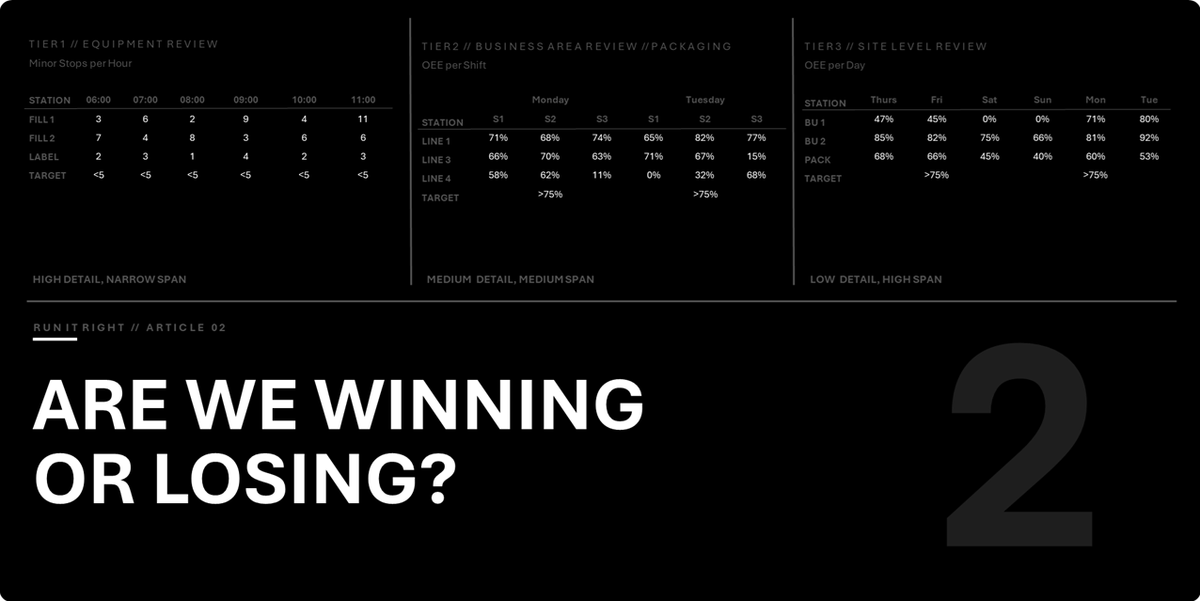
I worked with a plant where an operator on one of the filling lines had a target for minor stops. Fewer than fifteen per shift. That was their number. They owned it. They reported it every morning at the line board. They tracked it shift by shift.
The reason that number mattered was not because someone had decided fifteen was a good round number. It was because the engineering team had done the analysis. They knew that when minor stops exceeded fifteen per shift on that line, the line's OEE dropped below the threshold needed to hit the site's volume plan. And the volume plan was not just a production target. It was the commercial case for insourcing a product family that was currently being manufactured externally. The insourcing decision, which would bring 40 jobs to the site and secure its future for the next decade, was contingent on demonstrating that the site could run at a sustained OEE that made the internal cost competitive with the external manufacturer.
Fewer than fifteen minor stops per shift. That was their number.
But what stayed with me was not the number. It was the person.
They knew why it was their number.
They could tell you, standing at the line, without looking anything up, what their target was, what their actual was, and what they were doing about the gap. They could also tell you what that gap meant for the line, for the site, and for the people who worked there.
That is not a small thing. That is the whole thing.
What "are we winning?" actually requires
The question sounds simple. It is not simple to answer, not because the data is hard to find, but because answering it properly requires that the following three things are true simultaneously.
The person doing the work knows their target. Not approximately. Not in general terms. A specific, measurable number for this shift, this line, this product. A number that was set against the standard, not against last week's average.
The target connects to something that matters. Not just to the schedule. To the reason the schedule exists. To the site's volume plan, its cost position, its strategic case. The operator who knows their minor stop target is below fifteen, and knows why fifteen is the number, is connected to the organisation's purpose in a way that no engagement survey can manufacture.
The gap is visible and owned. When the number is off, someone knows it in real time, not on Friday morning when the spreadsheet arrives. And that someone has a name, a role, and a specific action they are taking to close it.
When those three things are true, the question are we winning or losing? has an answer. A real one. The kind you can verify by walking to the line and asking the person running it.
When they are not true, you get what most organisations have: a weekly review that tells you how last week went, a confidence that is genuine and unverifiable, and a gap between what the organisation is doing and what it needs to do that grows quietly, year by year, until it becomes the number nobody is questioning.
That answer, we're running, no major issues, was not a failure of the person giving it. It was a failure of the system they were working in.
The system had never told them what winning looked like. It had never connected their daily experience to a number, or that number to a target, or that target to the reason the target existed. It had given them eleven years of experience and no framework in which to use it.
The weekly review was the same failure, one level up. It told the room what had happened. It did not tell the room whether what had happened was good enough, good enough against what the site needed to achieve, not just against last week's plan. The question are we winning or losing? was never asked, because the room had everything it needed to answer a different question: did we hit the schedule?
Hitting the schedule is not the same as winning. It is a necessary condition, not a sufficient one. A plant can hit its schedule every week for years while its OEE drifts, its costs creep, and the commercial case for its existence quietly erodes.
The organisation that can answer are we winning or losing? in real time, at the line, at the shift review, at the weekly meeting, has built something that most organisations never build: a single definition of winning that runs from the operator's daily target all the way to the organisation's strategic purpose, and is visible and owned at every level in between.
That is not a technology problem. It is not a data problem. It is a management system problem. And it is solvable.
If you want to know whether your organisation can answer the question, do not start with the weekly review. Start at the line.
Find the person who has been running it longest. Ask them what a good day looks like. Listen to the answer. Then ask: what is your target for today, and are you ahead or behind it right now?
If they can answer that question, specifically, measurably, without looking it up, you have something to build on.
If they cannot, you have found the gap. Not in them. In the system that was supposed to give them the answer.
The question is not whether that gap exists in your organisation. It almost certainly does. The question is whether you are willing to go and find it, and what you are prepared to do once you have.