The Flow that is Broken
An operator raised a problem at 5am. Within one day it was solved. Three weeks later I watched the same instinct fail completely, because the system to catch it did not exist. Same people. Same problem. Different system.

It was 5am in a manufacturing site in eastern Europe.
I had spent two hours in a car to get there. I was still a bit bleary-eyed, notebook in hand, watching a shift handover directly on the line.
I had seen versions of this many times. But I already felt this one was different. The operators were doing most of the talking.
One in particular was animated about a problem. I was paying attention, but I was looking for key items to put into my assessment. It was early. The problem did not feel significant.
A waste bin. Located so that operators had to walk around the equipment from where the waste was generated to reach it, every cycle. And then walk the bin around the equipment again when it needed emptying.
I was about to move on to the next item on my assessment sheet.
Then the line supervisor asked a question that woke me up.
"Can you solve this here, with the team? Or does it need escalation?"
The operator thought for a moment. There was impact on other teams. The decision was not theirs to make alone.
It needed to go up.
So it went up.
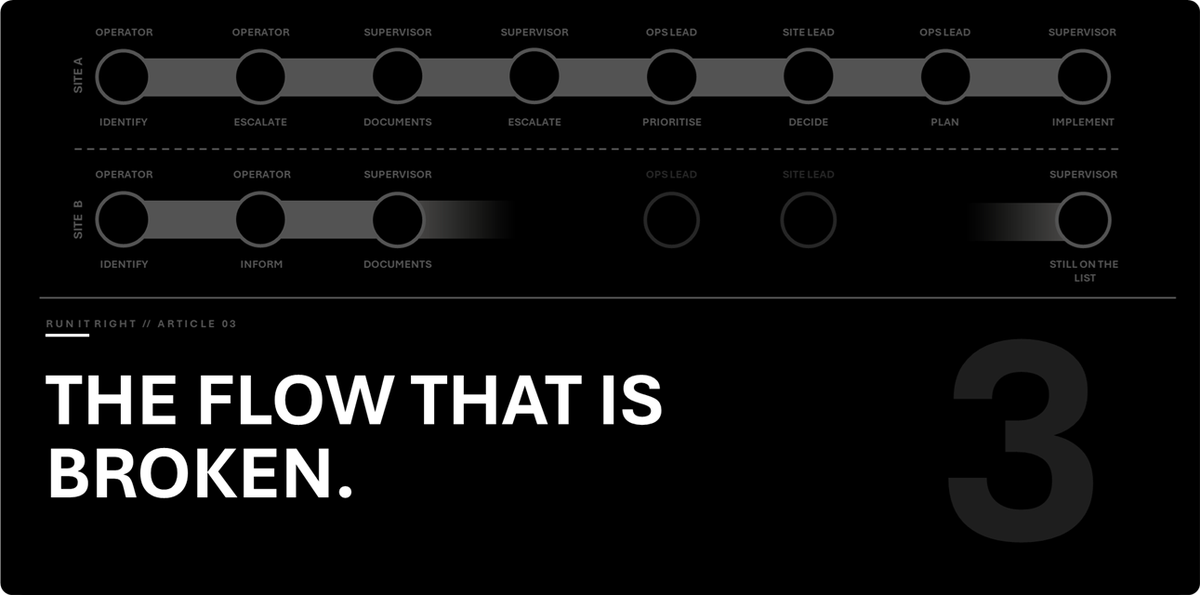
At the Tier 2 meeting, supervisors to the operations manager, the item was presented clearly. Current bin location. Proposed location. Why the change made sense. Who else was affected.
At Tier 3, the plant leadership team, at 10am, it was discussed. Maintenance confirmed the new location worked for them. The decision was made in the room.
The next morning, the operator had their answer. The floor was remarked. The unnecessary walk stopped.
From problem raised to decision made, one day.
I stood in that Tier 1 at 5am and watched something I had spent years trying to build in other organisations. Not the bin. Not even the decision. The flow.
Information moved from the person who saw the problem to the person who could act on it, in the right sequence, at the right speed, without getting lost, filtered, or forgotten. The operator knew what to raise. The supervisor knew the right question to ask. The leadership team knew what to decide. Everyone understood their role in the chain.
That is not a communication skill. It is a system.
And this site had built it deliberately, the structure, the processes, the tools, and importantly the behaviours that meant everyone knew what good looked like, and what to do when things did not look like that.
Three weeks later I visited another site. The other visit was still fresh in my mind.
Same industry. Similar lines. Similar people doing their best.
I watched an operator cleaning overflow off the floor. The waste was landing on the far side of the bin from where they were working. They filled a dustpan, walked around to the bin, emptied it, walked back, and did it again. And again. And again.
I asked about it.
They told me flatly, with no frustration, that they had raised it, but nobody had got back to them. They went back to the clean up.
I spoke to the supervisor. The item was on a list. They showed me the list. It was long. It had departments next to most items, not names. It had due dates only for quality and safety issues where parts needed ordering. Everything else sat without a date, without an owner, without a next step.
It had not been raised in the management meeting. Not because anyone had decided it was unimportant. Because the management meeting reviewed outputs, budgets, and items that required formal reporting, quality issues, backlogs, safety incidents. Individual improvement ideas from the floor were not part of the agenda. There was no formal tier system. Supervisors told the operations manager what was going on in their own way, with their own sense of what was most important.
And that is the real problem. Not the list. Not the meeting format. Not any individual decision.
The problem was that important and urgent were entirely subjective. With no shared system to define them, every person was filtering information through their own judgment about what deserved attention. When there are a thousand priorities, there are none. And when something goes wrong, as it always does, it gets all the focus, and everything else is lost until the next crisis arrives.
The operator's idea had not been rejected. It had not been considered. It had landed in a list and stayed there, which, for the person who raised it, is indistinguishable from being ignored.
They had stopped expecting anything to happen.
Not bitterly. Just practically. They had recalibrated what the system would do with their input and adjusted their expectations accordingly. They still did their job well. They still noticed the inefficiency every single time they filled that dustpan.
They had just stopped believing that noticing it was worth anything.
That is what a broken flow does. Not dramatically. It does not announce itself. It simply teaches the people closest to the work that their observations do not travel, and over time, they stop sending them.
The difference between those two sites was not the quality of the people.
It was not the size of the problem. Both problems were small. Both were solvable in a day.
It was not the industry, the product, or the equipment.
It was whether a system existed to move information from the person who saw the problem to the person who could act on it, with a shared understanding of what was important, what was urgent, and whose job it was to decide.
At the first site, that system existed. The supervisor's question, can you solve this, or does it need escalation?, was not improvised. It was the system speaking. The operator knew the answer because the system had given them the language and the confidence to know it. The escalation happened because everyone understood what escalation meant and why it mattered.
At the second site, the system did not exist. The supervisor was not negligent. The manager was not indifferent. The people were doing the best job they could. But without a shared structure for what is important, what is urgent, and how information moves, they were each making individual judgments that added up to collective inaction.
The information existed. The flow did not.
Nobody had decided this was how things would work. Nobody had chosen to ignore the operator's idea. The system had simply never been built to carry it anywhere useful.
Here is what I have learned about information flow in organisations.
The problem is almost never that people do not see things.
Operators see things every shift that their supervisors do not know about. Supervisors know things that never reach the operations manager. The operations manager has a picture of the site that is materially different from what the plant director sees in the weekly report.
The gap is not observation. It is transmission.
And when the formal transmission system does not exist, two things happen.
First, the information waits. It goes on a list, or sits in someone's head, without an owner or a date. It arrives eventually in a meeting that was not designed to act on it. By then it is stale, or buried, or overtaken by the latest crisis.
And eventually it stops being raised at all.
The operators recalibrate. The supervisor stops asking. The system settles into a version of itself where the floor's intelligence never reaches the people who could use it, and nobody decides that this is what will happen. It simply becomes the shape of things.
The daily tier meeting is not a status update. It is not a communication exercise. It is the mechanism that prevents this from happening, that moves information up in real time, at the right level, with the right owner, before it goes stale or gets lost.
Without it, you are not managing the operation.
You are managing the version of the operation that has survived the journey from the floor to the report.
Those are not the same thing.
Building the flow is not a single thing. The tier meeting is the visible part. But it only works when the things around it are in place.
You need a defined structure, escalating meetings at each level, with a clear purpose, a consistent format, and the discipline to run them the same way every day.
You need shared rules for what gets escalated, what gets decided at each level, and who is accountable for the outcome. Without it, every person defaults to their own judgment, and the sum of individual judgments is what you already have.
You need standards, a common language for what important and urgent mean, so that the operator and the plant director are working from the same definition, not their own version of it.
And you need capability, people at every level who know how to run the meeting, ask the right question, present an item clearly, and make a decision in the room rather than defer it to the next one. They need to know when they can make a decision and when they should propose a path forward to the next tier.
When those five things exist together, information moves. Ideas become decisions. Decisions become actions.
When any one of them is missing, the flow breaks, quietly, without announcement, in exactly the way the second site's list grew long and stayed there.
The operator in eastern Europe whose bin was moved went on to raise more improvements that year. They became a core member of an autonomous maintenance pilot. The site became a showcase, the place we took other sites to see what good looked like.
The operator with the dustpan. I honestly do not know what happened to their idea after I left.
What daily mechanism do you have to make sure what your operators see today reaches the people who can act on it?
Before it goes on a list and stays there.