Leader Standard Work Guide
A practical guide to building, running, and sustaining your Leader Standard Work plan. Covers what it is, why it matters, and how to build one that holds.
The leader who does not have a standard cannot confirm that anyone else is following one.
Leader Standard Work (LSW) is the documented schedule of what a leader does, when they do it, and what they check. It is not a to-do list. It is not a calendar. It is the standard for how a leader spends their time, the same discipline applied to leadership work that standard work applies to any other process.
Without it, leadership time fills with the urgent and the reactive. The important work, confirming the standard is being followed, developing the team, removing barriers, gets displaced by whatever arrived loudest that morning.
This guide explains what LSW is, why it matters, and how to build one that works. Work through it in sequence. The plan you produce at the end should look different from how you are spending your time today. If it does not, you have not looked hard enough.
What Leader Standard Work is
LSW is a documented, time-structured plan that defines what a leader does each day, each week, and each month to support the management system.
It has three components:
Why it matters
Most leaders in operations spend the majority of their time reacting. A problem on the line. An urgent request from above. A meeting that was not in the plan. By the end of the week, the work that was supposed to happen, the floor walk, the coaching conversation, the process check, did not happen. Again.
This is not a discipline problem. It is a system problem. Without a standard for how leadership time is spent, the urgent always wins over the important.
LSW addresses four specific losses:
Shadow of the leader
There is a second reason LSW matters that is harder to quantify but equally important.
If a leader expects their team to follow a standard, the leader must follow one too. LSW is the visible proof of that. When a leader runs their LSW consistently, when the team can see that the leader's time is structured, planned, and reviewed, it changes the culture of the area. Standards are not just for operators. They are for everyone.
How to build your LSW
Work through the following steps in order. Each step has a clear output. Do not move to the next step until you have it.
Step 1 — Identify your critical processes
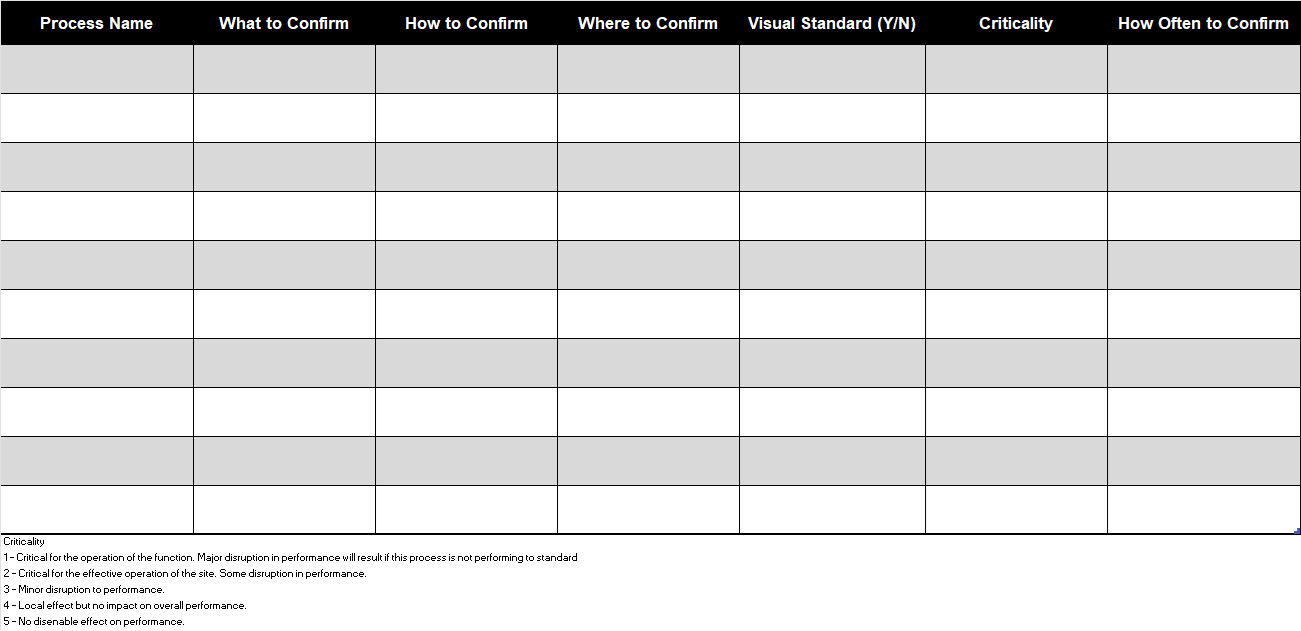
Start with the key processes you own or are accountable for. Not everything you touch, the ones where, if the process is not running correctly, there is a real consequence for the line, the area, or the site.
For each process, ask:
- What does good look like in this process?
- How would I know if it was not running correctly?
- How often do I need to check it to catch a problem before it becomes a loss?
| Process | What to confirm | How to confirm | How often | Location |
|---|---|---|---|---|
Rank your processes by criticality. The highest-rated processes should appear most frequently in your LSW schedule.
| Rating | What it means |
|---|---|
| 1 — Critical | Major disruption if this process fails. Must be confirmed regularly. |
| 2 — High | Significant impact if this process drifts. Confirm at least weekly. |
| 3 — Medium | Some disruption. Confirm fortnightly or monthly. |
| 4 — Low | Local effect only. Confirm monthly or as needed. |
Step 2 — Identify your critical tasks
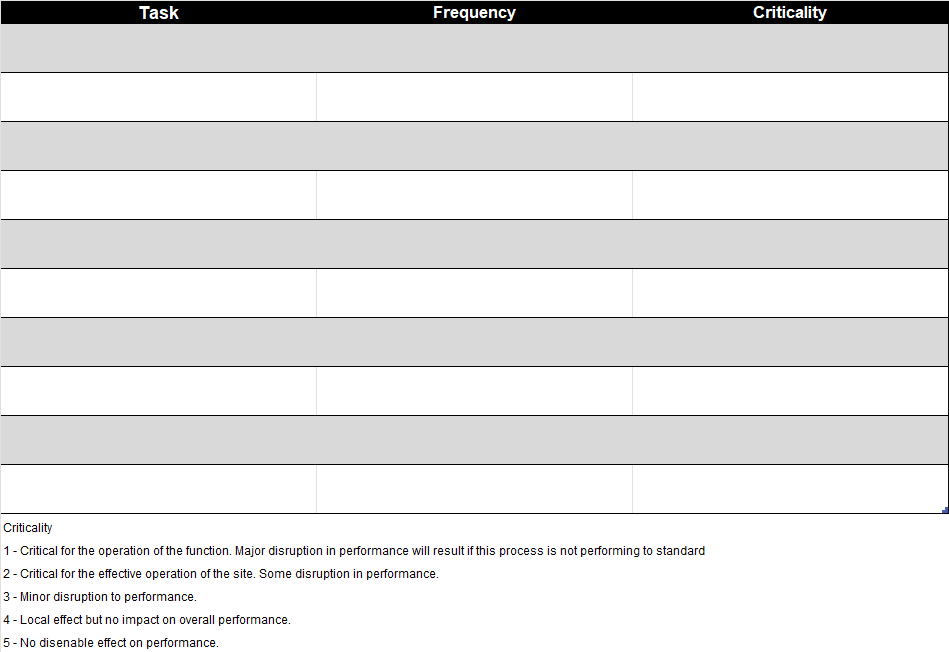
Separate from your process confirmations, list the recurring tasks that your role requires, meetings you lead, reports you own, coaching conversations, reviews, and handovers.
Apply the same criticality rating. Not every task deserves equal time. Some tasks are critical to the management system. Others are habitual but low-value. LSW is an opportunity to be honest about the difference.
Capture at this step:
| Task | Frequency | Criticality | Time required |
|---|---|---|---|
Step 3 — Align to the site calendar
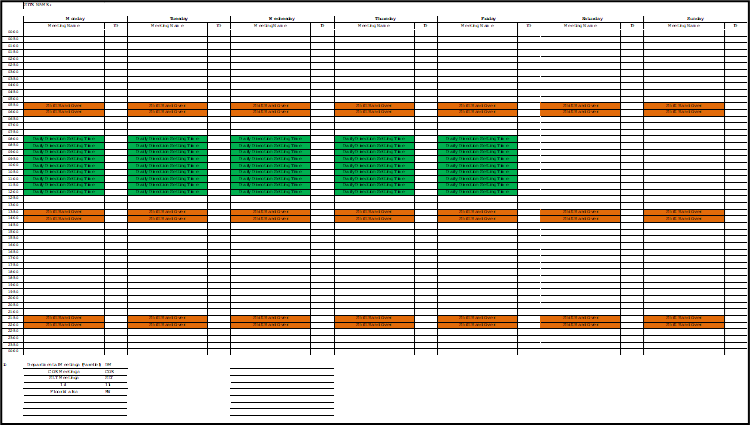
Before you build your personal LSW, confirm the fixed points in the management system that your plan must align to. These are the non-negotiables, the tiered accountability meetings, shift handovers, and daily direction-setting sessions that the whole site runs around.
If your site has a fixed site calendar, use it. If it does not, this is the moment to build one.
The fixed points to protect:
- Shift handovers — the structured transfer of information between shifts
- Tier 1 meetings — frontline team, daily, at the line or board
- Tier 2 meetings — department or area, daily or every other day
- Tier 3 meetings — site or function, daily or weekly
- Tier 4 meetings — site leadership, weekly
- Coaching meetings — agree fixed times in the week for coaching to ensure maximum flexibility at other times
Your LSW must be built around these fixed points, not in competition with them. If your LSW conflicts with the management system, the management system loses, and so does the team.
Step 4 — Build your personal LSW schedule
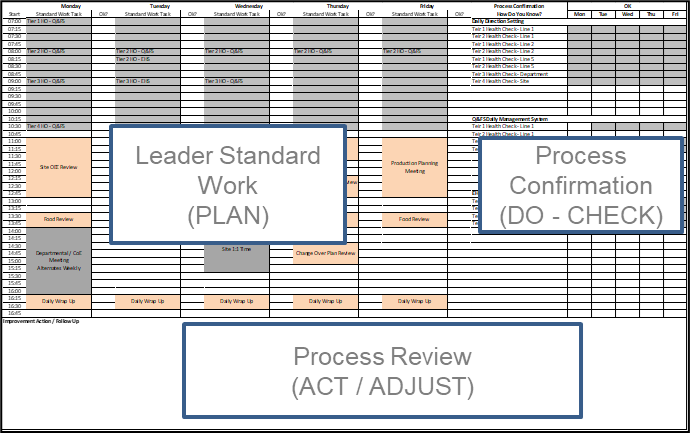
Now build your weekly or monthly plan. Time-block your schedule using the fixed points from Step 3 and the critical processes and tasks from Steps 1 and 2.
Structure your day around three types of activity:
Minimum content for a complete LSW:
| Element | Included? |
|---|---|
| All tiered accountability meetings | Yes / No |
| Shift handovers (where applicable) | Yes / No |
| Process confirmation checks (from Step 1) | Yes / No |
| Coaching or 1:1 time | Yes / No |
| Improvement and follow-up time | Yes / No |
| Weekly LSW review (PDCA) | Yes / No |
Step 5 — Add your process confirmation detail
For each process confirmation in your schedule, define exactly what you will check and how you will know whether it is right. Ideally this can be done visually, at a glance.
A process confirmation is not a walkthrough. It is a structured check with a defined standard. You should be able to complete it in a fixed time and know immediately whether the process is running correctly.
For each confirmation, define:
- What process are you checking?
- What does good look like? (the standard)
- What are you physically looking at, reading, or asking?
- What do you do if it is not right?
Step 6 — Run your LSW and track adherence
Your LSW is only useful if you run it. Track whether you did what you planned, not to report upward, but to understand your own patterns.
Mark each item as complete or not complete at the end of each day. If you missed something, note why. At the end of the week, review the pattern.
Common reasons for missing LSW items:
- A reactive event displaced planned time — is this a one-off or a pattern?
- The item was planned at the wrong time — does it need to move?
- The item is no longer critical — should it be removed?
- The item is critical but consistently missed — what barrier needs to be removed?
Step 7 — Run the weekly PDCA
At the end of each week, spend fifteen minutes reviewing your LSW. This is the PDCA cycle for your own standard work.
- Plan — Update your LSW for the coming week based on what you learned this week.
- Do — Run the updated LSW.
- Check — At the end of the week, reflect: did you do what you planned? Did you find what you expected in your process confirmations? What surprised you?
- Act — Update the LSW based on what you learned. Standardise what worked. Change what did not.
| Field | Your answer |
|---|---|
| Week number | |
| Items completed as planned | Number or percentage |
| Items missed | Which ones, and why |
| Process confirmations — what did you find? | Any gaps between the standard and what you observed |
| Actions raised this week | What was escalated, to whom, and by when |
| Changes to LSW for next week | What is being added, removed, or moved |
Common pitfalls
These are the patterns that cause LSW to fail. Most of them are not about effort. They are about misunderstanding what LSW is for.
What this gives you
Key Links
This guide depends on:
The tiered accountability meetings are the fixed points your LSW is built around. If those meetings are not yet in place, start there before building your LSW.
This guide connects to:
Process Confirmation is the discipline your LSW schedule is designed to make happen consistently. Your confirmation list is the core of your LSW.
The processes you confirm need a defined standard before you can confirm them. Process improvement is how those standards are set and maintained.