Maintenance
The Maintenance function's job is not to fix what breaks. It is to build the systems that prevent breaking in the first place. This pillar covers how that function evolves, from reactive to proactive to planned and from planned to predictive, as the operating team builds its own capability alongside it.
The Maintenance function in most sites is not underperforming. It is overwhelmed.
Every unplanned breakdown generates a reactive call. Every reactive call displaces a planned task. Every displaced planned task increases the probability of the next breakdown. The function is working hard and falling behind at the same time. The people in it are skilled. The model they are working in makes it almost impossible to get ahead.
I have seen maintenance teams where more than eighty percent of their time was spent on reactive work. Not because they were poorly managed. Because the equipment was deteriorating faster than they could respond to it, and the operating team had no capability to slow that deterioration down. Every shift produced new failures. Every failure consumed the time that should have been spent preventing the next one.
The answer is not more maintenance resource. It is a different model.
As Autonomous Maintenance builds the operating team's capability to maintain basic conditions, clean, lubricated, correctly adjusted, the Maintenance function gets time back. Not a little. Significantly. That time does not disappear. It moves. From reactive work, fixing what just broke, to proactive work, planned maintenance, lubrication systems, component life extension. And eventually to predictive work, condition monitoring, vibration analysis, reliability engineering, the technical disciplines that identify deterioration before it becomes a failure.
That is not a transfer of responsibility from the Maintenance function to the operating team. It is an upgrade of what the Maintenance function does. The work becomes more technical, more deliberate, and more effective. The function stops being the site's emergency service and starts being its reliability engine.
But there is a second problem that sits alongside the reactive cycle, and it is less often named.
Maintenance needs access to equipment to do planned work. Operations needs the equipment running. When a breakdown happens, maintenance gets the call, and the blame. Operations is not in the room for most of the actual repair work. The two functions are measured on different things, in different meetings, against different priorities. And then they are expected to collaborate on equipment reliability.
That tension does not resolve itself. It has to be designed out.
Pillar Intent
The Maintenance pillar exists to ensure that equipment is available when it is needed, running at the condition it was designed to run at, for as long as possible, at the lowest sustainable cost.
That means managing the technical work that is beyond the operating team's current capability, and shifting that boundary deliberately as the team's capability grows. It means building the systems that make planned maintenance possible: equipment ranking, lubrication management, parts availability, planning and scheduling. It means developing the technical knowledge to move from time-based maintenance to condition-based maintenance, so that interventions happen when the equipment needs them, not when the calendar says so.
This pillar works in close partnership with Autonomous Maintenance. AM builds the operating team's capability to maintain basic conditions and detect early deterioration. The Maintenance function provides the technical knowledge the team needs to do that correctly, and manages the work that requires specialist skills, tools, or access. The boundary between the two is not fixed. It shifts deliberately, step by step, as the AM journey progresses.
The Maintenance pillar also works alongside Problem Solving. Every breakdown that is not properly investigated is a breakdown that will happen again. The Maintenance function owns the discipline of Breakdown Elimination, a structured approach to recurring equipment failures that goes deeper than standard problem solving, using component-level failure analysis and Mean Time Between Replacement (MTBR) data to find and remove the root cause permanently.
How the pillar works
Planned maintenance requires access to equipment that operations controls. That is the structural tension at the centre of this pillar. If the two functions plan separately, planned maintenance will always lose to production pressure, not because operations is obstructive, but because the access conversation is happening in the wrong room, at the wrong time, without the right people present.
The Pillar team is cross-functional by design. It includes the Maintenance function, the production or equipment scheduler, and operations leaders from the areas where AM is active. Planned maintenance windows are agreed at the Tiered Accountability Meetings (TAM), not negotiated separately, so that access is built into the production schedule, not bolted on afterwards.
Maintenance is represented at the daily TAM at line level. Not to report on their own backlog, but to be part of the shared conversation about equipment condition, planned access, and abnormality response. The production schedule and the planned maintenance schedule are visible in the same room, at the same time, to the same people.
Equipment availability is a shared metric. A breakdown that happens because planned maintenance was deferred is not a maintenance failure alone. It is a failure of the system that should have protected the access. Both functions are accountable for it. If they are measured on different things, in different meetings, against different priorities, that shared accountability is not real, and the tension between them will not resolve.
Pillar Owned Losses
These losses show up in your OEE figures, your maintenance budget, and your production schedule. Some are visible, a line stop is hard to miss. Others are not, a run rate that is two percent below target, every shift, rarely triggers the same urgency as a breakdown. The causes behind all of them are structural. They are built into a maintenance model that responds to failure rather than preventing it.
The work of this pillar is to change the model that produces these losses, systematically, in sequence, building the foundations before the advanced techniques.
Pillar Owned Capabilities
The Maintenance pillar builds capability in response to the losses it owns. Those capabilities fall into two categories: the systems that make maintenance efficient, and the techniques that make it effective.
Process capabilities
Equipment ranking. Not all equipment is equally critical. Equipment ranking is the process of classifying equipment by its impact on safety, quality, output, and cost, so that maintenance effort, spare parts investment, and planned maintenance intervals reflect the actual consequences of failure. Without ranking, effort is distributed by habit. With it, effort goes where it matters most.
Planned and scheduled maintenance. The discipline of planning maintenance work before it is needed, identifying what needs to be done, what parts and skills are required, when the work will be done, and how long it will take. Planned maintenance is not just a schedule. It is a system. It requires equipment ranking to prioritise, parts availability to execute, and planning discipline to protect the time.
Lubrication management. A system that specifies the correct lubricant, quantity, frequency, and method for every lubrication point on every piece of equipment, and makes it possible to complete the lubrication routine in the time available. Lubrication management is one of the highest-return investments in equipment reliability. It is also one of the most commonly neglected.
Breakdown Elimination. A structured approach to recurring equipment failures that goes deeper than standard problem solving. Breakdown Elimination uses component-level failure analysis, MTBR charts, and failure mode classification to identify the root cause of failures that keep returning, and to remove them permanently. It is built on the same six-stage problem solving discipline used across the site, with additional tools specific to equipment failure analysis.
Condition-based monitoring. The use of measurement techniques, vibration analysis, thermography, oil analysis, ultrasonic testing, to detect deterioration in equipment components before they fail. Condition-based monitoring replaces fixed-interval maintenance with maintenance triggered by the actual condition of the equipment. It requires investment in tools and skills, and it requires the foundational maintenance systems to be in place before it can deliver its full value.
Shutdown and overhaul management. The planning and execution of planned shutdowns, major overhauls, regulatory inspections, and capital maintenance work that cannot be done during normal production. Effective shutdown management requires the same disciplines as planned maintenance, at greater scale: equipment ranking to prioritise the scope, parts and contractor management to resource it, and planning discipline to protect the schedule. A shutdown that runs over time or scope is a signal that the planning system is not yet mature.
Storeroom management. A system for managing spare parts and materials that ensures the right parts are available when needed, at the right cost, without holding excessive inventory. Storeroom management is connected to equipment ranking, critical equipment requires higher parts availability, and to planned maintenance, which allows parts to be staged before the work begins rather than sourced after the failure.
People capabilities
Maintenance technicians and engineers who can move from reactive repair to planned maintenance to condition-based monitoring, and the leaders who build the systems that make that progression possible.
- Maintenance technicians who can diagnose failures accurately, complete planned maintenance to standard, perform lubrication correctly, and contribute to breakdown investigations with component-level knowledge.
- Maintenance engineers and reliability specialists who can design and manage the systems, equipment ranking, lubrication management, condition monitoring, planned maintenance schedules, that prevent failures rather than responding to them.
- Maintenance leaders who understand the shift from reactive to proactive to predictive, manage the transition deliberately, and build the partnership with the operating team that makes both AM and planned maintenance more effective.
- Site and function leaders who set the expectation that maintenance is a reliability system, not an emergency service, and who allocate the time and resource for planned work to happen.
Pillar Behaviours
The shift from reactive to proactive to predictive maintenance does not happen automatically. It requires a deliberate change in how the function responds to failure, plans its work, and uses the time that AM returns to it. Here is what the same situation looks like with and without it.
A breakdown occurs on a critical line.
Planned maintenance is scheduled for next week.
The operating team reports an abnormality during their inspection routine.
The AM programme reaches Step 5 on the pilot line.
Planned maintenance access is requested for next Tuesday.
What Good Looks Like
Maintenance technician
- Completes planned maintenance to standard, on schedule, without being chased.
- When a breakdown occurs, repairs it correctly and contributes to the investigation. Does not just fix the symptom.
- Knows the failure history of the equipment they work on. Can describe which components fail most often, what the pattern looks like, and what has been done to address it.
- Works with the operating team, not around them. Shares technical knowledge. Listens to what the team has observed. Uses that observation in the diagnosis.
- Completes lubrication to the correct standard, right lubricant, right quantity, right frequency, right method.
- After every intervention, asks: did we replace something, or did we restore it? A replacement is a signal that the system did not prevent the failure. A restoration, an adjustment, a lubrication, a re-setting to standard, is the system working.
Maintenance engineer or reliability specialist
- Maintains the equipment ranking and reviews it when the loss picture changes.
- Manages the planned maintenance schedule and protects it from reactive displacement.
- Leads breakdown investigations on recurring failures. Uses component-level analysis and MTBR data to find the root cause, not just the most recent cause.
- Develops and maintains the lubrication management system. Ensures lubrication points are accessible, lubricants are standardised, and the routine can be completed in the time available.
- Builds the condition monitoring capability, identifies which components are candidates for condition-based monitoring, selects the right technique, and establishes the baseline.
- Reviews the boundary between operating team tasks and maintenance tasks as AM progresses. Ensures the transfer is deliberate and the operating team has the knowledge to do the transferred work correctly.
- Plans and manages shutdowns and overhauls to scope, time, and cost. Treats a shutdown that runs over as a planning failure, not a maintenance failure.
Maintenance leader
- Tracks the ratio of reactive to planned maintenance work. Sets a direction of travel, more planned, less reactive, and manages to it.
- Protects planned maintenance time. Does not allow reactive work to displace planned tasks on critical equipment without a deliberate decision.
- Reviews the breakdown investigation backlog. Ensures every recurring failure has been investigated and that the finding has changed something, the standard, the interval, or the component.
- Builds the partnership with the AM programme. Attends step audits. Understands where each line is in the AM journey. Adjusts the maintenance boundary accordingly.
- Is present at the daily TAM at line level. Not to report on the maintenance backlog, but to be part of the shared conversation about equipment condition, planned access, and abnormality response.
- Ensures planned maintenance windows are on the production schedule and agreed at the TAM, not negotiated separately after the schedule is set.
- Asks in reviews: what percentage of our maintenance is planned? What is our MTBR trend on critical equipment? Which failures are recurring? What has the investigation found? Are we replacing or restoring? How many planned tasks were deferred last week, and why?
Site or function leader
- Sets the expectation that maintenance is a reliability system, not an emergency service.
- Allocates time and resource for planned maintenance to happen. Does not treat it as something that happens after the reactive work is done.
- Ensures both functions, Maintenance and Operations, are measured on equipment availability, not just their own function's output. If they are measured on different things, the shared accountability is not real.
- Asks in reviews: are we moving from reactive to planned? Are we investing in condition monitoring capability? Is the partnership with AM working, is the boundary shifting as it should? Are planned maintenance windows being protected in the production schedule?
- Connects maintenance performance to the site's strategic objectives. Equipment availability is not a maintenance metric. It is a business metric.
Pillar Owned Processes
The Maintenance pillar owns a set of processes that build reliability systematically. They are introduced in sequence, the foundational processes first, the advanced techniques once the foundations are in place. Attempting condition-based monitoring before planned maintenance is established is like attempting AM Step 4 before AM Step 1. The advanced technique requires the foundation to deliver its value.
Equipment ranking. The starting point. Every other process depends on knowing which equipment is critical and which is not. Ranking is based on the consequences of failure, safety, quality, output, cost, and it drives the prioritisation of every other maintenance activity.
Breakdown Elimination. The discipline of investigating recurring failures at the component level and removing the root cause permanently. Breakdown Elimination uses the same six-stage problem solving process used across the site, with additional tools, MTBR charts, component failure classification, PM Analysis, that are specific to equipment failure modes. A dedicated guide covers the process in detail.
Lubrication management. The system that specifies and controls lubrication across all equipment. Correct lubrication is one of the highest-return reliability investments available. The lubrication management system ensures the right lubricant reaches the right point at the right time, and that the routine can be completed reliably by the people responsible for it.
Planned and scheduled maintenance. The process of planning maintenance work before it is needed and scheduling it so that it happens. Planning covers what needs to be done, what parts and skills are required, and how long it will take. Scheduling covers when it will happen and who will do it. Both require the equipment ranking and parts availability systems to be in place.
Shutdown and overhaul management. The planning and execution of major planned shutdowns. The same disciplines as planned maintenance, scope definition, parts and contractor management, scheduling, and plan adherence, applied at greater scale and with greater consequence if they fail. A guide covering the shutdown management process will follow.
Condition-based monitoring. The use of measurement techniques to detect deterioration before failure. Vibration analysis, thermography, oil analysis, and ultrasonic testing each detect different failure modes in different component types. Condition-based monitoring replaces fixed-interval maintenance with maintenance triggered by actual equipment condition, reducing both the frequency of unnecessary interventions and the number of unplanned failures.
Maintenance prevention. The discipline of designing maintainability into new equipment at the specification and procurement stage. Access for inspection and lubrication, standardisation of components, and specification of maintenance-free design features where possible. The best time to reduce the maintenance burden of a piece of equipment is before it is installed.
Hypercare Processes
Two measures in this pillar require Hypercare treatment, daily review at the TAM until they are stable and improving. They are introduced on the AM pilot line and expanded as AM progresses.
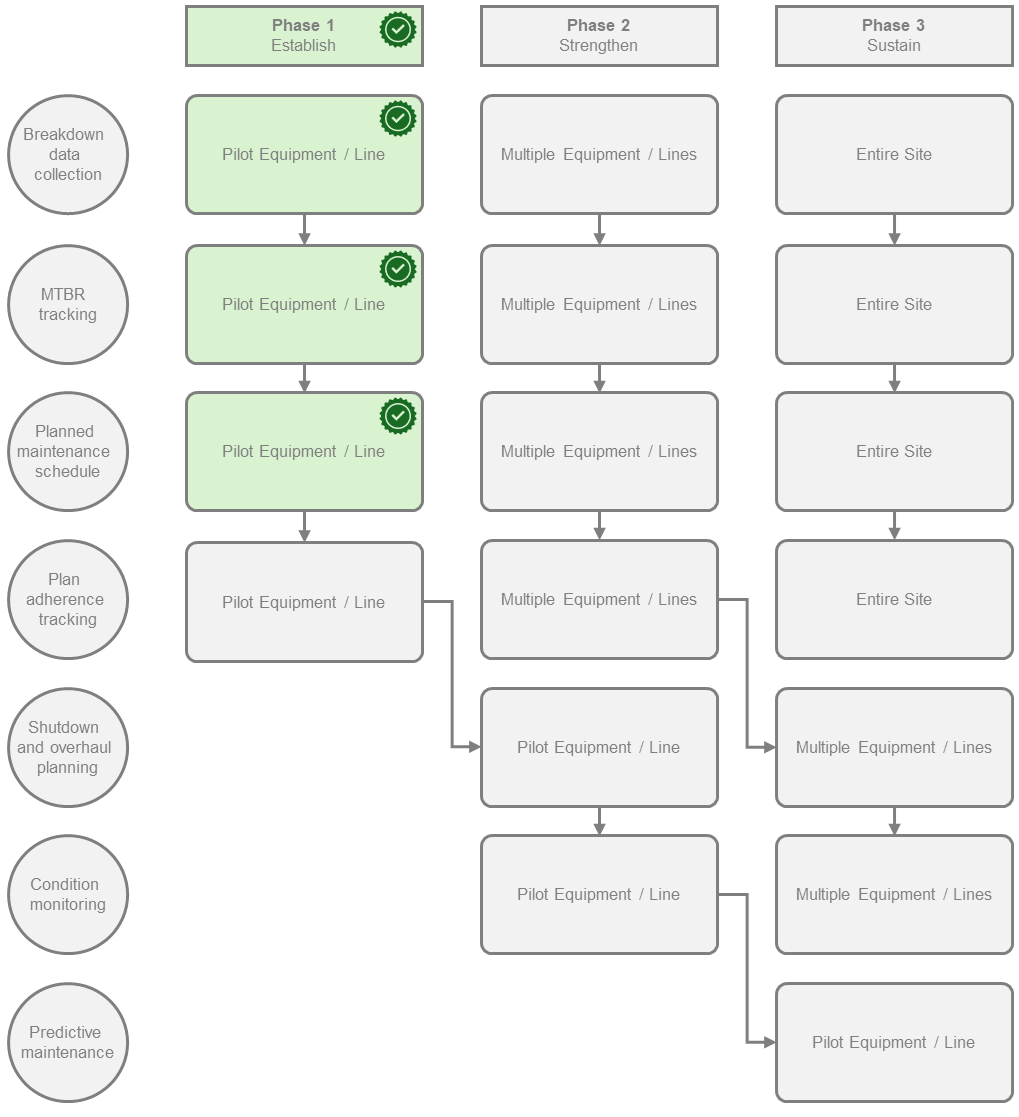
MTBR on critical equipment. Introduced from AM Step 4, when planned maintenance is established on the pilot line. MTBR, Mean Time Between Replacements, measures the average time between unplanned component replacements on ranked critical equipment. Adjustments and restorations are not counted, they are the system working. The data quality check is essential: work orders must be logged to component level, not just recorded as "mechanical failure." MTBR is reviewed at every TAM tier daily until it is stable and at or above the planned replacement interval. Hypercare is lifted when the trend is consistently positive and the reactive-to-planned ratio is improving.
Plan adherence for proactive maintenance. Introduced when planned maintenance is formalised on the pilot line, typically AM Step 3. Plan adherence measures the percentage of planned, time-based, and condition-triggered tasks completed within their scheduled period on ranked equipment. Reactive repairs are explicitly excluded, they are not planned, so they cannot be adherent. Deferrals are recorded with a reason code: parts availability, line access, reactive displacement, or planning quality. Reason codes are reviewed at the TAM to identify the systemic constraint. Hypercare is lifted when plan adherence is consistently above 80–85% and the reactive-to-planned ratio is improving.
Both measures are reviewed at every tier of the TAM, from the daily line review to the weekly site review, until they are stable. The floor coaching question for both is the same: did we replace something, or did we restore it? The answer tells you whether the maintenance system is ahead of the failure or behind it.
Audits and Confirmations
As the Maintenance pillar builds capability, there are straightforward questions that reveal whether the system is working.
Where to Start
Before selecting a process to build, take stock of where you are.
Ask these questions:
If the answer to most of these is no, start with Phase 1, Establish. Rank your equipment. Run Breakdown Elimination on your top three recurring failures. Build the lubrication management system. These are the foundations. Without them, everything else is built on unstable ground.
If the foundations are in place but planned maintenance is still being displaced by reactive work, start with Phase 2, Strengthen. The reactive load should be falling as AM progresses and Breakdown Elimination removes recurring failures. If it is not falling, find out why, and address it before moving to condition monitoring.
If planned maintenance is running reliably and MTBR is improving, move to Phase 3, Sustain. Build the condition monitoring capability. Extend it to more components. Review planned maintenance intervals against actual equipment condition data. The function is moving from proactive to predictive.
Phases
The Maintenance function's capability develops in parallel with the AM programme. The three phases of AM, Establish, Strengthen, Sustain, correspond to three shifts in what the Maintenance function does and how it spends its time. The shift is not automatic. It requires deliberate management of the boundary between the two functions at each stage.
Phase 1 — Establish
In Phase 1, the AM pilot is running on one line or a small number of lines. The Maintenance function's primary role at this stage is to support the AM pilot, providing the technical knowledge the operating team needs to clean correctly, identify abnormalities accurately, and set lubrication standards that are achievable and correct.
At the same time, the Maintenance function begins building its own foundations. Equipment is ranked. The top recurring failures on the pilot equipment are investigated using Breakdown Elimination. The lubrication management system is reviewed and improved for the pilot area. Planned maintenance is established for critical components on the pilot line.
The reactive load does not fall immediately. AM Steps 1 and 2 generate abnormalities that require maintenance response. The function should expect an increase in tagged defects in the early steps, this is the system working, not a sign that AM is creating more work. As AM Steps 3, 4, and 5 progress, the operating team takes on more of the basic condition maintenance, and the reactive load begins to fall.
The measure of Phase 1 for the Maintenance function is not the ratio of planned to reactive work. It is whether the foundations are in place, ranking, lubrication management, Breakdown Elimination on the top failures, and whether the partnership with the AM pilot team is working.
Phase 2 — Strengthen
In Phase 2, AM expands to multiple lines. The Maintenance function's boundary with the operating team shifts on each line as the AM steps are completed and audited. The function is managing multiple boundaries simultaneously, some lines at AM Step 2, others at AM Step 5, the pilot line at AM Step 6 or 7.
The reactive load should be falling on the lines that have progressed furthest through AM. The time recovered from reactive work moves to planned maintenance, extending planned maintenance coverage to more equipment, improving the planning and scheduling system, and beginning to build condition monitoring capability on the highest-criticality components.
Breakdown Elimination expands beyond the pilot area. The function develops the capability to run investigations independently, without external support. MTBR data is tracked and reviewed regularly. The lubrication management system covers all ranked equipment. Shutdown and overhaul management is formalised, scope, planning, and contractor management are managed to a standard, not improvised.
The measure of Phase 2 is the ratio of planned to reactive maintenance. It should be improving. If it is not, the Breakdown Elimination and AM work is not yet removing the causes of the reactive load. Find out why before expanding further.
Phase 3 — Sustain
In Phase 3, AM covers the full site. The operating team on the most advanced lines is self-directed, maintaining basic conditions, running the integrated inspection routine, monitoring quality-critical settings, and driving continuous improvement without being directed. The Maintenance function's role on those lines is primarily technical partnership and reliability engineering.
The function's time has shifted significantly from reactive to planned to predictive. Condition-based monitoring covers the critical components on the most important equipment. Planned maintenance intervals are reviewed against actual equipment condition data and adjusted where the data supports it. The storeroom is managed against equipment ranking and failure prediction, not against historical usage.
The measure of Phase 3 is MTBR on critical equipment, improving or holding at a level that reflects the equipment's design life, and the proportion of maintenance work that is condition-based rather than time-based. A function that has reached Phase 3 is not responding to failures. It is managing reliability.
The number of people who hold the capability grows across the phases. Phase 1 builds it in the Maintenance function's core team and in the AM Pillar team. Phase 2 extends it to the leaders and engineers responsible for each expanding area. Phase 3 reaches the full Maintenance function and the operating teams across the site.
The depth of capability also grows. In Phase 1, the goal is that the Maintenance function can support AM correctly and run Breakdown Elimination on the top failures. In Phase 2, the goal is that the function can manage the planned maintenance system independently and begin building condition monitoring capability. In Phase 3, the goal is that reliability engineering is embedded — the function is designing maintenance out of new equipment, extending component life through better practice, and managing the site's equipment reliability as a system.
How MTBR changes across phases
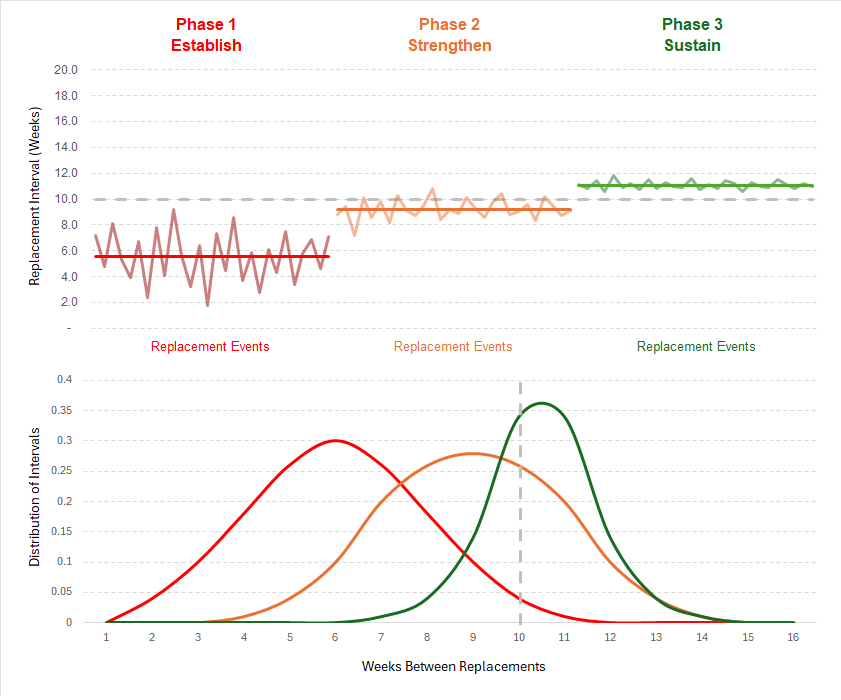
The goal of the Maintenance pillar is not just to reduce the number of unplanned replacements. It is to make them more predictable first, and then to extend the interval between them. Those are two different problems, and they need to be solved in sequence.
In Phase 1, the spread of replacement intervals is wide. Some components last three weeks, some last twelve. The average might be six weeks, but the variation is so large that planning around it is almost impossible. The first job is to reduce that variation, through consistent lubrication, correct settings, and Breakdown Elimination removing the early failures. The average may not move much yet. But the predictability improves, and that is what makes planned maintenance possible.
In Phase 2, with variation under control, the average interval begins to extend. Better lubrication, better planned maintenance, condition monitoring that catches deterioration before it becomes a replacement, all of these push the average out. MTBR improves. The planned replacement interval can be extended with confidence because there is now data to support it.
In Phase 3, the interval is narrow and long. The component is lasting close to its design life. Condition monitoring identifies the individual components that are deviating from the expected pattern, so the intervention happens before the failure, not after it.
Most maintenance improvement programmes try to extend the interval before they have reduced the variation. They set a longer planned replacement interval based on average data, and then get caught by the early-failure tail. A component that averages twelve weeks but varies by four weeks will still fail at six weeks sometimes. Narrow the spread first. Then shift the average.