Process Improvement
Most processes were never properly defined. The rest were defined once and never looked at again. The Process Improvement pillar exists to change that, by building the discipline to observe, map, redesign, and standardise the work before the loss becomes permanent.
I have walked into sites where the same changeover has been running for eight years. Nobody can tell you how long it really takes. There is probably a procedure somewhere. Each changeover is reported as taking the same, theoretical time.
That is not unusual. It is the norm.
They evolved. Someone did it a certain way, someone else watched and copied, a third person adapted it slightly, and now there are four versions of the same process running on the same line. Nobody planned it that way. Nobody noticed it happening.
How can you improve a process you have never properly defined? How can you hold a standard nobody has written down? How can you close a gap you have not measured?
Pillar Intent
The Process Improvement pillar exists to ensure that every process delivers the right result to the right customer, every time, not most of the time.
That means defining the process before you try to improve it. It means going to where the work is done and observing what actually happens, not what the procedure says, not what people remember. It means naming the waste, redesigning the method, and building the standard that holds the improvement in place.
This applies whether the process is a physical changeover on a manufacturing line or a transactional approval in a finance function. The losses look different. The discipline is the same.
This pillar works alongside Problem Solving and Leadership. Problem Solving identifies and removes the cause of a recurring problem. Process Improvement changes the process and creates the new standard. Leadership builds the routines that hold that standard over time. Each pillar depends on the others. None of them replaces the others.
Pillar Owned Losses
Process Improvement losses rarely appear on a loss report as "process failures." They appear as delays, rework, and variation, and they are accepted as normal long before anyone asks why they keep happening.
The causes are almost always the same.
These losses are not random. They are structural. They are built into processes that were never properly defined, never properly observed, and never properly standardised. And they compound, defects create overprocessing, overprocessing creates inventory, inventory creates waiting.
The work of this pillar is to make them visible, name them, and remove them systematically.
Pillar Owned Capabilities
The Process Improvement pillar builds capability in response to the losses it owns.
Process capabilities
One process. One discipline. One standard. Applied consistently across every type of work.
- Process Improvement (PI): The five-step discipline for defining, observing, redesigning, and standardising a work process. This is the core process of the pillar. Specific supporting tools, travel diagrams, time observation sheets, swim-lane maps, ECRRSE, lives within the PI steps. The process guide covers how to run each step in practice.
- 5S — Workplace Organisation: The method for eliminating Waiting, Inventory, Motion, and Transport losses from the workplace. 5S makes abnormal situations immediately visible and creates the standard conditions that make every other process standard easier to follow.
People capabilities
Leaders and process owners at every level who can run a PI, own a standard, and coach others to do the same.
- Frontline leaders who can observe a process accurately, name the waste they see, and hold the standard that results from an improvement.
- People leaders and process owners, line leaders, area managers, planning leads, support function leads, who can run the five steps independently, own the resulting standard, and coach the next Process Improvement.
- Site and function leaders who understand what a well-run PI looks like, can ask the right questions in a review, and model the discipline by running a PI on a leadership process first.
Pillar Behaviours
A process is producing inconsistent output.
A new standard is introduced after an improvement.
Someone suggests a better way to run the process.
A process improvement project ends.
What Good Looks Like
Frontline leader
- Goes to where the work is done to observe the process, not to inspect the person, but to observe and understand the method.
- Asks the people who do the work what makes it harder than it should be. Listens to the answer.
- Does not accept variation as normal. Asks what the process allows that it should not.
- Confirms the standard is being followed, and when it is not, asks why before assuming it is a training issue.
- Supports the improvement work by making time for observation, mapping, and trialling changes at the process.
Department or area leader
- Removes the barriers that stop the frontline team from following the standard, missing tools, unclear steps, access issues, conflicting priorities.
- Ensures every agreed as important process in their area has a named owner and a current standard.
- Asks regularly: do we know what the customer of this process expects? Are we delivering it?
- Connects process performance to the team's Strategic Objectives. Makes the line of sight visible.
- Supports reapplication, when an improvement works in one area, asks where else it applies.
Site or function leader
- Sets the expectation that processes are defined, observed, and improved, not assumed to be running correctly.
- Allocates time and resource for improvement work. Does not treat it as something that happens in addition to the real job.
- Asks in reviews: which processes are we improving this quarter? What did the last PI find? What is the standard now, and who owns it?
- Models the discipline by running a PI on a leadership process first. Not as a demonstration. As a genuine improvement.
Pillar Owned Processes
The Process Improvement pillar has one primary process: Process Improvement (PI). It is a five-step discipline for defining, observing, redesigning, and standardising a business process.
PI is not a form to fill in. It is a way of earning the right to have an opinion about a process before you change it. Work through the steps in order. The improved standard at the end of Step 5 is only useful if it looks meaningfully different from the one you wrote in Step 1. If it looks the same, you have not looked hard enough.
The same five steps apply whether the process is a physical changeover, a cleaning routine, a planning cycle, or an approval workflow. The tools you use in Step 3 will differ. The logic of the sequence does not.
Step 1 — Preparation
Before you observe anything, define what you are looking at. Name the process. Identify who owns it, who the customer is, where it starts and ends, and how you will know whether it is working. Then write the gap statement: the difference between what the customer expects and what the process is actually delivering.
The gap statement is the problem statement. Everything from Step 2 onwards is the work of closing it. A vague gap statement produces a vague improvement. A specific, measurable gap statement produces a specific, measurable result.
Step 2 — Restore the Process
Before redesigning anything, confirm what kind of problem you actually have. Most losses are not caused by a bad process. They are caused by a process that is not defined, or a standard that is not being followed.
There are three possible conditions: no standard exists; a standard exists but is not being followed; or the standard is being followed but is not good enough. Each condition has a different response. Skipping this step means improving a process that does not need improving, while the real problem goes untouched.
Step 3 — Map the Current State
Go to where the work is done. Watch it run. Map what actually happens, not what the procedure says, not what people remember, but what you can see.
Follow the thing: the product, the part, the document, or the information. Follow it from the trigger point to the end point. Then follow the people: watch who does what, in what order, and where they travel. Two people doing the same task differently is a finding. One person doing a task nobody else knows about is a finding.
The right mapping tool depends on the process type. Physical processes use travel and material diagrams and time observation sheets. Transactional processes use swim-lane diagrams. The map is not the point. Understanding is the point.
Step 4 — Identify and Reduce Waste
The map from Step 3 shows you what is happening. This step asks why it matters and what to do about it.
Name the waste first, explicitly. Most of the time lost in a process is not in the core work, it is in the waste around it. Naming it before you redesign anything keeps the team focused on what actually matters.
Then redesign using ECRRSE: eliminate, combine, re-arrange, reduce, simplify, and externalise. Eliminate before you simplify. Do not simplify a step that should not exist. Trial changes at the process and measure the result.
Step 5 — Standardise and Reapply
A standard that is not documented is not a standard. It is a habit. Habits belong to the person who has them. Standards belong to the process.
Document the improved method. Assign a named owner. Put in place the three things that hold a standard: standard work, visual management, and a leadership response when the standard is not being met. Then look for where the same improvement applies elsewhere. The next PI should be faster than the last.
The full how-to is in the Process Improvement guide. The five steps above describe what each stage does and why it matters. The process guide covers how to run each step in practice — the fields, the decision logic, the observation tools, the waste analysis, the redesign method, and the sustainment checklist.
Audits and Confirmations
As we review if our Process Improvement pillar is building the right capabilities in the right audiences, there are some simple questions we can ask.
Where to Start
Before selecting a process to improve, take stock of where you are.
Ask these questions:
If not, any improvement you make will drift. The gain belongs to the person who made it, not to the process. Start by defining the standard before you try to improve it.
If not, you may be focusing on the wrong areas, or implementing solutions without ownership. Start with Developing your Strategic Objectives.
If the team is making changes without ensuring they understand the real problem, they will implement the wrong solutions. Start with a strong Problem Definition.
If not, start with Leader Standard Work and Process Confirmation. The standard needs an owner and a confirmation routine, or the gain will not hold.
If the answer to most of these is no, start with Phase 1, Establish. Run a PI on a leadership process. Keep it simple. The goal is not a perfect result, it is a genuine experience of the five steps, so that the people asking others to use the method have used it themselves.
If some capability exists but it is patchy, some areas have standards, others do not; some improvements hold, others drift, start with Phase 2, Strengthen. Identify the two or three processes with the most direct impact on output, quality, or service. Assign a named owner to each. Run a PI on the one with the clearest gap.
If the discipline is established at the leader level but has not yet reached the people doing the work, move to Phase 3, Sustain. The goal is not to run more PIs. It is to build the conditions where the people closest to the work can see the standard, identify when it is not being met, and raise what they see.
The full process guide is available for members. It covers every step in detail, the fields, the tools, the decision logic, and the sustainment checklist.
Phases
The PI discipline is introduced in sequence. Not because later phases are more important, but because each phase builds the capability and the infrastructure that the next one depends on. Skipping a phase does not accelerate the programme. It removes the foundation the next phase needs.
Phase 1 — Establish
The first PI is run on a Phase 1 Leadership Pillar process. The leadership team defines it, observes it, maps it, and improves it, using the same five steps they will later ask their teams to use. The discipline then continues across all Phase 1 Pillar processes.
This is not symbolic. It is structural. Leaders who have run a PI understand what it requires. They know what good observation looks like, what a gap statement should say, and what it takes to hold a standard in place. That understanding changes how they support the work when it reaches their teams.
It also sets the expectation clearly: no process is exempt. Not the floor process. Not the leadership process.
Phase 2 — Strengthen
Once the leadership team has been part of and lead PI events, the discipline moves to the people who own and manage processes directly, line leaders, area managers, planning leads, quality leads, and anyone with named accountability for a process and its output.
At this phase the focus shifts to the processes that have the most direct impact on output, quality, cost, or service. These leaders learn to run the five steps, use the observation tools, and own the resulting standard. They are not participants in someone else's improvement project. They are the process owners.
This is where sustainable capability begins to build. A leader who has run a PI can coach the next one. A standard that has a named owner has someone to defend it.
Phase 3 — Sustain
In the third phase, the discipline reaches everyone. Operators, technicians, planners, and individual contributors participate in observing and improving their own processes, supported by named owners, confirmed standards, and leaders who know how to coach the method rather than just direct the outcome.
At this phase, improvement is no longer a project that happens to the team. It is something the team does. The measure of this phase is not the number of PIs completed. It is whether the people doing the work can describe the standard, identify when it is not being met, and raise what they see.
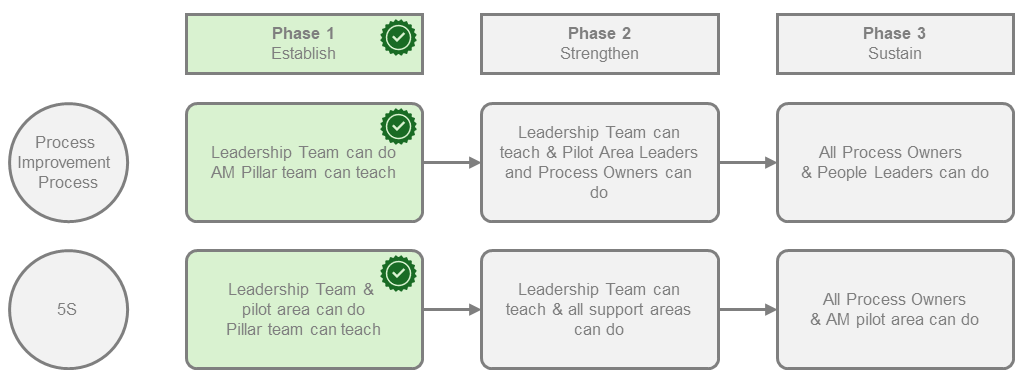
The PI discipline is introduced over time. Each phase builds the site / functions Process Improvement capability in two ways.
The number of people who hold the capability grow. Phase 1, Establish, builds it with the leadership team and AM Pillar team. Phase 2, Strengthen, extends it to the pilot area leaders and process owners who are closest to the work. Phase 3, Sustain, reaches all process owners and people leaders across the site or function.
The depth of capability also grows. For example in Process Improvement, in Phase 1, the goal is that leaders are part of a process improvement and eventually run one themselves, on a real process, so they understand what it requires. The AM Pillar team lead Process Improvements and might even start coaching others. In Phase 2, the goal is to expand the number of trainers, multiplying how many Process Improvement sessions we can run well. In Phase 3, the goal is that Process Improvement is second nature, the discipline is embedded widely enough that improvements are initiated, run, and sustained without central support.