Autonomous Maintenance
Most equipment does not fail suddenly. It deteriorates slowly, in ways that are visible to anyone who looks closely enough. The Autonomous Maintenance pillar builds the capability to look, to act, and to keep the equipment in the condition it was designed to run in.
I have walked into plants where the maintenance team is running flat out and the equipment is still failing.
Not because the maintenance team is bad at their job. Because the model they are working in makes it impossible to keep up. Every unplanned stop generates a reactive call. Every reactive call displaces a planned task. Every displaced planned task increases the probability of the next unplanned stop. The cycle feeds itself.
The operating team watches. They report the failure. They wait for it to be fixed. They run the equipment until the next failure. Nobody has asked them to do anything different, and nobody has given them the knowledge to do anything different.
Autonomous Maintenance breaks that cycle. Not by asking operators to become maintenance engineers. By building the knowledge and the routines that allow operating teams to maintain the basic conditions their equipment needs to run reliably, and to spot the early signs of deterioration before they become failures.
The equipment does not fail suddenly. It deteriorates. And deterioration is visible, if you know what to look for.
Pillar Intent
The goal of Autonomous Maintenance is to develop Technical Operators, team members who understand their equipment well enough to detect abnormalities early, maintain basic conditions without being told, and contribute to the improvement of the equipment they operate. This is not a job title. It is a capability. It is built step by step, through the AM development sequence.
That is not a maintenance task transferred to the wrong people. It is a capability built deliberately, in sequence, over time. The operating team learns what their equipment is supposed to look, sound, and feel like. They learn what clean actually means for that machine. They learn what to check, how often, and what to do when something is not right.
The result is equipment that runs closer to its design life, because the conditions that cause forced deterioration are removed and kept removed. And a team that owns the equipment they operate, rather than waiting for someone else to fix it.
This pillar works alongside Leadership, Process Improvement, and Problem Solving. Leadership builds the routines that make daily checks visible and escalation fast. Process Improvement defines and standardises the work. Problem Solving removes the causes that keep returning. Autonomous Maintenance is the equipment foundation of the management system. A management system running on deteriorating equipment is managing around failure, not preventing it.
Autonomous Maintenance works in close partnership with the Maintenance pillar. The two share responsibility for equipment reliability. The operating team maintains the basic conditions the equipment needs to run. The Maintenance function manages the technical work that requires specialist knowledge, lubrication specifications, planned overhauls, reliability engineering. That boundary is not fixed. It shifts deliberately as the operating team's capability grows, step by step through the AM journey. The Maintenance function also provides the technical knowledge the operating team needs to do their work correctly, particularly at AM Step 3, where lubrication standards are set, and at AM Step 4, where the team receives structured training on their equipment's components and functions.
As the team's knowledge grows through AM Steps 4 and 5, they become contributors to equipment failure investigations. The observations they make during daily inspection, the failure patterns they recognise, and the component knowledge they develop through general inspection training are the inputs that make Breakdown Elimination more effective. The operating team does not run the investigation. But they are often the people who first see that something is wrong.
How Autonomous Maintenance is built
Autonomous Maintenance is not a single activity. It is a capability-building management system, developed in sequence, using four principles that apply across every step.
Overlapping Small Groups
AM is built team by team, line by line. Each small group, the operating team on a line or a cell, works through the steps together. Their learning connects upward to the next level of the organisation and outward to adjacent teams. The improvement is not done to the team. It is done by the team, with support from their leader and from the functions around them.
The Step Process
The seven steps are not a checklist. They are a development sequence. Each step builds on the one before it. The team does not move to the next step until the current one is confirmed, by audit. This discipline is what makes the development real. Without it, teams skip ahead, the foundation is weak, and the capability does not hold.
The Audit Process
At the end of each step, a formal audit confirms that the expected capability has been achieved. The audit covers both the equipment condition and the team's knowledge and behaviour. A pass means the team is ready to move forward. A fail means the gaps are identified, countermeasures are developed, and the audit is repeated when the gaps are closed. The audit is not a test, it is a confirmation.
On-the-Job Training
The learning in AM happens on the equipment, not in a classroom. One Point Lessons are developed from real findings on the team's own machines. Training is delivered at the point of need, by people who have just learned the thing they are teaching. The knowledge stays close to the work.
Pillar Owned Losses
The losses this pillar addresses show up directly in your OEE figures. They appear as unplanned stops, repeated breakdowns, quality defects that trace back to equipment condition, and a maintenance team that never has enough time. The causes are almost always the same.
These are not maintenance problems. They are system problems. And system problems have system solutions.
Pillar Owned Capabilities
The Autonomous Maintenance pillar builds capability in your people, equipment and business processes to find and fix the losses it owns.
Process capabilities
- AM Step 1 — Initial Cleaning to Inspect: The defect-handling process and the initial cleaning standard.
- AM Step 2 — Address Sources of Problems: The contamination elimination and access improvement process.
- AM Step 3 — Set CIL Standards: The Cleaning, Inspection, and Lubrication standard, developed by the team and validated with the Maintenance function. The baseline for all that follows.
- AM Steps 4–5 — General Inspection and Autonomous Inspection: The centreline management process and the autonomous inspection routine.
- AM Steps 6–7 — Standardise and Self-Direct: Workplace organisation standards and the self-directed management routine.
People capabilities
Technical Operators and the leaders who develop them.
- Operating team members who can maintain basic equipment conditions without being directed, detect early signs of deterioration, and respond correctly when something is not right. This is the Technical Operator capability. It develops progressively across the seven steps.
- Frontline leaders who treat the daily cleaning and inspection routine as a management system activity, coach the team to observe as they clean, and confirm that CIL standards are being followed.
- Department and area leaders who connect AM performance to the site's loss picture, remove the barriers that prevent teams from completing their AM routines, and confirm that step audits are being completed.
- Site leaders who set the expectation that AM is a management system priority, allocate the time and resources for step-by-step implementation, and ask the right questions in reviews.
Pillar Behaviours
Good Autonomous Maintenance is not about cleaning. It is about building the knowledge and the habits that allow an operating team to maintain their equipment in the condition it needs to be in, and to recognise when that condition is slipping before it becomes a failure.
Here is what the same situation looks like with and without it.
A minor leak is spotted during a shift.
The equipment is cleaned at the end of a shift.
A recurring minor stop is reported.
What Good Looks Like
Frontline leader
- Treats the daily cleaning and inspection routine as a management system activity, not a housekeeping task.
- Knows the current condition of the equipment on their line, not from a report, but from direct observation.
- Ensures abnormalities are tagged, recorded, and escalated at the daily meeting with a named owner and a close-out date.
- Coaches the team to observe as they clean, to notice what has changed, not just to complete the task.
- Confirms that CIL (Cleaning, Inspection, and Lubrication) standards are being followed, and raises it when they are not.
- Tracks the number of open abnormalities and the rate at which they are being closed.
Department or area leader
- Reviews the abnormality log at the daily meeting. Asks what is open, what is overdue, and what is blocking close-out.
- Ensures the maintenance team and the operating team are working from the same picture of equipment condition.
- Removes the barriers that prevent operating teams from completing their AM routines, time, access, tools, training.
- Connects AM performance to the site's loss picture. If minor stops are not reducing, asks why the AM system is not catching the causes.
- Confirms that step audits are being completed and that the findings are being acted on.
Site or function leader
- Sets the expectation that Autonomous Maintenance is a management system priority, not a maintenance department initiative.
- Allocates the time and resources for the step-by-step implementation. Does not treat it as something that happens alongside the real work.
- Asks in reviews: which phase are we in? What is the abnormality close-out rate? What is the trend in minor stops?
- Ensures the relationship between the operating team and the maintenance team is collaborative, not transactional.
- Models the discipline. Visits the line. Looks at the equipment. Asks what the team has found this week.
Pillar Owned Processes
Autonomous Maintenance is built in seven steps, grouped into three phases. The phases are not arbitrary, each one builds on the last. You cannot sustain what you have not yet established. You cannot inspect what you have not yet cleaned. The sequence is the logic.
Each step has a detailed guide. Those guides cover the tools, templates, and workshop processes needed to run the step properly. The descriptions below explain what each step is for and what it achieves.
AM Phase 1 — Restoration
AM Steps 1, 2, and 3. The goal of this phase is to bring the equipment back to a known, clean, properly maintained condition, and to put the standards in place to keep it there.
AM Step 1 — Initial Cleaning to Inspect
The first step is not a cleaning exercise. It is the first real inspection the equipment has had in years.
The operating team cleans the equipment thoroughly, removing accumulated dirt, product residue, and contamination that has built up over time. As they clean, they find things. Loose fasteners. Worn seals. Lubrication points that have never been reached. Components that are cracked, corroded, or missing entirely.
Every abnormality found during cleaning is tagged, recorded, and escalated through the Tiered Accountability Meeting, assigned an owner and a close-out date before the shift ends. This defect-handling routine is the first Hypercare Process in the AM journey. A Hypercare Process is one that is actively reviewed at every tier of the Tiered Accountability Meeting until it is stable and performing to standard. It ensures nothing found during AM Step 1 is lost or deferred indefinitely.
The aim for the team at this step is to develop curiosity. To move from "I run it, you fix it" to "I wonder why that is happening." The coaching questions that drive this step are simple: Let's see if… I wonder… Does that cause this?
AM Step 2 — Address Sources of Problems
Finding abnormalities is not enough. The conditions that create them need to be removed.
AM Step 2 addresses the sources of contamination, the places where dirt, product, or fluid accumulates and causes deterioration. It also addresses the areas of the equipment that are difficult to reach for cleaning, inspection, or lubrication. If a lubrication point cannot be reached in the time available, it will not be lubricated. If a component cannot be seen during a routine check, it will not be inspected.
The team works with maintenance to eliminate contamination sources where possible, reduce them where elimination is not yet feasible, and improve access so that the standards set in AM Step 3 can actually be followed. The equipment is not just cleaned, it is made easier to keep clean.
AM Step 3 — Set Cleaning, Inspection, and Lubrication Standards
Once the equipment is in a known condition and the sources of contamination have been addressed, the team defines how it will be maintained.
AM Step 3 produces the Cleaning, Inspection, and Lubrication (CIL) standard, the documented routine that specifies what is cleaned, what is inspected, and what is lubricated, by whom, how often, and to what standard. This is not a procedure written by an engineer and handed to the team. It is written by the team, based on what they have learned in AM Steps 1 and 2, and validated with maintenance.
The CIL standard is the baseline. It defines what "correct condition" means for this equipment. Everything from AM Step 4 onwards is built on top of it.
CIL also becomes a Hypercare Process at this step, a standing item reviewed through the Tiered Accountability Meeting. At the line level, the daily review covers whether CIL was completed, what defects were found, and what has been fixed or escalated. The routine does not just maintain the equipment. It feeds the management system.
AM Phase 2 — Prevention
AM Steps 4 and 5. The goal of this phase is to build the structured knowledge and inspection routines that stop deterioration from returning.
AM Step 4 — General Inspection
The team now knows how to maintain the equipment. AM Step 4 builds the knowledge of why the equipment works the way it does.
Operating teams receive structured training on the components of their equipment, how each part functions, what it is designed to do, and what the early signs of failure look like. This is not a theoretical exercise. It is delivered at the machine, using the actual equipment as the teaching tool.
AM Step 4 is also where Centreline is introduced. The team learns what the correct operating settings are, the speeds, temperatures, pressures, clearances, and other parameters that define how the equipment should run. Understanding what "correctly adjusted" looks like is the knowledge that makes centreline monitoring meaningful. Without it, a setting that has drifted looks the same as one that has not.
Centreline becomes a Hypercare Process from this step, a standing item reviewed through the Tiered Accountability Meeting alongside CIL. The review covers whether settings are within standard, what has drifted, and what action has been taken.
The outcome is a team that can distinguish between normal and abnormal, not just by following a checklist, but because they understand what they are looking at. They know which components are critical, which conditions are acceptable, and which signs indicate that something needs attention. That knowledge changes how they operate the equipment, not just how they maintain it.
AM Step 5 — Autonomous Inspection
With the knowledge from AM Step 4 in place, the team takes ownership of the inspection process.
AM Step 5 consolidates the CIL standard and the general inspection findings into a single, efficient inspection routine that the team runs independently. Centreline monitoring becomes part of that routine, the team checks the correct operating settings at the start of a run, after a changeover, and at defined intervals during production. When a setting has drifted, they correct it or escalate it. AM checklists are implemented. The routine is timed, structured, and owned by the operating team, not triggered by a maintenance schedule or a breakdown.
The maintenance team's role shifts at this step. Rather than performing routine inspections themselves, they support the operating team's capability and focus their own time on the more complex technical work that requires specialist knowledge. The relationship between the two teams becomes collaborative rather than transactional.
AM Phase 3 — Optimisation
AM Steps 6 and 7. The goal of this phase is to standardise the system, embed continuous improvement, and hand full ownership of the equipment to the operating team.
AM Step 6 — Standardise the Workplace
The equipment is in good condition. The team has the knowledge and the routines to keep it that way. AM Step 6 extends that discipline to the wider workplace.
Workplace organisation is reviewed and improved. Non-value-adding activity in the maintenance routine is identified and eliminated. Standards are updated to reflect what has been learned through AM Steps 1 to 5. The workplace is organised so that the right tools, materials, and information are always in the right place, making it easier to maintain the standard than to let it slip.
AM Step 6 also addresses quality and process control. The team understands the relationship between equipment condition and product quality. They know which equipment settings affect which quality parameters, and they monitor those settings as part of their daily routine.
AM Step 7 — Self Directed Autonomous Management
The final step is not a destination. It is a way of working.
By AM Step 7, the operating team manages their equipment. They maintain the standards, run the inspection routines, identify and close out abnormalities, and drive continuous improvement, without waiting to be directed. The management system is embedded in daily work. The team does not need to be reminded to do it. It is what they do.
The maintenance team's capacity has been freed for higher-level technical work, planned maintenance, reliability engineering, and improvement projects that require specialist knowledge. The reactive cycle that defined the starting point has been replaced by a system that prevents failures rather than responding to them.
The measure of AM Step 7 is not a checklist completed. It is a team that takes care of their process.
Audits and Confirmations
Autonomous Maintenance is confirmed at two levels: the step audit and the daily routine check.
Where to Start
If your site has never run an Autonomous Maintenance programme, start with the preparation phase before AM Step 1.
The preparation phase is not a step in the sequence, it is the work that makes the sequence possible. It covers four things:
If your site has already started but the programme has stalled, the most common cause is that one of the steps was not properly completed before the next one began. Go back to the last step that was genuinely embedded. Audit it. Complete it properly. Then move forward.
Phases
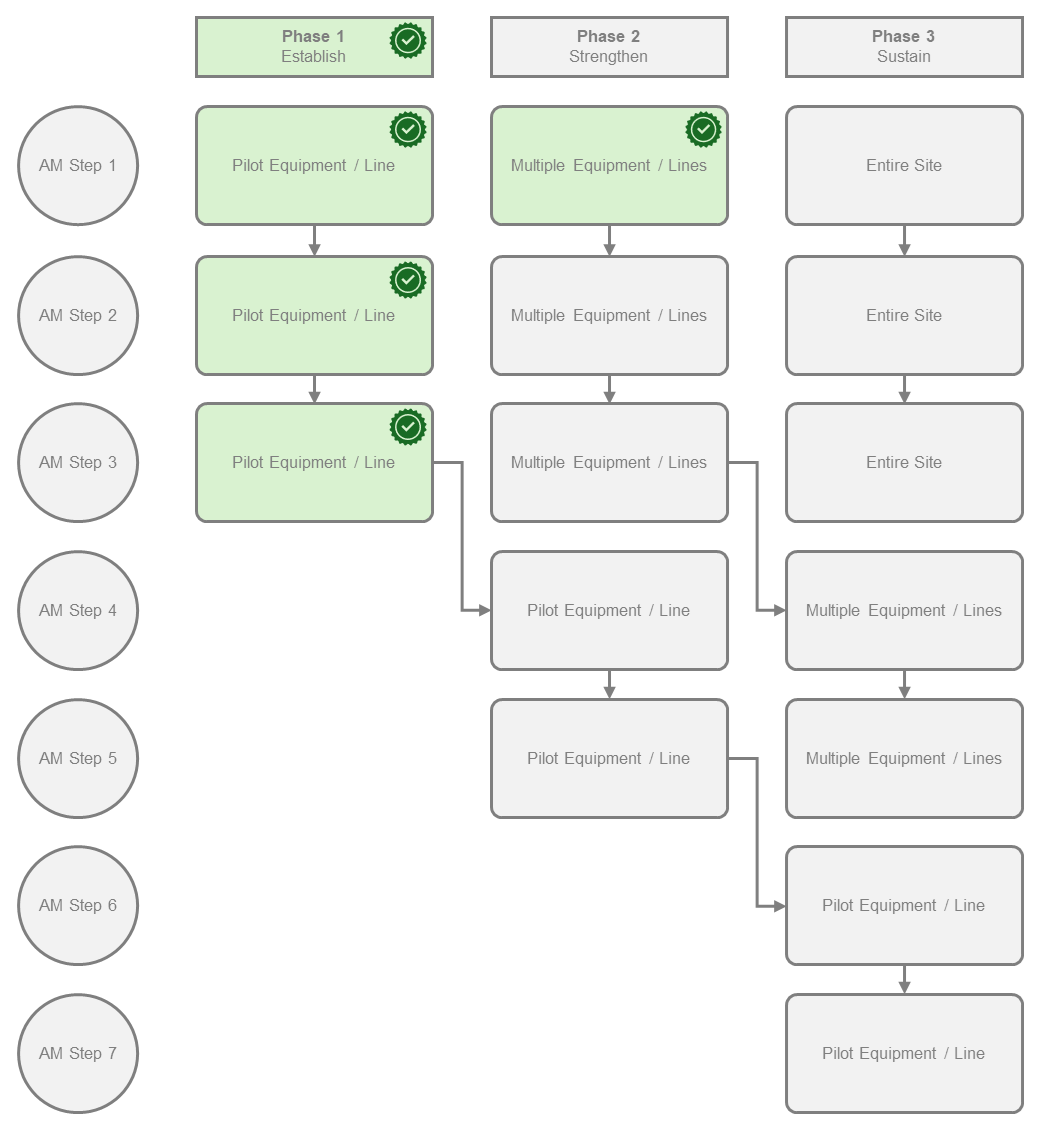
The AM development sequence is introduced over time. Each phase builds the site or function's Autonomous Maintenance capability in two ways.
The scope of equipment covered grows. Phase 1, Establish, runs the full seven-step sequence on a pilot line or piece of equipment. Phase 2, Strengthen, expands the steps that are ready to multiple lines. Phase 3, Sustain, reaches the entire site. The pilot area is always one phase ahead, it is the proof of concept and the source of the coaches.
The depth of knowledge in the operating team grows. In Phase 1, the goal is restoration, bringing equipment back to a known condition and building the habit of looking. In Phase 2, the goal is prevention, building the structured knowledge and inspection routines that stop deterioration returning. In Phase 3, the goal is optimisation, the team owns the equipment fully and drives continuous improvement without being directed.
The pace is set by the step audit, not the calendar. No step is declared complete until the audit confirms the capability is genuinely in place.