Equipment Ranking
The five-step process for classifying equipment by the consequences of failure, so that maintenance effort, spare parts investment, and planned maintenance intervals go where they matter most.
If everything is critical, nothing is.
Every maintenance function makes prioritisation decisions every day. Which breakdown to respond to first. Which planned task to protect when the schedule is tight. Which components to hold spare parts for. Which equipment to put on condition monitoring first.
Most of those decisions are made by instinct. By whoever shouts loudest. By whoever has been waiting longest. By habit.
Equipment ranking replaces instinct with a shared, documented understanding of which equipment matters most and why. It does not make the decisions for you. It gives everyone in the room the same picture when the decisions are made.
Without it, effort distributes itself by noise rather than by consequence. The equipment that generates the most complaints gets the most attention. The equipment that fails quietly, slowly degrading output or quality without triggering an alarm, gets what is left. That is not a prioritisation system. It is a reaction system.
What equipment ranking is
Equipment ranking is a structured assessment of every significant piece of equipment on a site or in a function, scored against a consistent set of criteria, and classified into tiers that drive how the maintenance system treats each piece of equipment.
The ranking is not a one-time exercise. It is a living document. It is reviewed when the loss picture changes, when new equipment is installed, when a process changes, or when a piece of equipment that was ranked low starts generating failures that the ranking did not anticipate.
The output of equipment ranking is not a list. It is a set of decisions. Which equipment gets planned maintenance first. Which components are held in the storeroom. Which failures trigger an immediate investigation. Which equipment is the first candidate for condition monitoring. The ranking is only useful if those decisions are connected to it.
The four ranking criteria
Equipment is ranked against four criteria. Each criterion is scored independently. The combined score determines the ranking tier.
Safety. What is the consequence of failure for people? A failure that creates an immediate risk of injury or a regulatory breach sits at the top of this criterion regardless of its production impact. Safety consequence is never traded off against output consequence. If the safety score is high, the equipment is critical. Full stop.
Quality. What is the consequence of failure for product quality? Equipment that, when it fails or drifts from its correct condition, produces output that does not meet specification is a quality-critical asset. This includes equipment where a setting drift, not just a breakdown, can cause a defect. Quality-critical equipment often does not generate dramatic failures. It generates quiet variation that accumulates into a significant loss before anyone connects it to equipment condition.
Output. What is the consequence of failure for production throughput? This is the criterion most maintenance functions already use informally. The question is not just whether the line stops, but how long it stops for, whether there is a buffer or an alternative, and what the downstream consequence is. A piece of equipment with no bypass, no buffer, and no alternative source is more critical than one that can be worked around for a shift.
Cost. What is the cost of failure, including repair cost, parts cost, lost production, and any regulatory or customer consequence? Cost is often the criterion that makes the ranking visible to leadership. A component that fails three times a year at significant repair cost each time may not be generating the loudest complaints, but the cumulative cost makes the case for investment in prevention.
The ranking tiers
Three tiers is the right number for most sites. More than three creates false precision. Fewer than three does not give enough differentiation to drive meaningful decisions.
Tier 1 — Critical. Failure has an immediate and significant consequence for safety, quality, or output, with no practical workaround. This equipment receives the highest planned maintenance frequency, the highest spare parts availability, and the first claim on condition monitoring investment. Every Tier 1 failure is investigated. No Tier 1 failure is accepted as normal.
Tier 2 — Important. Failure has a meaningful consequence but can be managed for a period, through a buffer, a workaround, or a reduced-speed operation. This equipment is on the planned maintenance schedule and has critical spare parts held, but at a lower level of investment than Tier 1. Recurring failures are investigated. Single failures are repaired and monitored.
Tier 3 — Standard. Failure has a limited consequence. The equipment can be bypassed, replaced quickly from standard stock, or allowed to run to failure without significant impact. This equipment is maintained reactively or on a low-frequency planned schedule. Spare parts are held at minimum levels or sourced on demand.
How to run the ranking
Work through the five steps in order. The ranking is only as good as the inputs. A ranking done in a meeting room from memory will reflect what people remember, not what the data shows.
Step 1 — Define the scope. List every significant piece of equipment in the area being ranked. Include utilities and ancillary equipment if their failure would affect production, quality, or safety. Do not include consumables or items that are replaced as a matter of routine. The list does not need to be exhaustive on the first pass. It needs to cover the equipment that matters.
Step 2 — Gather the loss data. Before scoring anything, pull the failure history. How often has each piece of equipment failed in the past twelve months? How long did each failure take to repair? What was the production impact? What were the quality consequences? What did the repairs cost? This data is the foundation of an honest ranking. Without it, the scoring reflects opinion rather than evidence.
If the data does not exist or is not reliable, that is itself a finding. A site that cannot answer these questions about its own equipment does not yet have the information it needs to manage reliability. Building the data collection system is part of Phase 1.
Step 3 — Score each piece of equipment against the four criteria. Use a simple scoring scale, typically 1 to 5 for each criterion, with defined descriptions for each score level. The descriptions matter. A score of 4 on the output criterion should mean the same thing to every person doing the scoring. Without defined descriptions, the scores reflect individual judgment rather than a shared standard.
Score each criterion independently. Do not allow a high safety score to pull up the output score, or a low cost score to pull down the quality score. Each criterion is assessed on its own merits.
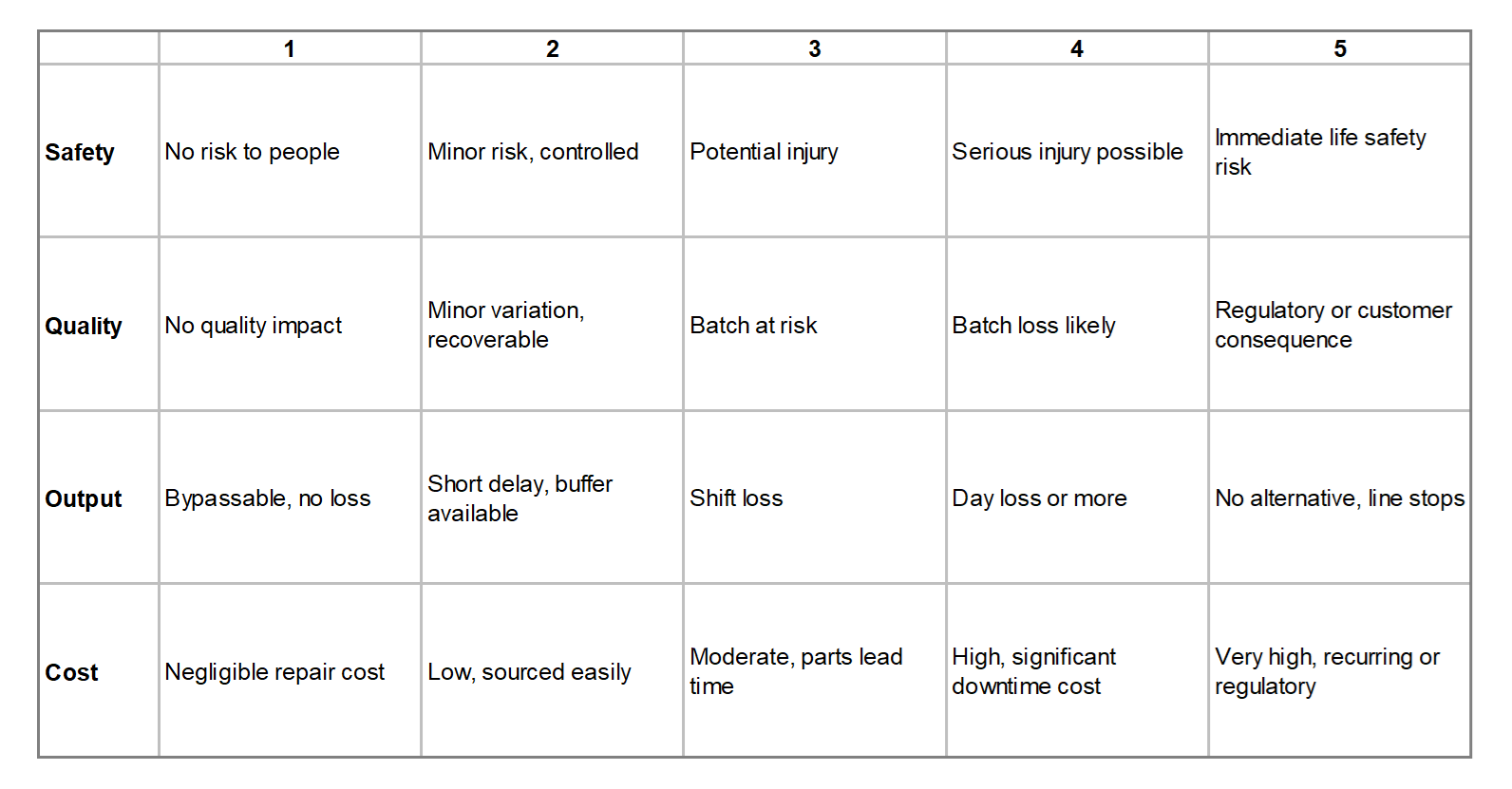
Step 4 — Calculate the combined score and assign the tier. Add the four criterion scores to produce a combined score. Set the tier boundaries based on the combined score. A typical starting point: Tier 1 for combined scores above 14, Tier 2 for scores between 8 and 14, Tier 3 for scores below 8. Adjust the boundaries to reflect the distribution of scores on your site. The goal is a meaningful spread across the three tiers, not a system where everything ends up in Tier 1.

Step 5 — Review and validate with the team. The ranking is not complete until it has been reviewed by the people who work with the equipment every day. Maintenance technicians, operators, and engineers will identify equipment that the data missed, failure modes that the scoring did not capture, and rankings that do not match their experience. That challenge is part of the process. The ranking should be able to withstand it. If it cannot, the scoring needs to be revisited.
The validated ranking is documented, dated, and owned by a named person. It is not filed. It is used.
What the ranking drives
The ranking is only useful if it changes how decisions are made. These are the decisions it should be connected to.
Planned maintenance frequency. Tier 1 equipment is maintained at the highest frequency the component life data supports. Tier 2 equipment is maintained at a frequency that reflects its consequence of failure. Tier 3 equipment is maintained reactively or at a low frequency. The ranking is the input to the planned maintenance schedule, not an output of it.
Spare parts holding. Critical spare parts for Tier 1 equipment are held on site. The consequence of waiting for a part on Tier 1 equipment is too high to accept. For Tier 2 equipment, parts are held based on lead time and failure frequency. For Tier 3 equipment, parts are sourced on demand unless the lead time makes that impractical.
Breakdown investigation. Every failure on Tier 1 equipment is investigated using the Breakdown Elimination process. Recurring failures on Tier 2 equipment are investigated. Single failures on Tier 3 equipment are repaired and monitored. The ranking determines the threshold for investigation, not the severity of the individual event.
Condition monitoring. Condition monitoring investment starts with Tier 1 equipment. The components most likely to fail without warning, on the equipment where failure has the highest consequence, are the first candidates for vibration analysis, thermography, or oil analysis. Condition monitoring on Tier 3 equipment is rarely justified.
MTBR tracking. MTBR is tracked on Tier 1 and Tier 2 equipment. The ranking defines which equipment is in the MTBR dataset. A site that tracks MTBR on everything is tracking noise alongside signal. A site that tracks it only on ranked critical equipment is tracking what matters.
Access prioritisation. When planned maintenance access is being negotiated at the TAM, the equipment ranking is the reference. A Tier 1 planned task that is at risk of deferral is a different conversation from a Tier 3 task. The ranking makes that distinction visible and shared.
When to review the ranking
The ranking is reviewed, not restarted, when any of the following occur:
- A piece of equipment generates a failure that the ranking did not anticipate as high-consequence. The ranking was wrong, or the equipment's role has changed.
- New equipment is installed. It needs to be ranked before it enters service, not after its first failure.
- A process change alters the consequence of failure for existing equipment. A line that previously had a buffer may no longer have one. A piece of equipment that was Tier 3 may now be Tier 1.
- The loss picture changes significantly. If the site's strategic objectives shift, the consequence of failure for some equipment may shift with them.
- Annually, as a minimum. The ranking should be reviewed at least once a year to confirm it still reflects the current state of the site.
What this gives you
Common pitfalls
Key Links
Equipment ranking is the foundation of the Maintenance pillar. Every other process in the pillar depends on it.
MTBR is tracked on ranked critical equipment. The ranking defines the dataset.
Breakdown Elimination is triggered by failures on ranked equipment. The ranking determines the investigation threshold.
OEE analysis identifies which equipment is generating the most loss. That analysis is the input to the ranking, and the ranking is the input to the improvement plan.