Why the Initiative Graveyard is not a failure of people
Every improvement programme gets a name. A logo. A launch. The ideas inside it were already there, they just needed a consultant to present them before anyone would listen. The programme delivers. The posters fade. The results slip. The consultants return. Nobody asks why.

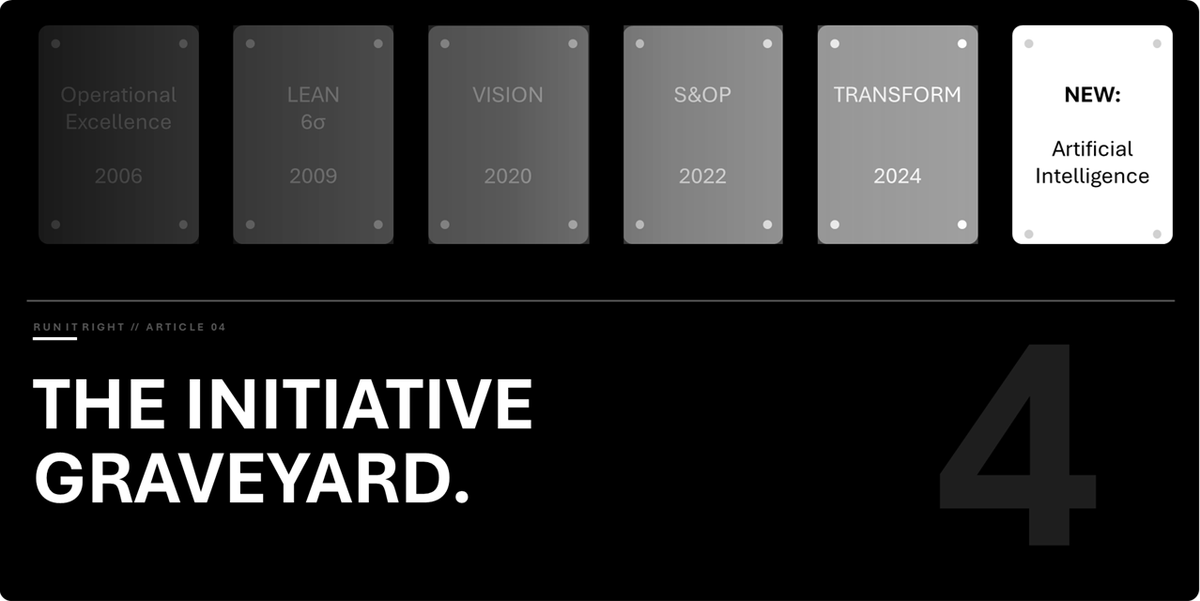
Every improvement methodology that I have seen fail had become a cost saving programme.
They didn't start that way, the emphasis changed. Not immediately. Not on purpose. But eventually.
Lean arrives. It is about flow, waste, and the people closest to the work. Within eighteen months it is a cost reduction programme with a Lean label on it.
Six Sigma arrives. It is about variation, data, and root cause. Within two years it is a cost reduction programme with a Six Sigma label on it.
Operational excellence. Data-driven decisions. Continuous improvement. Same journey. Different name on the slide.
Here is the thing nobody says out loud.
There is almost never a programme just called cost savings.
But that is what most of them become.
The methodology is not the problem. The methodology is usually sound. The people who designed it spent years thinking carefully about how organisations work and why they stop working.
What gets missed in that conversation is that it can work. It does work. Somewhere, in some organisation, the same methodology produced real and lasting change. That is not a coincidence. That is not luck. It is because the system underneath was ready to hold it.
The methodology is not a solution on its own. It is part of a system. When the system is designed, or redesigned, to carry the improvement forward, it sticks. When it is not, the improvement lands, produces a number, and then quietly fades.
That distinction matters. Because it changes who is responsible for what.
The consultant's job is to hit the number. Cost. Working capital. Customer service. Whatever the objective of the programme, their job is to deliver it. That is what they were hired to do. That is what they are measured on. That is what they will be paid for.
Sustaining it forever is not their job, in fact it does them out of their next job.
Nobody is formally assigned to ensuring it is sustained forever.
That is the gap. Not in the methodology. Not in the consultant. In the system that was never designed to hold what the programme built.
What happens next is predictable. And it happens the same way, in organisation after organisation, with a reliability that the improvement programme itself rarely matches.
The consultants arrive.
They are good. Most of them are. They ask the right questions, mostly. They spend time on the floor. They talk to the people who know what the problems are and where they are.
And the people tell them.
Because the problems are not a secret. They never were. The operators know. The supervisors know. The engineers know. The ideas have been sitting in heads, in notebooks, in emails that went unanswered, in improvement lists that nobody actioned, in meetings where they were noted and never followed up.
The consultants listen carefully. They take notes. They go away and populate their standard slides.
Weeks later they are back in the room. Shiny deck. Your company colours. Professional format. The senior team is there. The sponsor is there. There is coffee, might even be lunch.
And on the prioritisation matrix, there it is.
Your opportunity. Your observation about the line, the process, the gap that has been there for years. Reframed. Repackaged. Given a number and a position on a 2x2 grid.
The room nods. The senior team is engaged. Questions are asked. The consultant answers them well.
The programme is approved. It was always going to be approved.
What is in it is not new. The people in that room already knew most of it. Some of them put it there.
What changed is who was standing in front of the room when it was described.
Now it needs a name. A logo. A tag line. A launch.
The rebranding begins.
The posters go up on the walls with the programme identity on them. Lanyards, sometimes. A launch event, usually.
It looks like momentum. It feels like momentum.
But something has already happened that nobody has named.
The people who identified the problems are not the people who decided what to do about them. Raising an opportunity is not the same as shaping a solution. They were heard. They were not involved in deciding what the future would look like.
They are being told what we will do. Not asked what we should.
The programme has two kinds of work in it. Everyone can see that, even if nobody says it directly.
There are the quick wins. Projects with a number against them. Cost. Working capital. Service. Something that will show up in a report this quarter. These get the resources, the attention, the senior visibility. They get done.
And then there is the structural work. The governance. The ways of working. The cross-functional teams looking at how decisions get made and how information moves. Important work. Necessary work. Work that will determine whether any of this lasts.
No dollar figure against it. No quarterly milestone. No slide in the senior review.
It starts with less focus than the quick wins. It ends with less than that.
Ownership means you shaped the decision. You understand why it was made. You will defend it when it gets hard, because it is yours.
Accountability means you carry the consequences of a decision someone else made. You will comply when it is easy. When it gets hard, compliance is the first thing to go.
The programme did not fail because the people were not committed. It failed because commitment was assumed rather than built. Because the organisation confused being told with being involved.
The poster on the wall is not the same thing as belief in what it says.
The consultants push implementation. That is their job. They have a timeline, a set of milestones, a number to hit. They are good at this. They move fast.
And then they leave.
The programme delivers.
It always delivers something. That is important to say. The SMED project reduces changeover times. The 5S project transforms the area. The numbers move. The case study gets written. There is a celebration. Sometimes a cake.
The sponsor presents the results to the senior team. The consultants are thanked. The slides look good.
And then the programme ends. Or moves on. Or quietly becomes something else.
The audit sheets go into a folder. The changeover times are still being tracked, but now they are reported at the weekly management meeting rather than at the line. Then monthly. Then as part of a broader summary that nobody looks at too closely.
The 5S area drifts. Not dramatically. Gradually. But the drift is not really about tidiness. It never was. 5S was never meant to be an exercise in keeping an area looking nice. It was meant to maintain the standards that make the work reliable. When those standards are not connected to something that matters, to output, to quality, to safety, the audits become a checklist of whether the area looks presentable. People tick the boxes. The area looks fine at a glance, for a while. Then the standards erode anyway.
Then the audits stop. Because nobody could explain why they mattered. Because they were never tied to anything important enough to defend them.
The changeover times creep back. Not to where they were. But in that direction. Slowly enough that no single week looks alarming. Quickly enough that two years later the gap is significant.
And then the measurement stops. Not because anyone decided to stop. Because the meeting that tracked it was replaced by a different meeting. Because the person who owned it moved on. Because the number had stopped being comfortable and nobody wanted to have that conversation.
A few years later someone does an assessment.
They find an opportunity to reduce changeover times.
It feels like a new idea. In some ways it is. The people who ran the last project have moved on. The folder with the audit sheets is still there, if anyone looked. Nobody looks.
The consultants are called.
They ask the right questions. They spend time on the floor. They populate their standard slides.
The room nods.
The programme is approved.
It was always going to be approved.
Not everything fails.
Walk through any plant that has been through several cycles of this and you will find pockets where something stuck. A line still running the changeover the way the SMED project designed it. An area that never drifted back. A team that still meets at the board every morning and still knows their numbers.
And almost always, when you look closely, you find the same thing.
A manager who kept it going. Someone who held the standard when the programme moved on, the consultants left, and the senior team found something new to focus on.
It is tempting to point at that manager and say, that is what good looks like.
But when that manager moves on, what happens to the line?
If the answer is that it depends on who replaces them, the system has not worked. One person's commitment is not a system. It is a workaround for the absence of one.
The initiative graveyard is not filled with bad ideas. It is not filled with lazy people or failed methodologies.
It is filled with improvements that landed in a system that was never designed to hold them. With ownership transferred to people who then left. With structural work that was always going to happen after the quick wins, and never did. With standards that were never connected to anything important enough to defend them.
The people were not the problem.
They rarely are.
The question worth asking is not why the programme failed. It is what the organisation would need to look like for the next one to last.
That is a harder question. And it is the one nobody asks when the consultants are in the room.
Find the thing that stuck from the last programme. The standard still being held. The meeting that still happens. The area that never drifted back. Then ask yourself honestly, is that because the system was built to hold it? Or because one person decided they would not let it go?
Those are not the same thing. And the difference tells you everything about whether the next programme will end any differently.
What does a system designed to hold improvement look like? Start here.
Next in the series
 Damon Reid