Organisational System Design
A structured process for assessing how your organisation is currently designed, defining how it needs to be designed to deliver the strategy, and closing the gap between the two.
The organisation you have is producing exactly the results it is designed to produce. If you want different results, change the design.
Every reorganisation I have seen that did not work had one thing in common. It started with structure.
A new reporting line was drawn. A new leader was appointed. Sometimes a layer was removed. The announcement was made. And six months later the performance was the same, because the tasks had not changed, the skills had not changed, the decision making had not changed, the information had not changed, and the reward system was still recognising the same behaviour it always had.
Structure is the most visible element of an organisation. It is also the one that matters least if the others are wrong. You can draw the perfect reporting line and still have people doing the wrong work, with the wrong skills, making decisions at the wrong level, without the information they need, rewarded for behaviour the strategy does not require.
Organisational System Design is the discipline of looking at all of it before changing any of it.
What this process is for
Organisational System Design is used in two situations.
The first time — when the process has never been run. Most organisations have never looked at all six design elements together and asked whether they are aligned to the strategy. The first assessment will almost always find gaps that nobody knew were there, because nobody had looked at the whole picture at once.
When expectations or strategy change significantly — a new strategy, a change in what the organisation is being asked to deliver, a phase transition in the management system, a significant restructure, or a major shift in the external environment. Any of these changes what the organisation needs to produce. The design needs to be checked against the new requirement, not assumed to still be correct.
The phase transition trigger is worth naming explicitly. Each phase of the management system, Establish, Strengthen, Sustain, changes the task requirements, the capability requirements, and often the structure. Before moving from one phase to the next, an OSD assessment should confirm that the organisation is designed to deliver what the next phase requires. A system that moves into Phase 2 without the capability Phase 2 needs will stall, not because the processes are wrong, but because the organisation was not ready to run them.
It is not a tool for every management decision. It is the right tool when the question is whether the organisation is designed to deliver what the strategy requires — and when the honest answer might be no.
The model
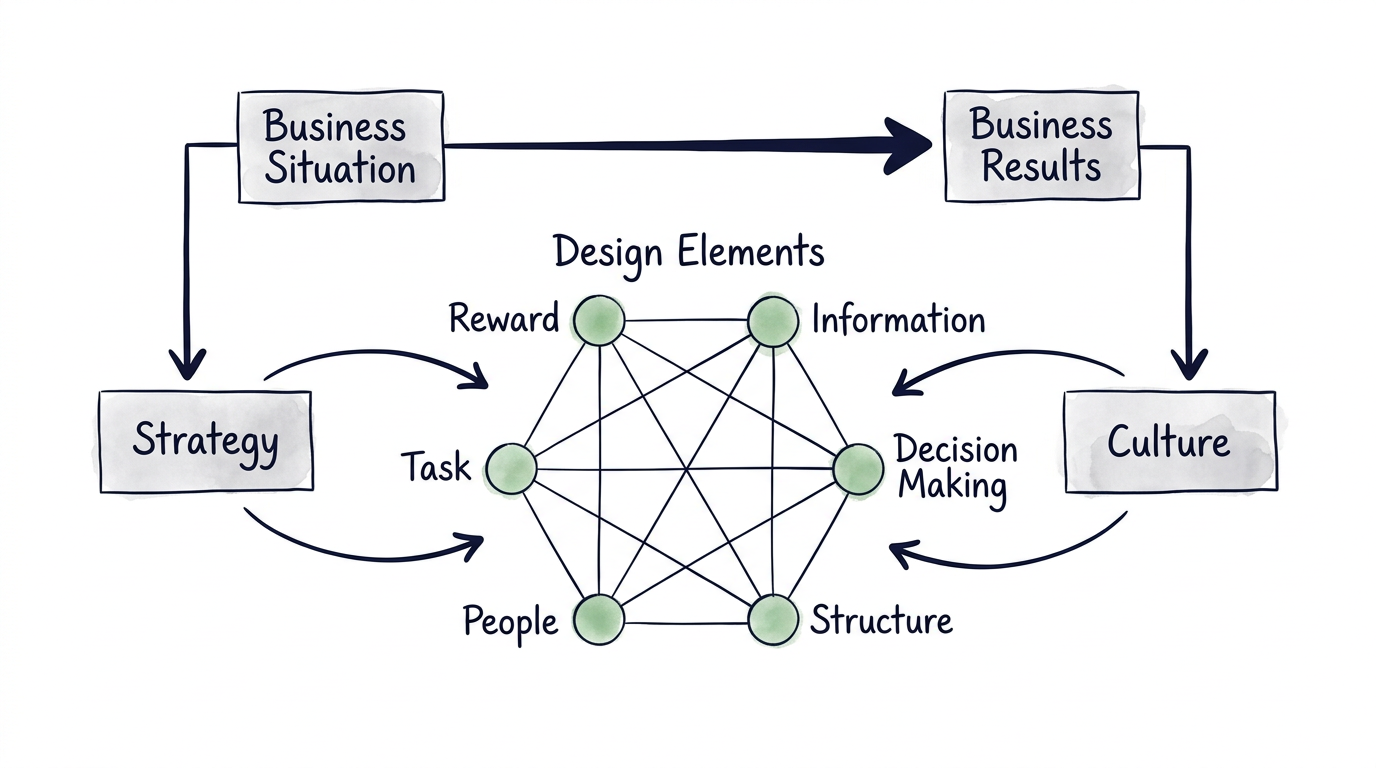
The model has three outer elements and six inner design elements.
The three outer elements describe the context the organisation operates in and the results it produces:
- Business situation — the external environment, market conditions, regulatory context, competitive pressures, and the internal starting point. What is true about the world this organisation operates in right now.
- Business strategy — the choices the organisation has made about how to respond to that situation. What it will do, and what it will not do, to deliver the results it needs.
- Culture — the observable behaviour of the organisation. Not the values on the wall. What people actually do, repeatedly, when nobody is watching. Culture is the output of the design, not an input to it. It changes when the design changes.
The six design elements sit at the centre. They are the levers. Change them and the results change.
- Task — the work that needs to be done to deliver the strategy. The key processes, the critical activities, what people spend their time on.
- People — the skills, knowledge, and capability required to do that work. Not the people currently in the roles. The capability the work requires.
- Structure — how the organisation is arranged to do the work. Roles, teams, reporting lines, spans of control, layers of hierarchy.
- Decision making — what decisions need to be made, by whom, at what level, and with what authority. Who makes the call and who is consulted.
- Information — what data and communication the decision makers need, when they need it, and whether the systems that provide it are working.
- Reward — what behaviour the organisation recognises and reinforces, formally and informally. What gets people promoted, praised, and noticed. What gets ignored.
The design elements are connected. Change one and the others are affected. A change in task changes the skills required. A change in structure changes who makes decisions. A change in decision making changes what information is needed. Treating them as independent is the most common reason organisational changes do not produce the results they were designed to produce.
The two processes
The model is used in two directions.
Assessment runs clockwise — from business situation to current results, then down into culture, then into the design elements, then to strategy. You are reading the organisation as it currently exists. The question at every step is: what is actually happening here, not what should be happening.
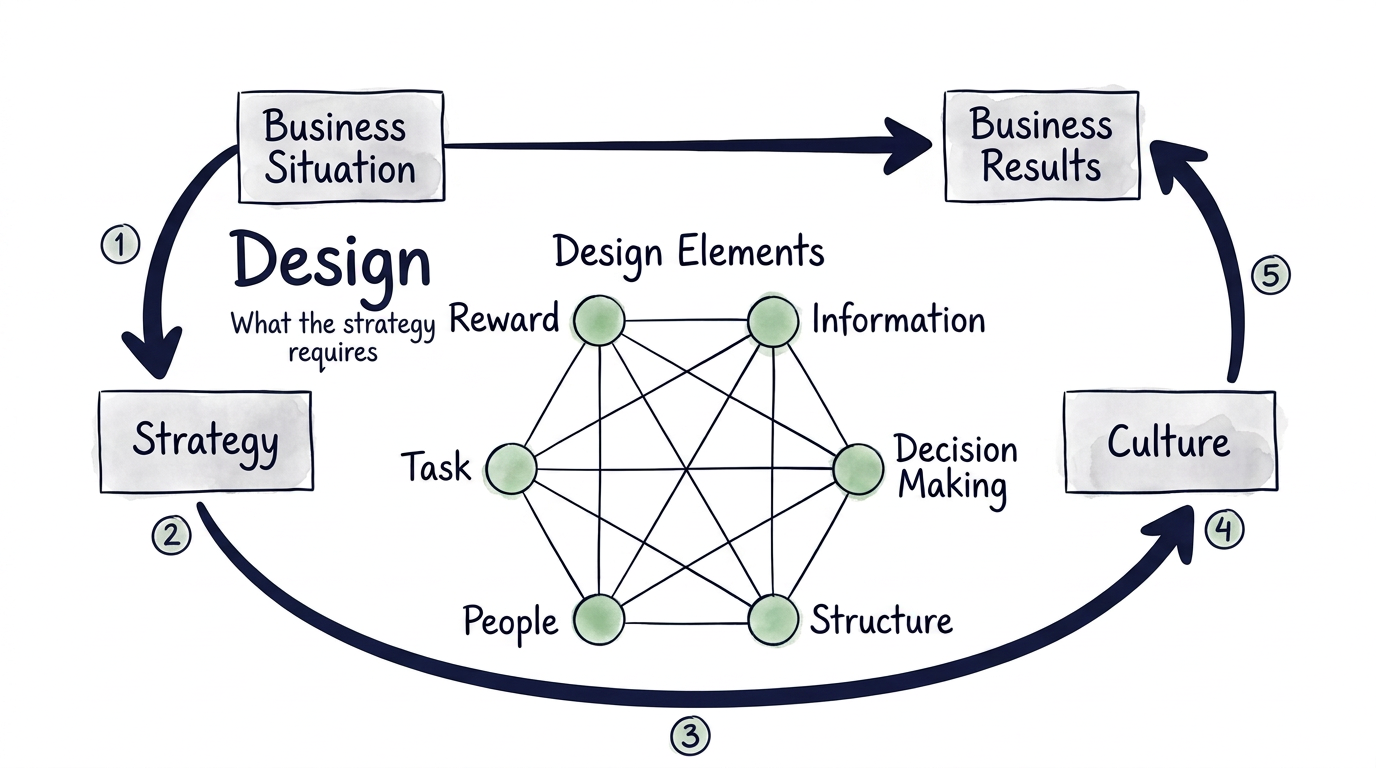
Design runs counter-clockwise — from business situation to strategy, then into the design elements, then to culture, then to business results. You are defining the organisation you need. The question at every step is: what does the strategy require here.
The gap between the assessment and the design is the action plan.
Running an assessment
The assessment is a structured read of the current organisation. It is not an evaluation. It is not a judgement. It is a description of what exists today.
Who runs it: A small group with a good overall understanding of the current organisation, two to four people is enough for a focused assessment. The business leader completes the business situation and the current results. The group completes the design elements together. Do not evaluate as you collect. Collect first. Evaluate at the end.
The role of the facilitator: The Organisational Capability Pillar member facilitates the session. Their job is not to fill in the boxes. It is to ask the questions the group will not ask themselves. The design elements that most need a skilled, facilitator are reward and culture , the two that people most want to soften or skip. A facilitator who accepts a vague answer on reward, or who lets the group move past culture without naming what is actually observed, will produce an assessment that describes the organisation people wish they had rather than the one they have. Push for specifics. If the answer is "it depends" or "it varies," ask what it depends on and what it varies between. The assessment is only useful if it is honest.
How long it takes: A focused assessment on a single team or function can be completed in two to three hours. A full site assessment takes longer. The discipline is to time-box each element, five to ten minutes per design element, and keep moving. The goal is a complete picture, not a perfect one.
What to capture for each element:
Business situation What is the external environment right now? What are the pressures, the constraints, the opportunities? What is the internal starting point, the current performance, the current capability, the current gaps?
Current results What is the organisation currently producing? Not what it should be producing. What it is actually producing, in measurable terms. Output, quality, cost, service, safety. This is the baseline.
Culture If you were a fly on the wall, what would you observe? What do people do repeatedly? What are they proud of? What do they avoid? What are the unwritten rules? What gets rewarded informally that is not in the formal reward system? What are the recurring tensions, the conversations that never quite get resolved?
Task What are the key work processes? What do people spend most of their time doing? What is the work that most directly drives the results, good and bad? What work is being done that does not need to be done at this level, or at all?
People What skills and capabilities currently exist? What is the profile of the team — where is the depth, where are the gaps? What learning is happening and how? What skills are valued and what skills are invisible? Where is a critical capability held by only one person? What happens to the system if that person moves on?
Structure How is the organisation arranged? How many levels of hierarchy? What are the spans of control? Where are the formal boundaries, between teams, between functions, between sites? Where do people have multiple reporting lines? What is unique or unusual about the structure that would not be obvious from the chart?
Decision making What are the key decisions this organisation makes? Who makes them? At what level? Where are decisions being made too high, held by leaders who could push them down? Where are they being made too low, made by people who do not have the full picture? Who influences decisions without formal authority? Who should be making decisions but is not?
Information Do the people who make decisions have the data they need, at the right time, without having to reconcile it from multiple sources? What information is missing? What systems work well and which create friction?
Reward What gets rewarded today, in behaviour and in results, formally and informally? What kind of leadership is recognised? What gets people promoted? What behaviour is tolerated that the strategy does not need? What would you need to start recognising that you are not recognising now?
Strategy What are the current stated strategies? Does the organisation behave them, or does it behave something different? What are the critical drivers when priority calls are made? What is the reason this organisation exists?
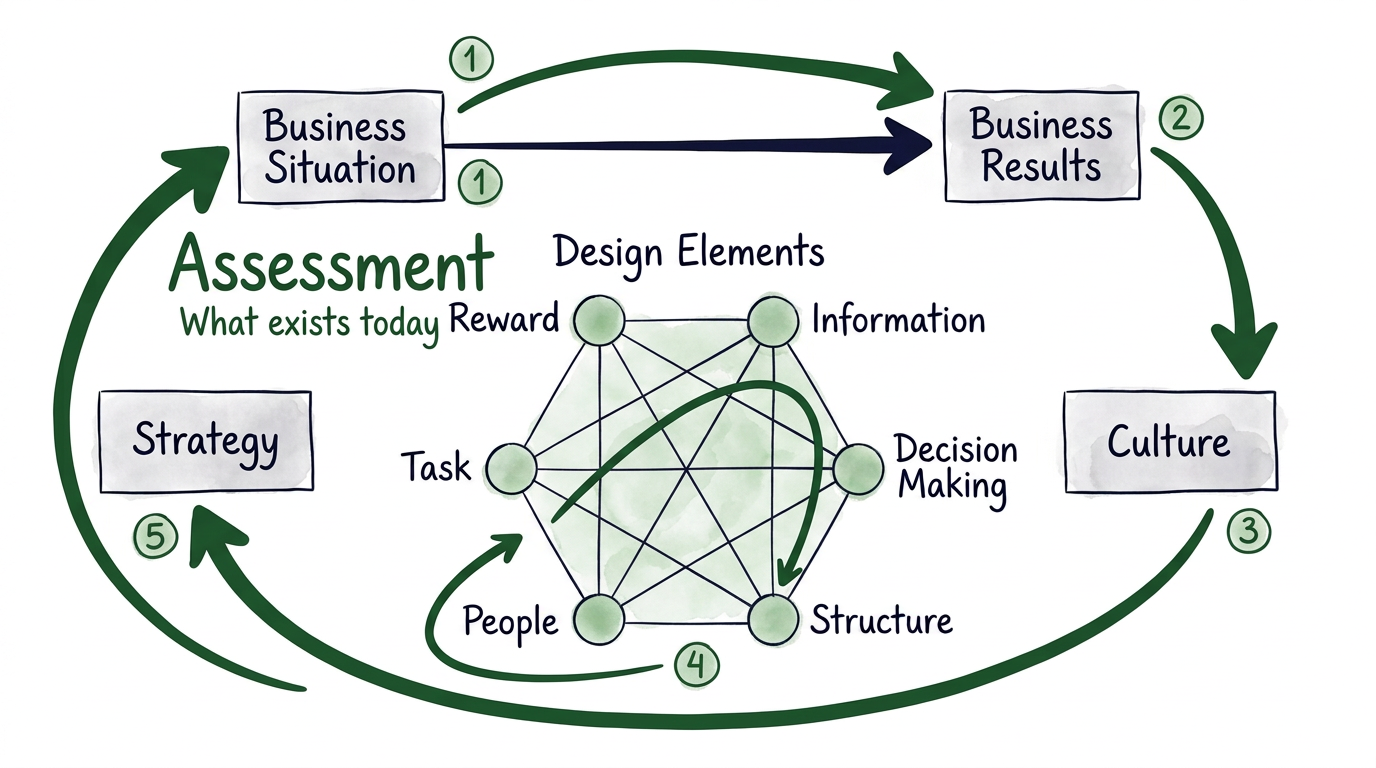
At the end of the assessment, step back and read the whole picture.
What are the key observations? What are the make-or-break characteristics of the current organisation? What would you keep? What would you change? What are the patterns that run across multiple design elements?
The assessment is complete when you can describe, in plain language, what the current organisation is designed to produce, and why.
Running a design
The design defines the organisation you need to deliver the strategy. It runs counter-clockwise through the same model.
Start with business situation and strategy. What does the strategy require? What choices have been made about where to focus, what to build, what to stop? The design must follow the strategy. If the strategy is unclear, the design will be unclear. Resolve the strategy question before the design question.
Work through the design elements in order. The sequence matters.
Task first. What is the work that needs to be done to deliver the strategy? Define the critical work processes. What does the organisation need to do, not what it currently does, but what the strategy requires it to do? This is the hardest element to define well and the most important to get right. Everything else follows from it.
People second. What skills and capabilities does the work require? Not the people currently in the roles, the capability the work needs. Where is the depth required? Where are specialist skills needed? Where is common capability needed across many people? What learning needs to happen and how? Where does a single point of failure need to be resolved by building the capability in more than one person?
Structure third. How should the organisation be arranged to do the work with the people available? What roles are needed? How should they be grouped? What spans of control allow effective coaching and decision making? What layers of hierarchy are necessary and which add friction? Structure follows task and people, not the other way around.
Decision making fourth. What decisions need to be made to run the work? Who should make them? At what level? What authority is needed where? What decisions should be pushed down that are currently held too high? What decisions need more information or more expertise than the current structure provides?
Information fifth. What data and communication do the decision makers need? When do they need it? In what form? What systems need to change to provide it? What currently exists that can be used? What is missing?
Reward last. What behaviour does the design need to succeed? What needs to be recognised, formally and informally, to reinforce that behaviour? What is currently being rewarded that the new design does not need? This is the element most commonly skipped. It is also the one most directly connected to whether the culture changes. A design that changes task, structure, and decision making without changing what gets recognised will produce the old behaviour in the new structure.
Design for what you control. Define the ideal design first. Then identify the elements that are within your control and build the action plan around those. For elements that are not in your control, a global structure, a shared system, a reward framework set at a higher level, define what you need from those interfaces and build a plan to negotiate them.
Design for the ideal, then action-plan for the next six to twelve months. The full design is the target. The action plan is the path. Not everything changes at once. Sequence the changes so that each one builds the foundation for the next.
Focused assessments
Not every application of this model requires a full assessment and design. When the scope is small, a single team, a single design element, a specific capability gap, a focused assessment covering only the relevant elements is faster and more useful than a full pass.
A leader checking whether their team is ready for the next phase does not need to run the full model. They need to ask: what does the next phase require of this team, and do we have it? That might be a thirty-minute conversation covering task, people, and decision making. It is still the same discipline. The scope is narrower.
A focused assessment should still produce three things: a named gap, a named owner, and a close-out date. Without those, it is a conversation, not a management tool.
From assessment to design
The gap between the assessment and the design is the action plan.
For each design element, compare what exists to what is required. Name the gap explicitly, as a specific, observable difference between the current state and the required state. Not as a problem to be solved later.
Then prioritise. Not every gap is equally important. The gaps that most directly prevent the strategy from being delivered are the ones to address first. Ask: what is the consequence of this gap not being closed? That is the priority.
Build the action plan with named owners and close-out dates. An assessment and design without an action plan is an observation. The output of this process is not a document. It is a change.
Update the Capability Matrix as part of every design cycle. Every design change has capability implications. When the task changes, the skills required change. When the structure changes, the roles change. The matrix should reflect the new design, not the old one.
What good looks like
A well-run Organisational System Design process produces three things:
Common pitfalls
What this gives you
Key Links
Organisational System Design is the primary process of the Organisational Capability pillar.
The design starts with a clear strategy. If the strategy is not yet defined, start there.
The Capability Matrix tracks whether the capabilities required by the design are being built in the right people at the right level.
Process Confirmation is how the design choices are verified to be in place and working as intended.