Safety
Most incidents are not random. They happen at predictable moments, after a change, after a break, when something new is introduced. The Safety pillar builds the capability to see those moments coming and act before the incident occurs.
A site I worked with had a persistent problem with lost time incidents in the days immediately after a planned shutdown. The data was clear. The pattern was consistent. Every shutdown, the same window, the same elevated risk.
The team had tried a number of things. Additional briefings before the restart. Supervisor walk-rounds on the first morning back. Reminders about safe working procedures. None of it moved the number significantly.
Then someone asked a different question. Instead of asking how to make the first day back safer, they asked whether the first day back needed to be a production day at all.
It did not. There was training that needed to happen. Regulatory checks that needed to be completed. Equipment that needed to be verified before it ran. All of it had been squeezed into the margins of a production day. It could just as easily fill a non-production day.
So that is what they did. The first day back after each shutdown became a structured non-production day. Training, verification, equipment checks, team briefings. The things that needed to happen anyway, given the time they needed.
The lost time incidents in that window dropped dramatically. Not because the hazard was removed. Because the people were not near it at the moment of highest risk.
That is what a proactive safety system looks like. Not more warnings. Not more rules. A clear picture of when and where the risk is highest, and a deliberate decision about what to do about it.
Pillar Intent
The Safety pillar exists to build the capability to identify hazards before they cause harm, reduce the risk they present through the most effective controls available, and investigate incidents and near misses in a way that changes something.
That is not a compliance function. Compliance sets the minimum. The Safety pillar works above the minimum, on the conditions, behaviours, and systems that determine whether the minimum is ever tested.
The starting point is always the hazard. Not the incident. An incident is what happens when a hazard was not identified, or was identified and not controlled, or was controlled and the control failed. By the time the incident occurs, the opportunity to prevent it has passed. The Safety pillar works upstream, on the hazards, the controls, and the moments of highest risk.
This pillar works in close partnership with Autonomous Maintenance. The safety map, the documented picture of every significant hazard in the work area, including isolation points, energy sources, and restricted access zones, is a prerequisite for AM Step 1. No team gets close to equipment without it. As AM progresses and the team's understanding of their equipment deepens, their understanding of its hazards deepens with it. The two develop together.
The Safety pillar also works alongside Problem Solving. Every incident and every near miss is investigated using the same six-stage problem solving discipline used across the site. The finding must change something, a condition, a design, a standard, a control. An investigation that closes with "the operator did not follow the procedure" has not found the cause. It has found the last person in the chain.
Pillar Owned Losses
Safety losses are not always counted in the same way as production or quality losses. Some are visible and recorded. Others are absorbed into the way work is done, accepted as normal, until they are not.
Pillar Owned Processes
The Safety pillar owns three processes. They are introduced in sequence. Hazard identification and ranking tells you where the risk is. Risk reduction tells you what to do about it. Incident and near miss investigation tells you what the system missed when something goes wrong.
Hazard Identification and Ranking. The starting point. A structured assessment of every significant hazard in the work area, energy sources, isolation points, chemical risks, mechanical risks, working at height, manual handling, and any other condition that could cause harm. Each hazard is assessed by likelihood and consequence and classified into tiers that drive the priority and type of control. The output is the safety map: a documented, visual picture of the hazards in the area, the controls in place, and the residual risk. The safety map is a prerequisite for AM Step 1. It is reviewed whenever the work area, the equipment, or the process changes.
Hierarchy of Controls. For each ranked hazard, the question is: what is the most effective control available? The hierarchy runs from most effective to least — eliminate the hazard entirely, substitute it with something less dangerous, engineer a physical barrier, reduce exposure, add warnings and procedures, and as a last resort, add PPE. The most effective controls work regardless of what anyone decides to do. The least effective depend on human behaviour being correct every time.
Incident and Near Miss Investigation. Every lost time incident is investigated. Every near miss is investigated with the same rigour. The investigation uses the six-stage problem solving process, Define, Return to Standard, Understand Why, Select the Solution, Validate the Fix, Make it Stick, applied to the conditions that produced the event. The finding must change something. A procedure that was not followed is not a finding. It is a symptom. The finding is the reason the procedure was not followed, the pressure, the design, the standard that made non-compliance the easier path.
When incidents are most likely
Incidents are not evenly distributed across time. They cluster. Understanding when the risk is highest is one of the most practical things a safety system can do, because it turns a reactive response into a proactive one.
These are the moments that consistently produce elevated risk. They are not excuses. They are signals. A system that recognises them can act before the incident, not after.
After a shutdown or extended break. Routines are disrupted. Equipment may be in a different state than when it was last running. People are mentally returning to the work, not yet fully in it. The physical environment may have changed during the shutdown. This is one of the most consistently high-risk windows in any operation that runs planned shutdowns. The response is not more warnings. It is a deliberate decision about what work happens in that window and what does not.
After any change. New equipment. New process. New layout. New product. New procedure. Change introduces unfamiliarity, and unfamiliarity is where incidents live. The hazard assessment for the area needs to be reviewed before the change goes live, not after the first incident reveals what was missed. A change that has not been assessed for new or altered hazards is a change that has been introduced without a safety review.
When new people are present. New to the site. New to the role. New to the team. New people do not yet know what the experienced team knows, which equipment behaves unexpectedly, which area has a hazard that is not obvious, which procedure is critical and which is routine. The induction covers the formal requirements. It does not cover the knowledge that the experienced team carries without thinking about it. That knowledge needs to be made explicit and transferred deliberately.
When production pressure is high. The schedule is tight. The batch is late. The customer is waiting. In these moments, the shortcuts that are always available become more tempting. The isolation that takes five minutes feels like five minutes the line cannot afford. The guard that slows the changeover gets left off for one run. The pressure does not create new hazards. It reduces the likelihood that existing controls will be followed. A safety system that only works when the pressure is low is not a safety system.
After a near miss that was not investigated. A near miss is a signal that a hazard is active and a control is not working. When that signal is not investigated, when it is recorded and filed, or not recorded at all, the hazard remains. The next event in the same location, with the same hazard, may not be a near miss. The investigation is not optional. It is the mechanism by which the system learns.
Pillar Behaviours
A near miss is reported on the line.
A new team member joins the line.
A process change is being planned.
The planned shutdown is approaching.
A hazard is identified during an AM Step 1 .
What Good Looks Like
Safety pillar team member
- Maintains the safety map for each area. Reviews it whenever the equipment, process, or work area changes. Does not wait for an incident to trigger a review.
- Leads hazard identification and ranking assessments with the operating team and the Maintenance function. Does not complete the assessment in isolation and hand it over. Builds it with the people who work in the area.
- Applies the hierarchy of controls to every ranked hazard. Starts at the top, can this hazard be designed out? and works down. Does not accept PPE as the primary control for a hazard that could be engineered out.
- Investigates every near miss with the same rigour as a lost time incident. The investigation asks: what condition produced this event, and what needs to change so it does not produce the next one?
- Tracks near miss reporting rate as the primary leading indicator. A low near miss rate on a site with active hazards is not a sign of a safe workplace. It is a sign of an under-reporting problem.
- Is present at AM step preparation for each line. Ensures the safety map is complete and the team understands the hazards in their area before AM Step 1 begins.
- Knows the high-risk windows for the site, shutdowns, changes, new people, and has a plan for each one that goes beyond additional briefings.
Frontline leader
- Reviews the safety map for their area and can explain every significant hazard and the control in place for it. Does not treat the safety map as a document that lives in a folder.
- When a near miss occurs, records it immediately and raises it at the Tier 1 meeting the same day. Does not decide whether it is worth reporting. Reports it and lets the investigation decide.
- Confirms safety-critical controls through the Process Confirmation routine, isolation points, guards, permit requirements. Does not assume controls are in place because they are on the procedure.
- Manages the high-risk windows deliberately. Knows when new people are on the line, when a change has been introduced, when the team is returning from a break. Adjusts supervision and confirmation accordingly.
- Does not allow production pressure to displace safety controls. When the schedule is tight and a shortcut is available, names it explicitly and refuses it. The team learns what the standard is by watching what the leader does when it is inconvenient.
Operations leader
- Ensures near miss investigations are completed, not just opened. A named owner and a due date are not enough. The investigation needs a finding that has changed something.
- Reviews the near miss rate and the lost time incident rate together. Asks: what is the ratio telling us? A site where near misses are rising and lost time incidents are falling is a site where the reporting system is working and the investigation system is working. A site where near misses are low and lost time incidents are occasional is a site where the signal is not being captured.
- Supports the Safety pillar team's access to the line for hazard assessments and investigations. A hazard assessment that cannot get to the equipment is an assessment that will not find the hazard.
- Ensures the high-risk windows are managed in the production plan, shutdowns, changes, new team members. Does not treat these as safety team responsibilities alone. They are operational decisions.
Site or function leader
- Sets the expectation that near misses are reported and investigated, not managed. A near miss that is recorded and filed is not a near miss that has been addressed.
- Asks in reviews: what are our top three near miss types this month, and what have the investigations found? Not: what is our lost time incident rate?
- Ensures the hierarchy of controls is being applied. When a new PPE requirement is introduced, asks: what higher-order control was considered and why was it not used? PPE as a first response is a signal that the hazard assessment did not go far enough.
- Connects safety performance to the site's strategic objectives. A lost time incident rate that is not improving is a strategic problem, not just a safety metric.
- Treats the first day back after a shutdown as a managed event, not a normal production day. Reviews the incident data. Makes a deliberate decision about what work happens in that window.
Audits and Confirmations
Where to Start
Before selecting a process to build, take stock of where you are. These questions are a quick read of the safety system as it stands today.
If not, start with Hazard Identification and Ranking. You cannot apply controls to hazards you have not identified. The safety map is the prerequisite for everything else in this pillar, and for AM Step 1 on any line.
If your primary controls are procedural or PPE-based for hazards that could be engineered out, the hierarchy has not been applied. Review the top-ranked hazards and work through the hierarchy from the top. Design it out first. Engineer a barrier second. Reduce exposure third. Add warnings fourth. Write a procedure fifth. Add PPE last.
If near miss reporting is low, or if near misses are being recorded but not investigated, the leading indicator system is not working. A site that only counts lost time incidents is always one step behind the risk. Start by building the near miss reporting and investigation discipline before the next lost time incident makes it urgent.
If you have not analysed when and where your incidents cluster, you are managing safety reactively. Pull the incident and near miss data. Look for patterns, time of day, day of week, after shutdowns, after changes, in the first weeks of new team members. The pattern tells you where to focus the proactive effort.
If safety controls are assumed rather than confirmed, they will drift. Add safety-critical controls to the Process Confirmation schedule before the next audit reveals they are not being followed.
If the answer to most of these is no, start with Phase 1, Establish. Complete the safety map for the pilot area. Apply the hierarchy of controls to the top-ranked hazards. Build the near miss reporting and investigation discipline. These are the foundations. Without them, the safety system is reactive by design.
If the safety map exists and near misses are being investigated, but incidents are still clustering in predictable windows, start with Phase 2, Strengthen. The most common gap at this stage is not in the tools. It is in the proactive management of high-risk moments. Identify the windows. Build a plan for each one that goes beyond additional briefings.
If near miss investigations are completing with findings that change conditions, and high-risk windows are being managed deliberately, move to Phase 3, Sustain. Extend the safety map and the hierarchy of controls to all areas. Build the capability across the full site so that hazard identification and near miss investigation are not dependent on the Safety pillar team to lead them.
Phases
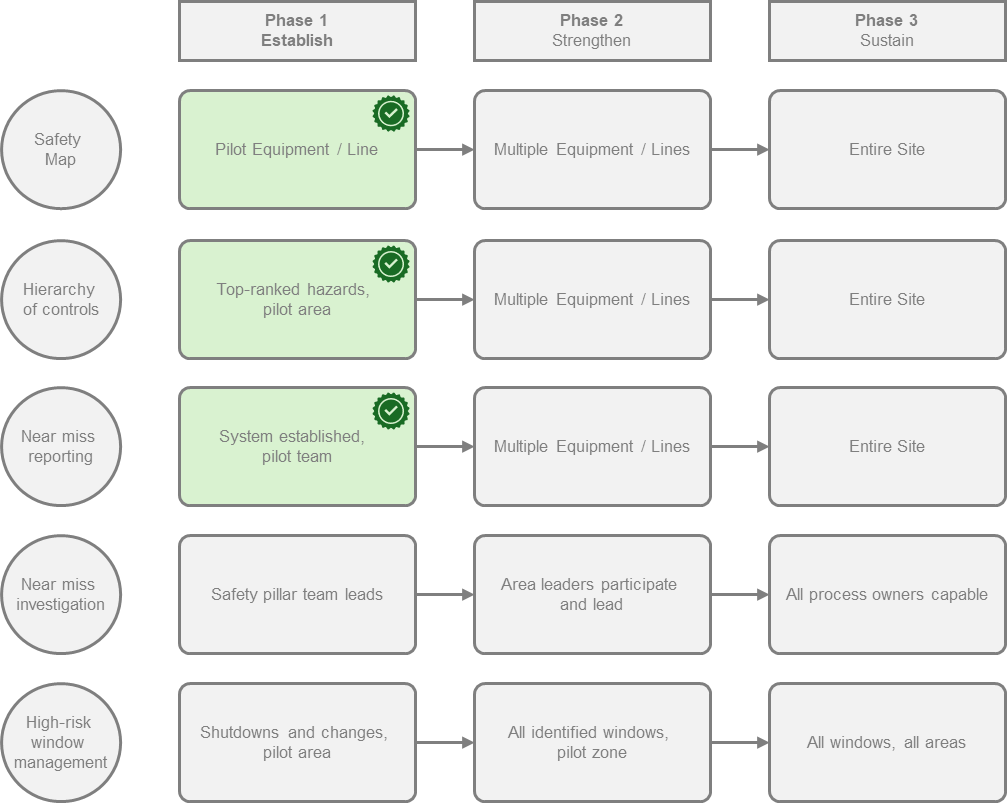
The Safety pillar is introduced in sequence. Each phase builds the capability and the infrastructure that the next one depends on.
Phase 1 — Establish
The safety map is completed for the pilot area. Every significant hazard is identified, assessed, and classified. The hierarchy of controls is applied to the top-ranked hazards. Controls that are procedural or PPE-based, where a higher-order control is available, are reviewed and upgraded where possible.
The near miss reporting and investigation system is established. The team understands what a near miss is, why it is reported, and what happens when it is. The first near miss investigations are completed with findings that change something. The near miss rate is tracked as a leading indicator alongside the lost time incident rate.
The safety map is integrated into AM Step 1 preparation for the pilot line. The team understands the hazards in their area, the isolation points, the energy sources, the restricted access zones, before the first cleaning session begins.
The measure of Phase 1 is not the lost time incident rate. It is whether the foundations are in place: a current safety map, controls at the highest level the hierarchy allows for the top-ranked hazards, and a near miss investigation system that is producing findings that change conditions.
Phase 2 — Strengthen
The safety map expands to cover all areas in the pilot zone. Hazard identification and ranking is run by the Safety pillar team with the operating team and the Maintenance function as active participants, not completed in isolation and handed over.
Near miss investigations are running consistently. The findings are reviewed at the monthly safety review. Every top near miss type has either a completed investigation with a confirmed fix, or an open investigation with a named owner and a due date. The near miss rate is rising, because reporting is improving, and the lost time incident rate is falling.
The high-risk windows are being managed deliberately. The data on incident patterns has been reviewed. The plan for shutdowns, changes, and new team members goes beyond additional briefings. For each high-risk window, the question has been asked: what is the highest-order control available?
The measure of Phase 2 is whether the near miss investigation system is producing findings that change conditions, and whether the high-risk windows are being managed with a plan that addresses the conditions, not just the symptoms.
Phase 3 — Sustain
The Safety pillar's capability reaches all areas across the site. Hazard identification and ranking is a standard capability, area leaders and process owners can run an assessment without the Safety pillar team leading it. Near miss investigation is embedded, the team closest to the work can define the problem, examine the conditions, and find the cause without waiting for the Safety pillar team.
The hierarchy of controls is applied consistently. PPE is the last control considered, not the first. Every new change, new piece of equipment, and new process is assessed for hazards before it goes live, not after the first incident.
The measure of Phase 3 is not the absence of incidents. It is the speed and quality of the response when a near miss occurs, and the consistency with which the hierarchy of controls is applied to new hazards. A site that has reached Phase 3 does not manage safety reactively. It identifies hazards, applies the most effective controls available, and investigates every signal the system produces, consistently, quickly, and without needing to be directed.
The number of people who hold the capability grows across the phases. Phase 1 builds it in the Safety pillar team and the AM pilot team. Phase 2 extends it to the leaders and process owners in the pilot area. Phase 3 reaches all process owners and people leaders across the site.
The depth of capability also grows. In Phase 1, the goal is that the Safety pillar team can complete a hazard assessment and run a near miss investigation. In Phase 2, the goal is that operations leaders and process owners can participate in and lead assessments and investigations. In Phase 3, the goal is that safety capability is embedded, the team closest to the work can identify a hazard, apply the hierarchy of controls, and investigate a near miss without waiting for the Safety pillar team to lead it.
Ready to build your pillar?
Before you start, make sure your team is in place, your charter is drafted, and your plan connects to the site's strategic objectives. The Setting Up Your Pillar guide takes you through each step in sequence.