Organisational Capability
Every organisation is perfectly designed to get the results it achieves. If you do not like the results, change the design.
Most organisations treat people as a resource to be managed rather than a system to be designed. They hire for skills, reorganise when performance drops, and run engagement surveys when the culture feels wrong. None of those things are bad. But none of them are a system.
The Organisational Capability pillar exists to change that. It builds the capability to look at an organisation the way you would look at a process — to understand what it is currently designed to produce, to define what it needs to produce instead, and to change the design deliberately.
That is not an HR exercise. It is a management discipline. And like every other discipline in this system, it starts with understanding what you have before you try to change it.
Pillar Intent
The Organisational Capability pillar exists to ensure that the organisation is designed to deliver the results the strategy requires, and that the design is reviewed and updated as the strategy and the system evolve.
That means understanding the current organisation honestly: what work is being done, by whom, with what skills, in what structure, with what information, making what decisions, rewarded for what behaviour. It means defining what the organisation needs to look like to deliver the strategy. And it means closing the gap between the two, deliberately, in sequence, with named owners and visible progress.
This pillar works alongside Leadership. Leadership builds the routines that hold the system together. The Organisational Capability pillar builds the organisation that runs those routines. The two are not the same thing. A well-run management system in a poorly designed organisation will produce consistent results, consistently below what the strategy requires.
This pillar also works alongside every other pillar in the system. Each pillar requires specific capabilities in specific roles. The Organisational Capability pillar is the mechanism for ensuring those capabilities exist, are developed in the right sequence, and are held in the right places in the organisation.
Pillar Owned Losses
Organisational capability losses are the hardest to see on a loss report. They do not appear as downtime or defects. They appear as friction, delay, and underperformance that everyone accepts as normal.
Pillar Owned Capabilities
The Organisational Capability pillar builds capability in response to the losses it owns.
Process capabilities
Three processes. One assesses and designs the organisation. One tracks whether the capability the system needs is actually being built. One ensures new people enter the system correctly.
- Organisational System Design: The structured process for assessing the current organisation, defining the required design, and closing the gap between the two. It uses a consistent model, business situation, strategy, and six design elements, to ensure that every aspect of the organisation is considered and that the design choices are connected to each other. The process guide covers how to run an assessment, how to define a design, and how to build and manage the action plan.
- Capability Matrix: The tool every pillar uses to track whether the right people hold the right capabilities at the right level. The matrix maps each capability in the system against three levels of development: can support, can lead, can teach. It is not a training record. It is a picture of where the capability is in the organisation, how widely it is held, and whether the depth is sufficient to sustain the system without depending on a small number of people.
The Capability Matrix lives in this pillar because the Organisational Capability pillar owns the question of whether the organisation is designed to deliver the strategy. Capability is part of that design. Each pillar defines the capabilities it needs. This pillar tracks whether those capabilities exist, at the right level, in the right people, at the right time in the phase plan.
- System Onboarding: The process for introducing a new person, whether new to the site or new to a role, to the management system, their place within it, and the capabilities they are expected to develop. Onboarding is not an induction checklist. It is the first entry in the Capability Matrix for that person. It defines what they need to be able to do, at what level, and by when. Without it, new people learn the system by observation, which means they learn whatever version of it is currently visible on the floor, not the version the system is designed to run.
People capabilities
Leaders at every level who can assess an organisation honestly, design it deliberately, and manage the gap between the two.
- Site and function leaders who can run an organisational assessment, define the design the strategy requires, and manage the transition from current to future state without losing the performance the current organisation is delivering.
- People leaders and process owners who understand how the design elements connect, that a change in structure changes decision making, that a change in task changes the skills required, and who can apply the model to their own team without waiting for a formal programme.
- Organisational Capability Pillar members who can facilitate an organisational assessment and design process, coach leaders through the model, maintain the Capability Matrix across all pillars, manage system onboarding, and track the action plan to completion.
Pillar Behaviours
The site reorganises after a period of underperformance.
A new capability is needed in the organisation.
The strategy changes.
A leader is asked to support a new pillar or process.
A new person joins the team.
What Good Looks Like
Organisational Capability Pillar member
- Can run an organisational assessment on a team, a function, or a site, and produce a clear picture of what the current design is producing and why.
- Can facilitate a design session that connects the strategy to the six design elements in sequence, without jumping to structure before the task and skills questions have been answered.
- Maintains the Capability Matrix across all pillars. Keeps it current. Uses it to identify gaps before the system reaches a phase that requires a capability that has not been built.
- Manages system onboarding for new people and new roles. Ensures every new person has a starting point on the Capability Matrix and a development plan connected to it.
- Tracks the action plan to completion. Does not treat the assessment and design as the output. The output is the change.
- Coaches leaders through the model so they can apply it themselves. The goal is not dependency on the pillar. It is capability in the leaders.
- Tracks whether leaders are participating in the tools they sponsor, not just reviewing the results. A leader who has never run a PI cannot coach one. The capability plan should reflect this.
Department or area leader
- Understands how the design elements in their team connect to each other. Knows that changing one changes others.
- Does not reorganise as a first response to underperformance. Asks what the design is producing and why before changing the structure.
- Connects the capability plan for their team to the system's phase plan. Knows which capabilities are needed in Phase 1, which in Phase 2, and which in Phase 3, and manages to that sequence.
- Ensures the information their team needs to do their work is available, accurate, and timely. Does not accept information gaps as normal.
- Has personally used the tools they ask their teams to use. Does not sponsor a method they have not experienced. Uses that experience to coach the method, not to provide the answer.
- Owns the onboarding of new people into their team. Does not treat it as an HR task. Knows what each new person needs to learn, at what level, and by when.
Site or function leader
- Reviews the organisational design at least annually, or when the strategy changes, whichever comes first.
- Asks in reviews: is the organisation designed to deliver the strategy? Which design elements are misaligned? What is the action plan and who owns it?
- Ensures the Capability Matrix is current and being used to make decisions, about who leads the next PI, who coaches the next AM step, who is ready to move to the next phase.
- Models the discipline. Runs an organisational assessment on the leadership team before asking others to do it on their teams.
- Sets the expectation that leaders go first. That they participate in the tools before they sponsor them. That equipment ownership belongs to the operating team, and that the leader's job is to build that ownership, not to manage the equipment condition on the team's behalf.
Audits and Confirmations
Where to Start
Before running an organisational assessment, take stock of where you are.
If not, the assessment will produce different answers from different people, and the design will reflect those differences. Start with strategic clarity before organisational design.
If not, you are designing from assumption. An honest assessment of the current state, what work is being done, by whom, with what skills, in what structure, is the starting point. You cannot close a gap you have not measured.
If not, you do not have a reliable picture of where the capability is in the organisation. You may be assuming capability exists that does not, or missing that a single person is carrying knowledge the system depends on. Build the matrix before the phase plan, not after.
If not, the system will build processes that the organisation does not yet have the capability to run. The capability plan and the phase plan need to be developed together, not separately.
If not, that is the starting point. A leader who has never run a PI or participated in an AM step cannot coach one. The first PI on a leadership process is not a symbolic gesture. It is the foundation.
If the answer to most of these is no, start with Phase 1, Establish. Run an organisational assessment on the leadership team. Keep it focused. The goal is not a perfect design. It is an honest picture of what the current design is producing, and a clear view of what needs to change to deliver Phase 1 of the system.
If some capability exists but it is patchy, some leaders can assess and design, others cannot; some teams have clear task definitions, others do not, start with Phase 2, Strengthen. Identify the two or three design elements with the most direct impact on the system's current phase. Assign a named owner to each gap. Build the action plan.
If the discipline is established at the leadership level but has not yet reached the people who own processes directly, move to Phase 3, Sustain. The goal is not more assessments. It is an organisation where leaders at every level can look at their team, understand what the design is producing, and make deliberate changes when the strategy or the system requires it.
Phases
The Organisational Capability pillar develops in parallel with the system. Each phase of the system requires a different organisational design, and this pillar's job is to ensure the design is ready before the system needs it.
Phase 1 — Establish
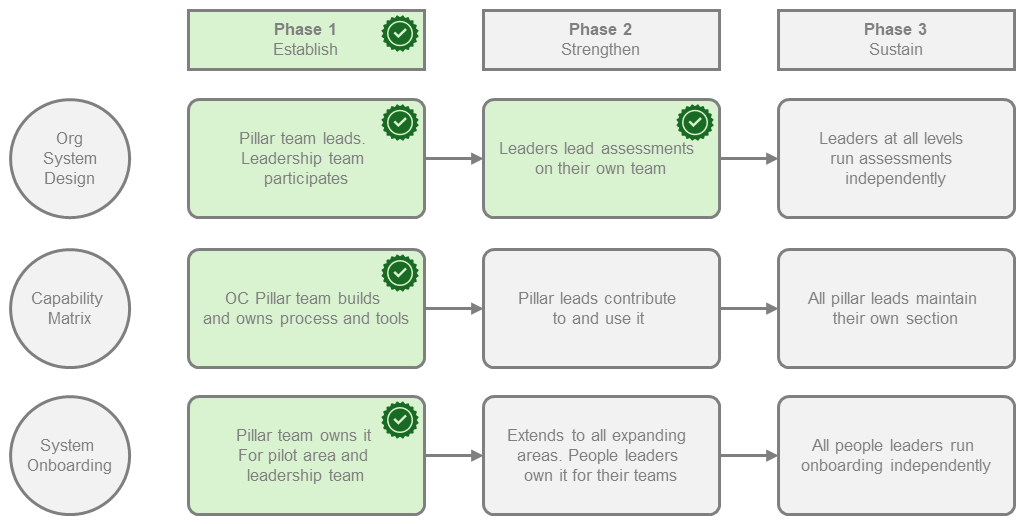
The first organisational assessment is run on the leadership team. The current design is assessed against the requirements of Phase 1 of the system: what tasks need to be done, what skills are required, what structure supports the pilot, what decisions need to be made at what level, what information the team needs, and what behaviour needs to be recognised.
The Capability Matrix is built for the first time in Phase 1. It covers the capabilities required across all active pillars, mapped against the people who currently hold them and at what level. This is the baseline. Everything from Phase 2 onwards is measured against it.
System onboarding is established in Phase 1. Every new person joining the pilot area or the leadership team has a structured introduction to the system, a starting point on the Capability Matrix, and a development plan connected to it.
Phase 2 — Strengthen
As the system expands to more areas and more people, the organisational design needs to expand with it. The assessment is updated to reflect Phase 2 requirements: more process owners with named accountability, more leaders who can coach rather than direct, more people with the skills to run the system's processes independently.
The Capability Matrix is updated to reflect Phase 2 requirements. New capabilities are added as new pillars and processes are introduced. The matrix is reviewed at each phase assessment to confirm that the capability is genuinely held — not just trained — before the next phase begins.
The Organisational Capability pillar facilitates assessments at the team and function level, not just the site level. Leaders who have been through the model once begin to apply it to their own teams. The capability to assess and design is itself a capability that needs to be built and tracked.
Phase 3 — Sustain
In Phase 3, the organisational design is reviewed annually as a standard management system activity, not as a response to underperformance. The assessment is embedded in the site's planning cycle. Leaders at every level can run a focused assessment on their own team when the strategy or the system requires it.
The Capability Matrix is a live management tool in Phase 3, reviewed regularly, updated when people move, and used to identify succession risks before they become gaps. The goal is an organisation where no single capability is held by only one person, and where the system can sustain itself through normal levels of change in the people who run it.
The measure of Phase 3 is not the number of assessments completed. It is whether the organisation is consistently designed to deliver what the strategy requires, and whether leaders at every level have the capability to identify and close the gaps when they appear.
The scope of people who hold the capability grows with each phase. The depth of that capability grows too. In Phase 1, the Organisational Capability Pillar team runs the assessment with the leadership team. In Phase 2, leaders participate in and begin to lead assessments on their own teams. In Phase 3, the capability is embedded widely enough that assessments are initiated and run without central support.
Ready to build your pillar?
Before you start, make sure your team is in place, your charter is drafted, and your plan connects to the site's strategic objectives. The Setting Up Your Pillar guide takes you through each step in sequence.