Quality
Most quality problems are not random. They are produced by conditions that are out of standard, a setting that has drifted, a material that has changed, a method that has been modified without anyone noticing. The Quality pillar builds the capability to find those conditions and remove them.
Most sites have a quality system. They have procedures, inspection points, release criteria, and a team responsible for making sure the product meets the standard before it leaves.
What most sites do not have is a clear picture of where their defects are coming from.
The defects are recorded. The rejects are counted. The rework is done. But the conditions that produced the defect, the equipment setting that drifted, the material that changed, the method that was modified, are often not investigated. The defect is managed. The cause is not removed. And so the defect returns, on the next batch, or the one after that, or three months later when the same condition recurs.
A quality system that records defects without eliminating their causes is a system that has learned to live with them.
The Quality pillar is built on a different premise. A defect is not a random event. It is produced by a condition. Find the condition, correct it, and confirm it stays corrected. That is the work.
Pillar Intent
The Quality pillar exists to build the capability to define what good looks like, make defects visible before they leave the process, and eliminate the conditions that keep producing them.
That is not an inspection function. Inspection finds defects after they have been made. The Quality pillar works upstream, on the conditions that produce defects in the first place. Equipment settings. Material standards. Method consistency. The four conditions that must be right for the process to produce a consistent result: the right person, with the right method, using the right material, on equipment in the right condition.
When all four are defined, monitored, and confirmed, defects become rare. When any one of them is undefined, unmonitored, or drifting, defects become predictable. The Quality pillar makes that predictability visible, and then removes it.
This pillar works in close partnership with Autonomous Maintenance and Problem Solving. AM Step 6 is where quality control standards are built into the operating team's daily inspection routine, the team learns which equipment settings affect which quality parameters, and monitors them as part of their standard work. The Quality pillar defines those standards. Problem Solving provides the investigation discipline when a defect occurs. The Quality pillar applies that discipline specifically to defects, using the four conditions as the structured analysis lens.
Pillar Owned Losses
Quality losses are not always directly visible on a loss report. Some are obvious, a batch rejected, a line stopped for a quality hold, a customer complaint. Others are hidden inside the numbers that everyone accepts as normal.
Pillar Owned Processes
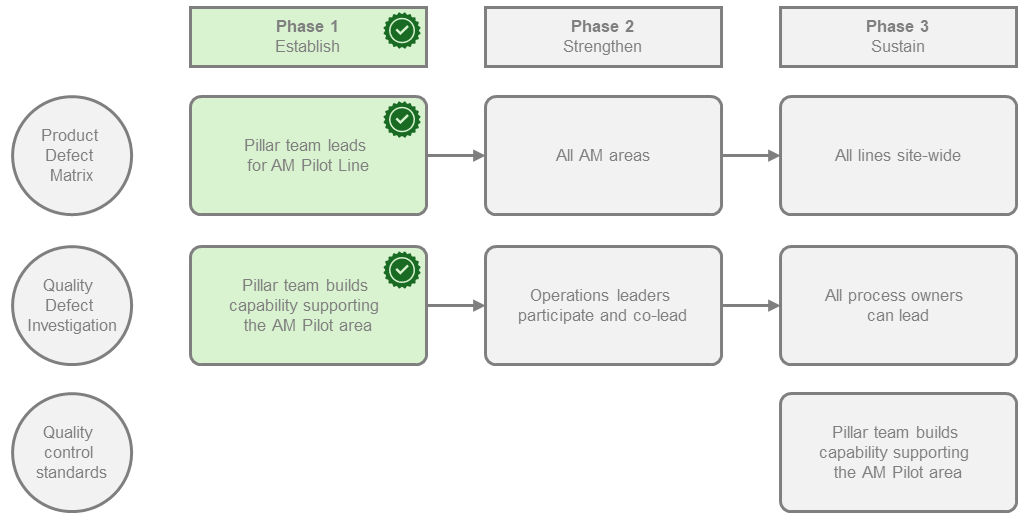
The Quality pillar owns three processes. They are introduced in sequence. The Product Defect Matrix tells you where to focus. Quality Defect Investigation removes the cause. Quality Control Standards prevent the defect from returning.
Product Defect Matrix. The starting point. A structured classification of defects by type, severity, frequency, and the sub-process or equipment that produces them. The matrix makes the defect picture visible across the site or function, and it drives the prioritisation of investigation and improvement work. Without it, effort goes to the most recent defect, not the most significant one.
Quality Defect Investigation. The process for finding and eliminating the root condition behind a defect. It uses the same six-stage problem solving discipline used across the site, Define, Return to Standard, Understand Why, Select the Solution, Validate the Fix, Make it Stick, with the four conditions (Man, Machine, Material, Method) as the structured analysis lens. A defect investigation that does not examine all four conditions has not finished the investigation.
Quality Control Standards. The documented connection between process conditions and product quality. For each critical quality parameter, the standard specifies: which equipment setting or process condition affects it, what the correct value is, what the acceptable range is, how it is monitored, at what frequency, and what to do when it drifts. These standards are integrated into the operating team's inspection routine at AM Step 6. The Quality pillar defines them. AM owns the monitoring.
Pillar Behaviours
A defect is found during production.
A quality control standard is introduced at AM Step 6.
A customer complaint is received.
The Product Defect Matrix is reviewed at the monthly quality review.
What Good Looks Like
Quality team member (pillar team)
- Maintains the Product Defect Matrix. Reviews it monthly and ensures the top defect types have active investigations or confirmed fixes.
- Leads or supports Quality Defect Investigations on the highest-priority defect types. Uses the six-stage process and the four conditions as the structured analysis lens.
- Builds quality control standards in partnership with the operating team and the Maintenance function. Does not write standards in isolation and hand them over. Builds them with the people who will monitor them.
- Reviews quality control standards regularly. A standard that is consistently found outside its range is a standard that needs to be examined, not enforced.
- Is present at the AM Step 6 work on each line. Brings knowledge of which quality parameters are most affected by equipment condition. Ensures the quality control standards built at Step 6 are correct and complete.
- Connects quality data to the TAM agenda. The quality score belongs in the daily meeting, not only in the monthly quality review.
Frontline leader (in areas with quality control standards)
- Confirms quality control standards as part of the Process Confirmation routine. Not a separate quality check, part of the same confirmation that covers the CIL and Centreline standards.
- When a setting is found outside the standard, corrects it and records it. Does not accept drift as normal. If the same setting drifts repeatedly, raises it as a quality investigation, not just a recurring adjustment.
- Ensures the team understands the quality control standards they monitor, which parameter each one affects, and what happens to the product when it drifts. A team that monitors a setting without understanding why will stop monitoring it when the audit pressure drops.
- When a defect occurs, asks the right first question: was the process in standard when the defect was produced? That question determines whether the investigation starts with the standard or with the condition.
Operations leader
- Ensures quality defect investigations are completed, not just opened. A named owner and a due date are not enough. The investigation needs a finding that has changed something.
- Reviews the Product Defect Matrix at the monthly quality review. Asks: what have the investigations found? Not: what are the numbers?
- Supports the Quality pillar team's access to the line for investigation work. A defect investigation that cannot get to the equipment is an investigation that will not find the cause.
- Connects quality performance to the site's strategic objectives. A defect rate that is not improving is a strategic problem, not just a quality metric.
Site or function leader
- Sets the expectation that defects are investigated, not managed. A rework step that has been in the process for two years is not a quality system. It is a workaround for a cause that has not been found.
- Asks in reviews: what are our top three defect types this month, and what have the investigations found? Not: what is our defect rate?
- Ensures the Quality pillar team has the resource and the access to do investigation work. An investigation that is always deprioritised by production pressure will never finish.
- Connects the Quality pillar to the AM programme. Asks AM teams what quality control standards they are monitoring and whether they understand what they are for. The question signals that quality is not the quality team's problem alone.
Audits and Confirmations
Where to Start
Before selecting a process to build, take stock of where you are. These questions are not a formal audit. They are a quick read of the quality system as it stands today.
If not, start with the Product Defect Matrix. You cannot prioritise investigation work without a clear picture of where the defects are coming from. The matrix is the starting point for everything else in this pillar.
If defects are being managed, reworked, adjusted around, or accepted as normal, rather than investigated, start with Quality Defect Investigation on your highest-frequency defect type. Use the six-stage problem solving process. Apply the four conditions as the analysis lens. Find the condition. Remove it.
If not, the quality control standards for AM Step 6 have not yet been built. This work requires the Quality pillar team, the Maintenance function, and the operating team to work together. The Quality pillar team leads it. It cannot be delegated to AM alone.
If not, the standards exist on paper but are not being held in practice. Add quality control standards to the frontline leader's Process Confirmation schedule before the standards drift and the defects return
If the answer to most of these is no, start with Phase 1, Establish. Build the Product Defect Matrix. Run a Quality Defect Investigation on your top recurring defect type. These are the foundations. Without them, quality control standards built at AM Step 6 will not be grounded in the right priorities.
If the matrix exists and investigations are running, but defects are still recurring, start with Phase 2, Strengthen. The most common gap at this stage is not in the tools. It is in the quality control standards, either they do not cover the right conditions, or they are not being confirmed consistently. Fix that before expanding further.
If quality control standards are established, confirmed, and the defect rate is improving, move to Phase 3, Sustain. Extend the standards to all lines. Build the capability across the full Quality pillar team so that investigation and standard-setting work does not depend on one or two people.
Phases
The Quality pillar is introduced in sequence. Each phase builds the capability and the infrastructure that the next one depends on.
Phase 1 — Establish
The Product Defect Matrix is built for the pilot line. The top defect types are identified, classified by severity and frequency, and prioritised for investigation. The Quality pillar team is formed and trained in the six-stage defect investigation process.
At least one Quality Defect Investigation is completed on the pilot line's highest-priority defect type. The investigation uses the four conditions as the analysis lens. The finding changes something, the standard, the equipment condition, the material specification, or the method. The defect does not recur.
Quality control standards are built for the pilot line in partnership with the AM Step 6 work. The Quality pillar team leads this work with the operating team and the Maintenance function. The standards are integrated into the AM integrated inspection routine and confirmed through Process Confirmation.
The measure of Phase 1 is not the defect rate. It is whether the foundations are in place: a current Product Defect Matrix, at least one completed investigation with a confirmed fix, and quality control standards integrated into the AM inspection routine on the pilot line.
Phase 2 — Strengthen
The Product Defect Matrix expands to cover all lines in the pilot area. Quality Defect Investigations are running on the top defect types across the pilot area, led by the Quality pillar team with operations leaders and process owners as active participants.
Quality control standards are built for each line as it reaches AM Step 6. The Quality pillar team supports each line's Step 6 work, ensuring the standards are correct, complete, and integrated into the inspection routine.
The Quality pillar team develops the capability to run investigations independently and to build quality control standards without external support. The measure of Phase 2 is whether the defect rate is improving on the lines where standards are established, and whether investigations are completing with findings that change something.
Phase 3 — Sustain
The Quality pillar's capability reaches all lines and all processes across the site. Quality Defect Investigation is a standard capability, process owners and area leaders can run an investigation without the Quality pillar team leading it. Quality control standards cover all critical quality parameters on all lines and are confirmed through Process Confirmation as a matter of course.
The measure of Phase 3 is not the absence of defects. It is the speed and quality of the response when a defect occurs. A site that has reached Phase 3 does not manage defects. It investigates them, finds the condition, and removes it, consistently, quickly, and without needing to be directed.
The number of people who hold the capability grows across the phases. Phase 1 builds it in the Quality pillar team and the AM pilot team. Phase 2 extends it to the leaders and process owners in the pilot area. Phase 3 reaches all process owners and people leaders across the site.
The depth of capability also grows. In Phase 1, the goal is that the Quality pillar team can run an investigation and build a quality control standard. In Phase 2, the goal is that operations leaders and process owners can participate in and lead investigations. In Phase 3, the goal is that quality defect investigation is embedded, the team closest to the work can define the problem, examine the four conditions, and find the cause without waiting for the Quality pillar team to lead it.
Ready to build your pillar?
Before you start, make sure your team is in place, your charter is drafted, and your plan connects to the site's strategic objectives. The Setting Up Your Pillar guide takes you through each step in sequence.