Hierarchy of Controls
A structured way to choose the most effective control for a hazard, and to make the trade-offs between effectiveness and cost consciously, not by default.
The best control is the one that works regardless of what anyone decides to do.
Think about when you are driving, how do you make sure you are not speeding?
Every country in the world has tried to solve it. The tools are familiar. Driver training and testing. Speed limit signs. Cameras and fines. Speed bumps and road narrowing. And in newer vehicles now, GPS-linked speed alerts based on the zone the car is in.
All of these work to some degree. But they do not all work in the same way, or with the same reliability.
A speed limit sign depends on the driver seeing it, reading it, and deciding to comply. A speed bump works whether the driver has seen the sign or not.
The difference is not just effectiveness. It is dependency. The lower down the list you go, the more the control depends on human behaviour being correct every time. The higher up you go, the less it matters what the person decides.
That is the logic of the hierarchy of controls. It does not tell you which control to use. It tells you which controls are most reliable, and why, so that when you choose a lower-order control, you are making that choice deliberately, with a clear understanding of what you are accepting.
What the hierarchy is
The hierarchy of controls is a framework for selecting and evaluating safety controls. It ranks controls from most effective to least effective, based on one principle: the less a control depends on human behaviour, the more reliably it works.
It does not say that lower-order controls are wrong. It says they are less reliable. A warning sign is better than nothing. A physical barrier is better than a warning sign. Removing the hazard entirely is better than both.
The hierarchy is used in two situations. First, when a new hazard is identified, to select the most effective control available. Second, when reviewing existing controls, to ask whether a higher-order control is available that has not yet been applied.
The output of the hierarchy is not a list of controls. It is a decision. Which control gives the best reduction in likelihood and impact, at a cost the organisation can justify? And if a lower-order control is chosen, who has made that decision, and why?
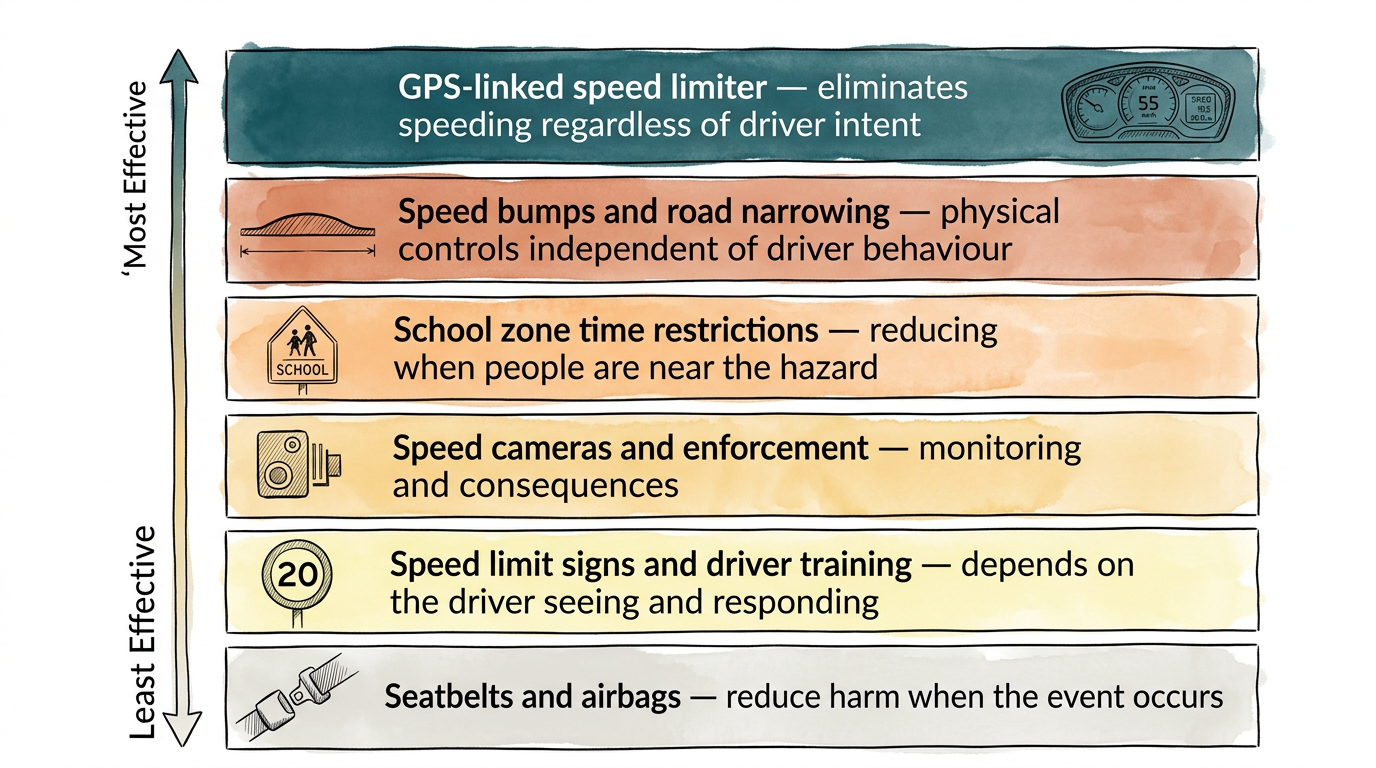
The six levels
Eliminate the risk
Remove the hazard entirely. If the hazard does not exist, it cannot cause harm, regardless of what anyone does, forgets to do, or decides to do under pressure.
Elimination is the most effective control because it has no dependency on human behaviour at all. It does not require a sign to be read, a procedure to be followed, or a piece of equipment to be worn. The hazard is gone.
In the speeding example, true elimination would mean designing a transport system where speed differentials between vehicles and pedestrians do not exist, fully separated systems, closed roads, or environments where the hazard is physically impossible. At scale, this is rarely practical. But on a specific road, in a specific location, it sometimes is. A pedestrianised zone eliminates the vehicle-pedestrian speed hazard entirely.
In the workplace, elimination looks like redesigning a process so that a hazardous step is no longer needed. Removing a chemical that requires special handling. Automating a task that previously required a person to work at height. Changing the layout so that a crossing point between pedestrians and vehicles no longer exists.
The question to ask first is always: does this hazard need to exist at all?
Substitute
Replace the hazard with something that presents a lower risk. The hazard still exists, but its potential to cause harm is reduced, either because the new substance, process, or piece of equipment is less dangerous, or because the consequence of failure is smaller.
In the speeding example, substitution is lowering the speed limit in a high-risk zone. The hazard, a moving vehicle, still exists. But a car travelling at 30 kph causes significantly less harm than one at 80 kph. The consequence of the same event is reduced.
In the workplace, substitution looks like replacing a hazardous cleaning chemical with a less hazardous one that achieves the same result. Using a lighter component that removes a manual handling risk. Switching to a process that operates at lower temperature or pressure. The task still happens. The risk of the task is lower.
Substitution is often overlooked because it requires questioning whether the current substance, process, or equipment is the only option. It usually is not.
Engineer a barrier
Put a physical control between the person and the hazard. The barrier works independently of what the person decides to do. It does not require them to remember, comply, or be present when the decision is made.
In the speeding example, engineering controls are speed bumps, chicanes, road narrowing, and raised junctions. The driver does not choose whether the speed bump is there. It is there. The vehicle slows because the physical environment requires it. A GPS-linked speed limiter, if mandated, would also sit here: the car cannot exceed the speed limit in a given zone, regardless of what the driver does.
In the workplace, engineering controls are guards that prevent access to moving parts, interlocks that stop a machine when a guard is opened, isolation points that physically disconnect energy before maintenance begins, ventilation systems that remove hazardous fumes before they reach a person's breathing zone. The control is built into the environment or the equipment. It does not depend on the person.
This is the level where the phrase design the mistake out applies most directly. If the guard physically prevents access, the person cannot make the mistake of reaching in. The design has removed the option.
Reduce exposure
Change when, how often, or how many people are near the hazard. The hazard still exists and the barrier is not physical, but the number of opportunities for harm is reduced.
In the speeding example, school zone time restrictions are an exposure control. The reduced speed limit applies only during school hours, when children are likely to be near the road. Outside those hours, the standard limit applies. The hazard, a moving vehicle near pedestrians, is managed by limiting when the two are in proximity.
The shutdown training day is another example. The hazard, a team returning to equipment after an extended break, with disrupted routines and unfamiliar conditions, cannot be eliminated. But the exposure can be managed. By using the first day back for training and verification rather than production, the team is not near the hazard at the moment of highest risk.
In the workplace, exposure controls include rotating tasks so that no single person accumulates excessive exposure to a physical or chemical hazard, scheduling high-risk work for periods when fewer people are in the area, and separating pedestrian and vehicle routes so that the two are never in the same space at the same time.
Warnings and procedures
Alert people to the hazard and define the safe method for working near it. This level depends on the person seeing the warning, understanding it, and choosing to act on it, every time.
In the speeding example, speed limit signs, road markings, in-car warnings when the speed limit is exceeded, and driver training and testing all sit here. They work when the driver is paying attention and decides to comply. They do not work when the driver is distracted, in a hurry, or has decided that the risk is acceptable.
Enforcement, cameras and fines, also sits at this level. It changes the consequence of non-compliance, which changes the calculation the driver makes. But it still depends on the driver making a calculation. A driver who believes they will not be caught, or who is willing to accept the fine, is not controlled by the camera.
In the workplace, warnings and procedures include hazard signs, permit-to-work systems, safe operating procedures, toolbox talks, and induction training. These are necessary. They are not sufficient on their own for high-ranked hazards. A procedure that is not followed is not a control. A sign that is not seen is not a control. The reliability of this level depends entirely on human behaviour being correct every time.
Personal protective equipment
Protect the person from the consequences of the hazard when all other controls have failed or are insufficient. PPE does not prevent the event. It reduces the harm when the event occurs.
In the speeding example, seatbelts, airbags, and crumple zones are PPE. They do not stop the collision. They reduce the injury when the collision happens. They are essential. They are also the last line of defence, not the first.
In the workplace, PPE includes hard hats, safety glasses, hearing protection, gloves, high-visibility clothing, and respiratory protection. Every one of these is valuable. Every one of them depends on being worn correctly, every time, by every person. A hard hat that is not worn is not a control. A glove that does not fit is not a control.
PPE is the right answer when no higher-order control is available or practical. It is the wrong answer when it is chosen because it is cheaper or easier than a control that would actually prevent the event.
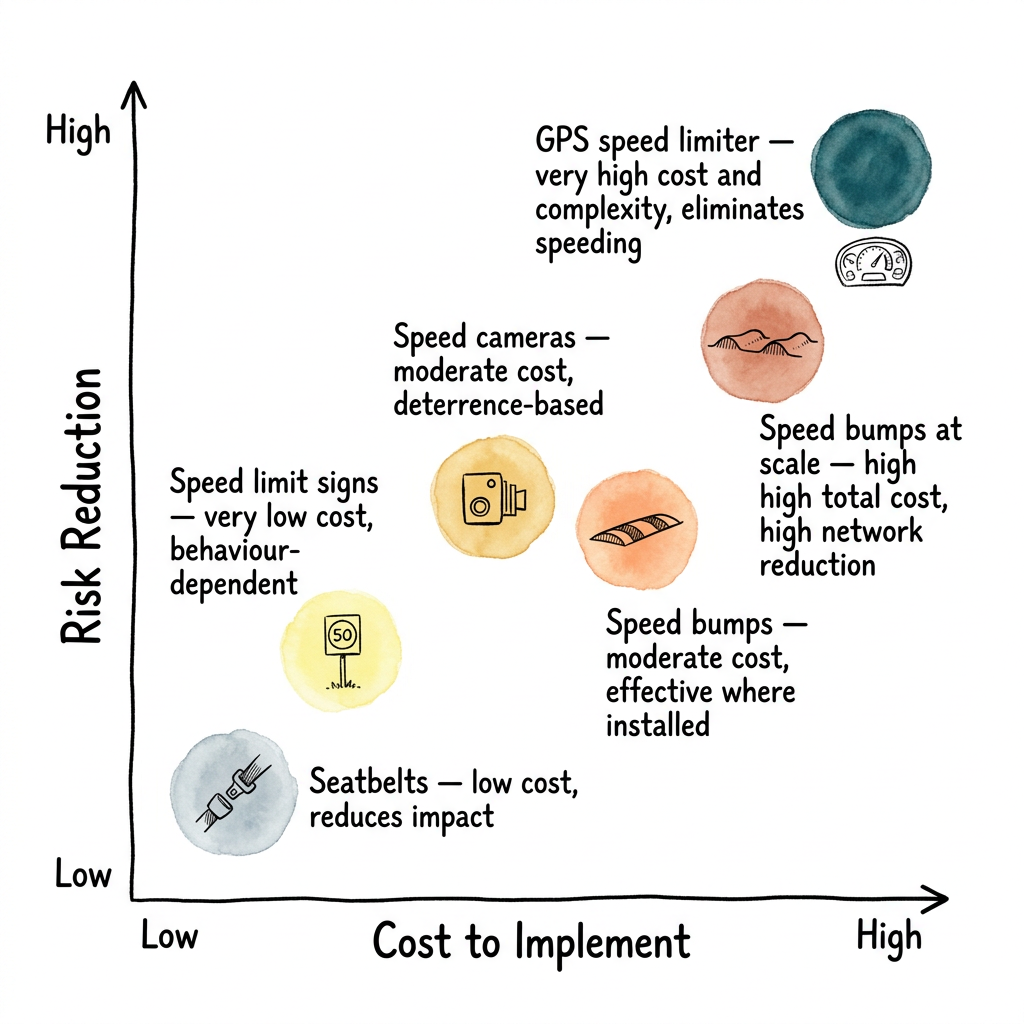
Choosing the right control
The hierarchy tells you which controls are most reliable. It does not tell you which one to use. That decision requires weighing four questions for each control being considered.
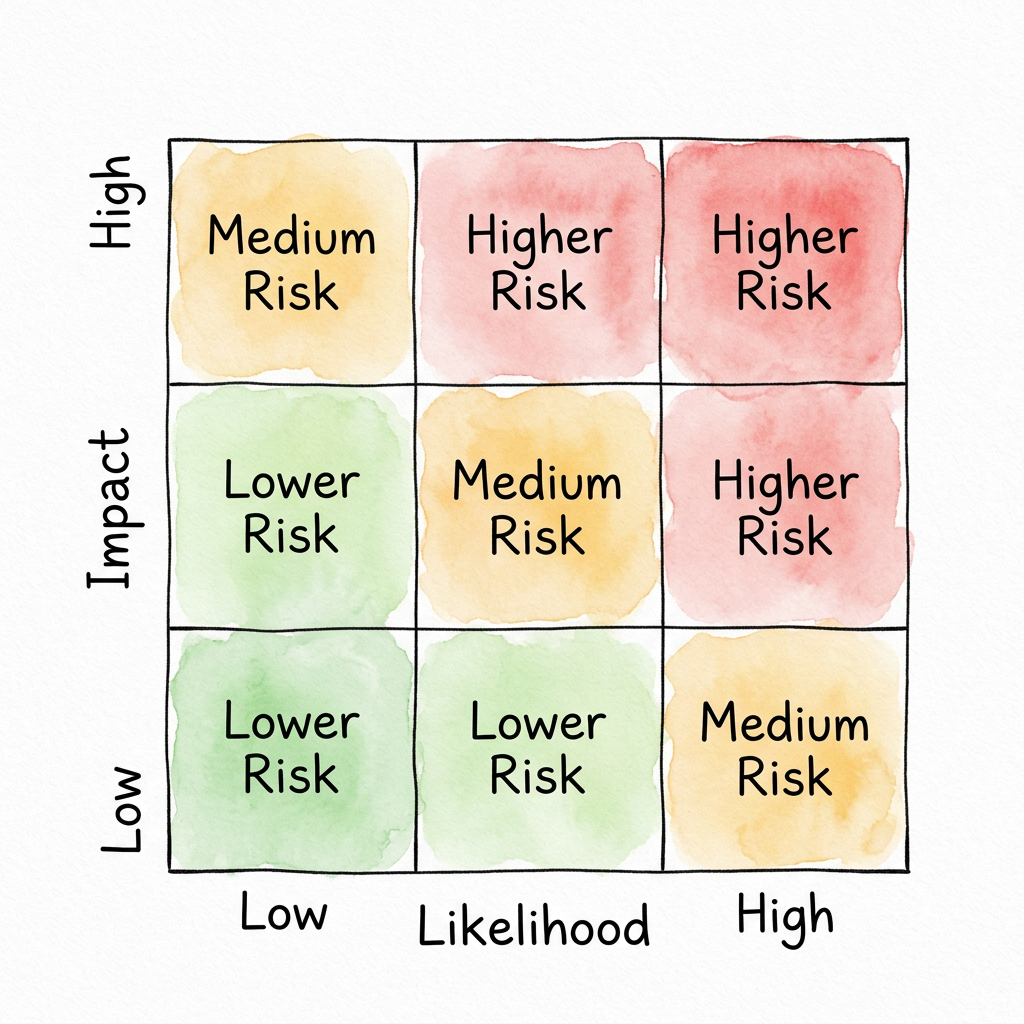
Does it reduce the likelihood of the event? Some controls make the hazardous event less likely to occur. A physical barrier prevents access. A substituted chemical is less likely to cause a reaction. A redesigned process removes the hazardous step. Likelihood reduction means the event happens less often, or not at all.
Does it reduce the impact if the event occurs? Some controls reduce the harm when the event happens, even if they do not prevent it. PPE reduces injury. A lower speed limit reduces the severity of a collision. A reduced chemical concentration reduces the severity of exposure. Impact reduction means the consequence is smaller when the event does occur.
Does it do both? The most effective controls reduce both likelihood and impact. Elimination removes the hazard entirely, the event cannot occur and there is no impact. Substitution reduces both the likelihood of a serious event and its consequence. Engineering controls typically reduce likelihood significantly. PPE reduces impact only. Understanding which axis a control addresses helps you assess whether it is sufficient on its own or needs to be combined with another.
What does it cost to implement and maintain? Cost is a legitimate factor. A GPS-linked speed limiter in every vehicle would eliminate speeding. It would also cost billions to implement and raises significant questions about civil liberties and edge cases. The decision not to mandate it is not irrational. It is a trade-off, a conscious choice to accept a less effective control because the cost of the most effective one is not justified.
The same logic applies in the workplace. A guard that costs €500 to install and nothing to maintain is a different proposition from a ventilation system that costs €50,000 to install and requires regular servicing. Both may be the right answer for their respective hazards. The question is whether the cost has been weighed against the risk, and whether the decision has been made consciously.
The risk of this question is that cost becomes the default reason to stay at the bottom of the hierarchy. A procedure is cheaper than a guard. A sign is cheaper than a procedure. PPE is cheaper than all of them. If cost is always the deciding factor, the organisation will always end up with the least effective controls, and the incidents that follow will be predictable.
The right question is not what is the cheapest control? It is what is the most effective control we can justify, and if we are choosing something less effective, who has made that decision and why?
The conscious trade-off
The speeding example makes one thing clear that is easy to miss in a workplace context.
The GPS-linked speed limiter exists. The technology is available. Several countries have begun mandating it on new vehicles. The decision not to mandate it universally is not a technical limitation. It is a policy choice, a conscious trade-off between effectiveness, cost, practicality, and other values.
Most organisations have made similar trade-offs without naming them. A hazard that could be engineered out has a warning sign instead, because the engineering solution was expensive and the sign was available. A task that could be redesigned to remove a manual handling risk is still done the old way, because the redesign would require capital investment. A chemical that could be substituted is still in use, because the alternative costs more.
None of these decisions are necessarily wrong. Some of them are entirely reasonable. The problem is when they are not decisions at all, when the lower-order control was chosen not because the trade-off was considered, but because nobody asked the question.
The hierarchy of controls is the tool that forces the question. For every significant hazard, the question is: what is the highest-order control available, and if we are not using it, why not? The answer may be cost. It may be practicality. It may be that the higher-order control introduces a different risk. All of those are legitimate answers. The absence of an answer is not.
How to use it
The hierarchy of controls is used in two situations.
When a new hazard is identified. Start at the top of the hierarchy and work down. Can the hazard be eliminated? If not, can it be substituted? If not, can it be engineered out? Work through each level until you reach the most effective control that is available and justifiable. Document the decision, which control was chosen, why, and what higher-order controls were considered and rejected.
When reviewing existing controls. For each significant hazard in the area, ask: what level of the hierarchy is the current control? Is a higher-order control available that has not been applied? Has the cost/benefit been assessed? If the current control is at the warnings and procedures level, is there an engineering control that would be more reliable? The review does not require every control to be upgraded. It requires every control to be consciously chosen.
The output of both processes feeds directly into the Hazard Identification and Ranking assessment. The ranking tells you which hazards to prioritise. The hierarchy tells you what to do about them.
Common pitfalls
What this gives you
Key Links
The hierarchy of controls is the decision framework that follows hazard identification and ranking. The ranking tells you which hazards to prioritise. The hierarchy tells you what to do about them.
Every incident and near miss investigation asks whether the control that failed was at the right level of the hierarchy.