Product Defect Matrix
The five-step process for classifying product defects by how often they occur, how serious they are, and how easily they are detected, so that quality improvement effort goes where it matters most.
If you treat every defect the same, you will never eliminate the ones that matter.
Every operation produces defects. The question is not whether they exist. It is which ones are worth investigating, which ones need a standard to prevent them, and which ones the team should be watching for every shift.
Most sites already have some form of defect tracking. Reject counts. Rework logs. Customer complaint records. The data exists. What is usually missing is a structured way to look across all of it and decide where to focus.
The Product Defect Matrix does that. It takes every known defect mode for a product or process, scores each one against three criteria, and classifies them into tiers that drive where the quality improvement effort goes. It does not replace investigation. It tells you which defects are worth investigating, and in what order.
Without it, quality effort distributes itself by urgency rather than by consequence. The defect that triggered the most recent complaint gets the most attention. The defect that occurs quietly, batch after batch, without triggering an alarm, gets what is left. That is not a quality system. It is a reaction system.
What the Product Defect Matrix is
The Product Defect Matrix is a structured assessment of every significant defect mode for a product or process, scored against a consistent set of criteria, and classified into tiers that drive how the quality system responds to each one.
A defect mode is a specific way a product can fail to meet its standard. Not a general category like "packaging defect", a specific, observable failure: a missing label, a seal that does not close fully, a tablet below the specified weight. The more specific the defect mode, the more useful the matrix.
The matrix is not a one-time exercise. It is a living document. It is reviewed when the loss picture changes, when a new product or process is introduced, when a defect that was ranked low starts appearing at a rate the matrix did not anticipate, or when a customer or regulatory event changes the consequence of a defect that was previously considered manageable.
The output of the matrix is not a list. It is a set of decisions. Which defects are investigated immediately. Which defects have a Quality Control Standard built around them. Which defects the AM team checks for during their inspection routines. The matrix is only useful if those decisions are connected to it.
The three scoring criteria
Each defect mode is scored against three criteria. The combined score determines the tier. Each criterion is scored independently.
Frequency. How often does this defect occur? A defect that appears on every third batch is a different problem from one that has been seen twice in two years. Frequency is scored against the actual data, reject logs, rework records, line inspection results. If the data does not exist, that is itself a finding. A site that cannot answer this question about its own defects does not yet have the information it needs to manage quality.
Severity. What is the consequence when this defect occurs? This is not just about whether the product is rejected. It is about what happens if the defect reaches the next stage of the process, or the customer, or the end user. A defect that creates a safety risk for the patient or consumer sits at the top of this criterion regardless of how rarely it occurs. A defect that causes rework but never leaves the site sits lower. Severity is never traded off against frequency. If the severity score is high, the defect is critical.
Detectability. How easily is this defect found before it causes a problem? A defect that is immediately visible at the point it occurs is different from one that can pass through multiple process steps undetected. A defect that is only found at final inspection, or by the customer, scores higher on this criterion than one that is caught at source. Low detectability increases the risk that the defect will cause harm before it is found.
The defect ranking tiers
Three tiers is the right number for most operations. More than three creates false precision. Fewer than three does not give enough differentiation to drive meaningful decisions.
Tier 1 — Critical. The defect occurs with meaningful frequency, has a significant consequence if it reaches the customer or end user, or is difficult to detect before it causes harm. Tier 1 defects have a Quality Control Standard built around them. They are checked at the point in the process where they originate, not just at final inspection. Every recurrence is investigated. No Tier 1 defect is accepted as normal.
Tier 2 — Important. The defect has a meaningful consequence but is manageable — it is caught reliably before it reaches the customer, or it occurs infrequently enough that the risk is contained. Tier 2 defects are on the inspection schedule and are monitored. Recurring patterns are investigated. Single occurrences are recorded and tracked.
Tier 3 — Standard. The defect has a limited consequence. It is caught early, it occurs rarely, or its impact is minor and contained. Tier 3 defects are recorded and monitored at a low frequency. They are reviewed when the matrix is updated.
How to build the matrix
Work through the five steps in order. The matrix is only as good as the inputs. A matrix built in a meeting room from memory will reflect what people remember, not what the data shows.
Step 1 — Map the process and identify defect modes. Start with the process flow. Work through each step and sub-process and identify every known way the product can fail to meet its standard at that point. Use the process flow diagram, machine drawings, quality records, and customer complaint data. Include defects that have been seen before, defects that are currently being managed, and defects that the team knows are possible but have not yet occurred at scale. Be specific. "Packaging defect" is not a defect mode. "Carton seal open at the trailing edge" is.
Step 2 — Gather the data. Before scoring anything, pull the records. How often has each defect mode occurred in the past twelve months? What was the consequence each time, rework, rejection, customer complaint, regulatory event? Was it caught at source, at final inspection, or after it left the site? This data is the foundation of an honest matrix. Without it, the scoring reflects opinion rather than evidence.
If the data does not exist or is not reliable, that is itself a finding. Build the data collection system as part of Phase 1. The matrix can be built on the best available information and updated as the data improves.
Step 3 — Score each defect mode against the three criteria. Use a simple scoring scale, typically 1 to 5 for each criterion, with defined descriptions for each score level. The descriptions matter. A score of 4 on the severity criterion should mean the same thing to every person doing the scoring. Without defined descriptions, the scores reflect individual judgment rather than a shared standard.
Score each criterion independently. Do not allow a high severity score to pull up the frequency score, or a low detectability score to pull down the severity score. Each criterion is assessed on its own merits.
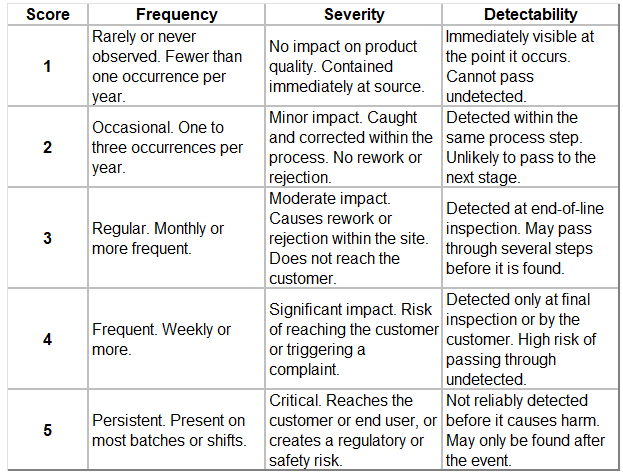
Step 4 — Calculate the combined score and assign the tier. Add the three criterion scores to produce a combined score. Set the tier boundaries based on the combined score. A typical starting point: Tier 1 for combined scores above 10, Tier 2 for scores between 6 and 10, Tier 3 for scores below 6. Adjust the boundaries to reflect the distribution of scores in your operation. The goal is a meaningful spread across the three tiers, not a system where everything ends up in Tier 1.
Apply the override rule: any defect that has reached the customer or created a regulatory risk is Tier 1 regardless of its combined score.
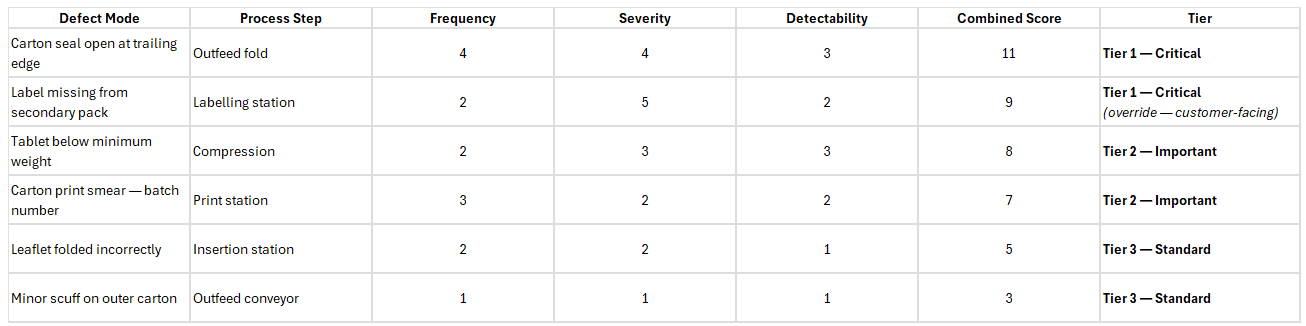
Step 5 — Review and validate with the team. The matrix is not complete until it has been reviewed by the people who work with the product and process every day. Operators, quality technicians, and engineers will identify defect modes the data missed, failure patterns the scoring did not capture, and rankings that do not match their experience. That challenge is part of the process. The matrix should be able to withstand it. If it cannot, the scoring needs to be revisited.
The validated matrix is documented, dated, and owned by a named person. It is not filed. It is used.
What the matrix drives
The matrix is only useful if it changes how decisions are made. These are the decisions it should be connected to.
Quality Control Standards. Tier 1 defects have a Quality Control Standard built around them. The standard defines the condition that must be in place at the point in the process where the defect originates, the machine setting, the material specification, the method, and the check that confirms that condition is being maintained. The matrix identifies which defects need a standard. The standard is what prevents the defect from recurring.
AM inspection routines. When the AM team builds their inspection standards at Step 6, the Product Defect Matrix is the input. The checks that go into the AM standard are the checks that matter for quality, the conditions that, if they drift, produce a Tier 1 or Tier 2 defect. The matrix tells the AM team what to look for and why it matters.
Defect investigation. Every recurrence of a Tier 1 defect is investigated using the Quality Defect Investigation process. Recurring patterns in Tier 2 defects are investigated. Single occurrences of Tier 3 defects are recorded and monitored. The matrix determines the threshold for investigation, not the severity of the individual event.
4M analysis. When a defect is investigated, the starting point is the four inputs that can produce it: the person doing the work (Man), the equipment running the process (Machine), the material being processed (Material), and the method being followed (Method). The matrix identifies which defect modes are worth that level of investigation. The 4M framework is how the investigation is structured.
Inspection point design. The matrix identifies where in the process each defect originates. That is where the inspection point should be, at source, not at the end of the line. A defect that is only caught at final inspection is a defect that has already passed through every step of the process. Moving the detection point upstream reduces the cost of the defect and increases the chance of finding the cause.
When to review the matrix
The matrix is reviewed, not restarted, when any of the following occur:
- A Tier 1 or Tier 2 defect recurs after a Quality Control Standard has been put in place. The standard was not sufficient, or the condition it was designed to control has changed.
- A new product or process is introduced. New defect modes need to be identified and scored before production begins, not after the first batch is rejected.
- A defect that was ranked Tier 3 starts appearing at a rate the matrix did not anticipate. The scoring was wrong, or the process has changed.
- A customer complaint or regulatory event involves a defect that was not in the matrix, or was ranked lower than the event suggests it should have been.
- Annually, as a minimum. The matrix should be reviewed at least once a year to confirm it still reflects the current state of the product and process.
What this gives you
Common pitfalls
Key Links
The Product Defect Matrix is the foundation of the Quality pillar. It drives the Quality Control Standards and the defect investigation process.
The AM team's quality checks at Step 6 are built from the Product Defect Matrix. The matrix must be in place before Step 6 begins.
When a Tier 1 defect recurs, the investigation uses the six-stage problem solving process with a 4M lens.
The problem definition stage of any defect investigation starts here.