Deploying Your Strategic Objectives
A step-by-step guide to making your strategy real at every level of the organisation. Covers how to launch, cascade, plan, and track, from the leadership team to the floor.
A strategy that is never properly deployed is just a document with good intentions.
Most strategies do not achieve their goals, not because they were wrong, but because they were never properly deployed and tracked.
The development work is done. You have a clear set of Strategic Objectives, a story that connects them, and a visual that makes the picture real. That is the foundation. But a foundation is not a building.
The strategy only becomes real when it reaches every team in the organisation, when the person on the floor can see their work in it, and when leaders have a way to know, day by day, week by week, whether the organisation is moving in the right direction.
That is what structured strategy deployment does.
This guide covers four steps:
- launching the strategy so it lands as something real
- cascading it so every team knows their part
- building the plans that make it executable
- tracking progress so you know early when something is going off course
Step 1 — Communicate, Sell, and Launch
The story is built. The visual is ready. Now it has to reach every person in the organisation, and it has to land as something real, not something that was decided somewhere else and handed down.
This step has three parts: the communication plan, selling the story to the people who need to believe in it, and the launch itself. They are connected. Work backwards from the launch.
Part 1 — The Communication Plan
Internal communication
Map every audience inside the organisation and decide what they need to hear, from whom, and when. The sequence matters.
- Leadership team first. They need to understand the story well enough to tell it themselves, not read from a slide, but tell it. If a member of the leadership team cannot explain the strategic objectives in their own words, they are not ready to lead the launch.
- People leaders (supervisors and team leaders) next. They are the people who will answer questions on the floor the day after the launch. Prepare them. Give them the story, the key numbers, and the answers to the questions they are most likely to be asked.
- The whole organisation at the launch. Everyone at the same time, or as close to it as the operation allows. The launch is a moment. It loses its power if it happens in instalments over several weeks.
External communication
Decide what your key external partners need to know. Customers, suppliers, and regulators do not need the full internal story, but they may need to understand the direction, particularly if your strategy involves changes that affect them. Keep it simple and relevant to their relationship with you.
Part 2 — Selling the Story
Communicating and selling are not the same thing.
Communicating means getting the information to people. Selling means getting them to believe in it, to see themselves in it, to feel that it is worth their effort, and to understand why it matters now.
The people who need to be sold first are your leaders. If they are not convinced, they will not convince anyone else. A leader who presents the strategy with visible doubt will undermine it faster than any gap in the plan.
The questions people will ask are not usually about the strategy itself. They are about what it means for them. What will change? What will stay the same? What does this mean for my team, my job, my day? Prepare honest answers. If you do not know yet, say so, but say when you will.
Part 3 — The Launch
The launch is not a presentation. It is a moment.
It should feel different from a normal meeting. It should signal that something has changed, that the organisation has made a decision about its future and is now moving towards it together.
A few principles for a launch that lands:
- One overarching message, one moment. The same story, told the same way, to everyone at the same time.
- Make it memorable. Make it visual. Use the strategy visual you built. Let people see the picture, not just hear the words.
- Make it human. The leader who tells the story matters as much as the story itself.
- Leave time for questions. Not a token five minutes at the end, real time, with real answers.
- Follow up. The launch is the beginning, not the end. What happens in the week after the launch matters as much as the launch itself.
Step 2 — Cascade the Strategic Objectives
The strategic objectives at the top of the organisation are not the strategy for every team. It is the direction. Each team's job is to work out what their contribution to that direction looks like, in their own language, at their own level.
It is how a picture becomes real plans and real work on the floor.
What Cascading Means
Each level of the organisation takes the level above's direction and translates it into their own goals and plans. The connection between levels is the line of sight, the thread that runs from the person on the floor all the way up to the organisation's Strategic Objectives.
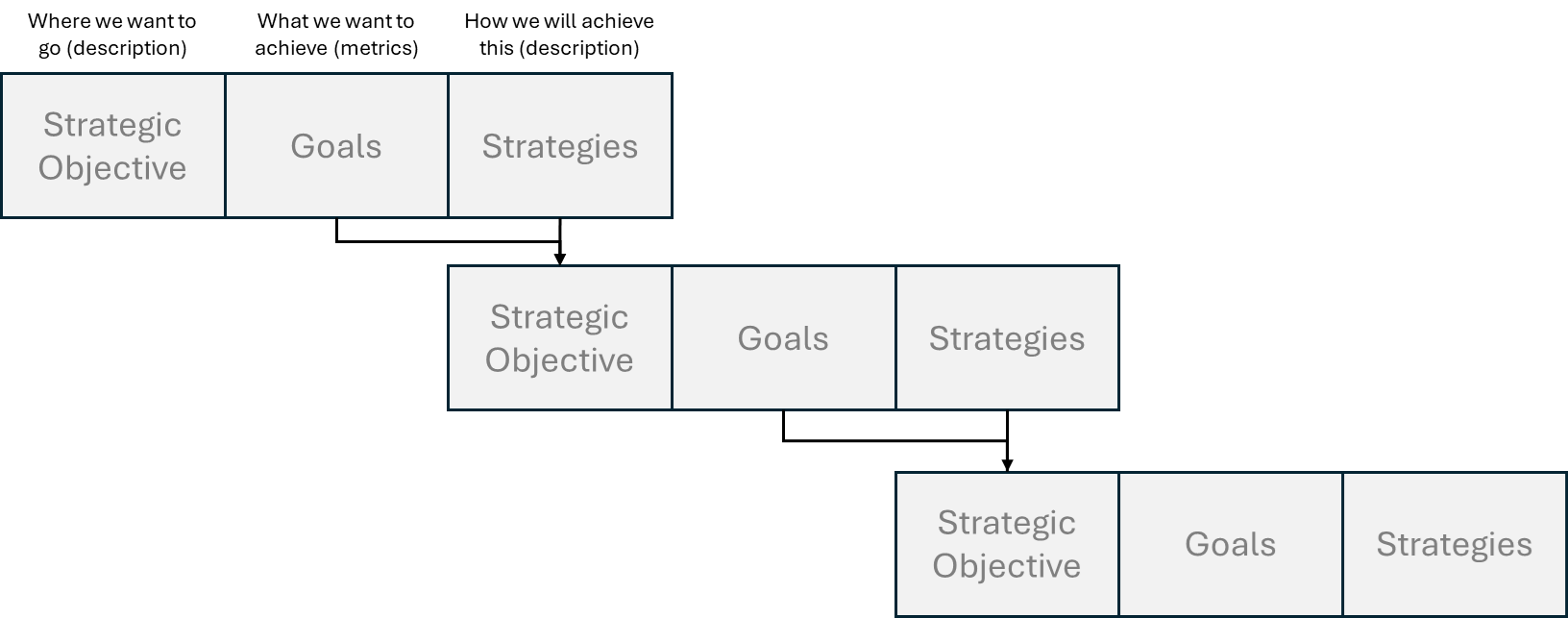
A team that has cascaded well can answer three questions:
- What are we trying to achieve, and how does it connect to the organisation's direction?
- What is our specific plan to get there?
- How will we know if we are on track?
A team that cannot answer those questions has not cascaded. They may have received the strategy. They have not made it their own.
How to Cascade
First — Understand the level above. Start with the Strategic Objectives and the goals that sit beneath them. What is the organisation trying to achieve? What does success look like in numbers? What are the strategies that have been chosen to get there?
Second — Define your contribution. Your team's goals come from the level above. If the organisation has a goal to improve service reliability by a specific amount, your team's goal is your part of that improvement. Be specific. Vague contributions produce vague plans.
Third — Choose your strategies. How will your team deliver its contribution? These are your team's strategies, the specific things you will do, at your level, to move towards the goal. They should be concrete enough to plan from.
Fourth — Check your resources. Before the cascade is finalised, check that you have what you need to deliver it. Time, people, budget, and support from other teams. If you do not have the resources, say so now, not six months later when the plan has already slipped.
Fifth — Align with peers. Share your plan with the teams at the same level. Can all of you collectively deliver what the level above needs? If there are gaps or conflicts, resolve them before the plans are locked. Are your plans in conflict or in support of each other?
Step 3 — Build the Plans
Plans are how intent becomes action.
The three plans below are for change the business work, the programmes, projects, and capability investments that move the organisation towards its Strategic Objectives. They are not the place to track daily output, quality, or service. That work has its own home in team boards and daily reviews.
There are three planning horizons. They serve different purposes and operate at different levels of detail.
The Strategic Objective Master Plan
The Strategic Objective Master Plan is the multi-year view. It covers the full period of the strategy, typically three years, and shows the major programmes, milestones, and transitions the organisation needs to make to reach its Strategic Objectives.
Not everything can happen at once, and not everything can happen in year one. The multi-year plan makes the sequence visible. It shows what needs to be true before the next thing can start, and it gives every team a sense of the journey, not just the destination.
This plan is owned by the leadership team. It is reviewed and updated annually.
The Integrated Master Plan
The integrated master plan is the annual view. It shows, across the full year, by quarter, what the organisation needs to achieve to deliver the Strategic Objective Master Plan.
It is built at the site or function level, then shared with every department and team so they can see where their work fits. It is updated based on the department and team plans to ensure it reflects reality.
The key questions it answers are:
- What are the most important milestones this year, and when do they need to happen?
- Which teams own or contribute to each milestone?
- Are we on track to deliver what we committed to?
The integrated master plan is reviewed at least quarterly. If a milestone is at risk, the response is not to wait and see. It is to understand why, decide what to do, and escalate if the team cannot resolve it alone.
The 90-Day Plan
The 90-day plan is the working plan for the quarter. It operates at the departmental and team task level. Specific actions, owned by specific people, with specific success criteria.
Its purpose is to make the quarter visible before it starts, not after it has already gone wrong.
Before each quarter begins, every team should be able to answer:
- What exactly are we doing this quarter to deliver our part of the plan?
- Do we have the resources we need, people, time, budget, and support from other teams?
- If we do not have the resources, who needs to know, and when?
The 90-day plan is reviewed at least monthly. The review is not a status update. It is a decision point. Did we do what we said we would do? If not, can we catch up, or do we need to escalate? Did we get the results we expected? If not, why not, and what are we going to do about it?
Any task that cannot be linked to a strategy, and through that strategy to a goal and an objective, should be questioned. If the team cannot explain why a piece of change work matters to the direction of the organisation, it may not be the right work to be doing.
Step 4 — Track Progress and Act on What You Find
A plan that is not reviewed is not a plan. It is a wish list.
Tracking is not about reporting. It is about knowing early enough to do something. The difference between an organisation that delivers its strategy and one that does not is usually not the quality of the plan. It is the quality of the review.
Two Questions That Matter
At every review, at every level, two questions should be asked:
- Did we do what we said we would do?
- Did we get the results we expected?
These are different questions. A team can do everything it planned and still not get the results it expected, which means the plan needs to change. A team can get good results without doing what it planned, which means it got lucky, and luck is not a strategy.
Both questions need honest answers. If the answer to either is no, the next question is: what are we going to do about it?
Outcomes and Leading Indicators
Every team needs two types of measures.
Outcome measures tell you what happened. Sales, output, quality, cost, the results the team is responsible for. These are essential, but they are always looking backwards. By the time an outcome measure turns red, the problem has already happened.
Leading indicators tell you what is likely to happen. They are the early signals that something is going off track before the results show it. A team that only watches outcome measures is always reacting. A team that also watches its sensors has time to act.
Every team should be able to name both sets of measures and review them regularly.
The Review Rhythm
- 90-day plan: reviewed at least monthly.
- Integrated master plan: reviewed at least quarterly.
- Team boards: reviewed at the frequency that matches the team's work, daily for operational teams, weekly or bi-weekly for strategic or project teams.
When a review finds a problem that the team cannot resolve on its own, the right response is to escalate, early, clearly, and with a specific ask. Escalating is not a sign of failure. Absorbing a problem silently until it becomes a crisis is.
Making the Work Visible
The most practical tool for tracking at the team level is a visual board, a shared, physical or digital space that shows:
- Who the team is and what they are responsible for
- What the team's goals are and how they connect to the level above
- What the plan is for the current period
- How the team is performing against that plan
- What is being done about any gaps
A board that is updated and used in regular team reviews is a working tool. A board that is updated for the sake of appearances is a decoration. The difference is whether the team actually makes decisions in front of it.
The two questions, did we do what we said, did we get what we expected, should be clear on the board. If the answer to either is no, the action being taken to address it should be visible too.
Leadership Behaviours
Deployment does not run itself. It requires leaders who do specific things consistently.
- Review plans, not just results. A leader who only looks at outcomes will always be reacting. A leader who reviews plans can see problems before they become results.
- Ask the two questions. Did we do what we said? Did we get what we expected? Ask them at every review, at every level.
- Escalate early. When a team cannot resolve a problem on its own, the leader's job is to escalate it, not to protect the team from scrutiny, but to get the problem the attention it needs before it gets worse.
- Protect the line of sight. If a team's plan has no visible connection to the organisation's Strategic Objectives, that is a problem to fix. Work that cannot be linked to the direction of the organisation should be questioned.
- Keep the rhythm. The review cadence only works if it is consistent. A leader who cancels reviews when things are busy is removing the early warning system at exactly the moment it is most needed. If you skip it for a good reason, eventually you will skip it for a bad reason. Protect the rhythm.
What this gives you
A strategy that is deployed well does three things.
Common pitfalls
Key links
This guide depends on the strategy development work being complete before deployment begins.
The deployment process connects directly to the daily management system through tiered accountability meetings.
Leader Standard Work is how leaders keep the strategy visible in their daily routine.