5S - Before you start, have you asked why?
The 5S audit was happening every week. The scores were tracked. The standards were, on paper, being kept. But the team dreaded it. The system designed to make their work easier had become the thing that made it harder.

I have visited sites where 5S had been done. Completed. Signed off. Most of them had the audits of one kind or another. Most of them had the scores they could show me. Very few of them had the thing 5S is actually for.
On one site in particular, 5S had become a source of tension.
Not because the people were difficult. Not because the audits were being skipped. The audits were happening every week. The scores were tracked. The actions were logged.
But the team dreaded it.
The audit had become the thing the system was for. Not faster changeovers. Not less searching. Not fewer stops. The audit. The score. The conversation afterwards about why something was not in the right place.
And because every standard carried the same weight, nothing felt more important than anything else. The check that confirmed changeover tools were complete before the line started sat alongside the check that confirmed the cleaning materials were in the right cupboard. Same form. Same score. Same conversation if either one was wrong.
When everything is equally important, nothing is important.
The team had learned that. Not decided it. Absorbed it, shift by shift, audit by audit, until the system that was supposed to support them felt like a system designed to catch them out.
That is not a 5S problem. That is a thinking-before-the-workshop problem.
I want to tell you about a changeover I worked on at a different site, because it shows how a genuinely useful standard can become that same kind of tension without anyone deciding that it should.
The line was losing forty minutes every switch. The target was twenty. The gap was real and it was costing the site batches it could not recover.
We went to look at the changeover properly. Not to fix it from a distance. To watch it, from the first tool picked up to the line running on the new product.
The tools were the first problem. Not missing. Not wrong. Just scattered. Some on the machine. Some on a trolley nearby. Some on a bench at the other end of the area. The operator knew where everything was. They had been doing this changeover for years. But the knowledge lived in their head, not in the workplace. When they were off shift, the changeover took longer. When a new operator did it, it took much longer. And when something was not where it was expected to be, the whole thing stopped while someone went to find it.
We built a shadow board. Not because shadow boards are the answer to everything. Because in this case, the right tools in the right place in the right sequence, visible before the changeover started, solved a real problem. You could see at a glance whether you were ready. You could not start the changeover and discover halfway through that a tool was missing.
The changeover time came down. The team had helped design the board. They knew what was on it and why those tools and not others. They knew what it meant when one was missing.
That shadow board was worth having. And because it was worth having, the team protected it.
Then a tool went missing.
Not stolen. Borrowed. Someone on another line needed it, took it, meant to bring it back.
This happens. It will always happen. The question is what the system does next.
What happened next was colour coding.
Each line got a colour. Tools got coloured tape. The shadow board got coloured outlines. The audit got a new check. Are the tools the right colour for this line? Are they back on the board after the changeover?
The colour coding was not a wrong idea. You can see at a glance whether a tool belongs here or has come from somewhere else. As a concept, it made sense.
But something shifted.
The conversation after the next audit was not about changeover time. It was about the tool with the wrong colour tape. The conversation after the one after that was about a tool that was on the board but in the wrong position. The standard had expanded. The audit had expanded with it. And the original purpose, faster changeovers, a line that runs, had quietly moved to the background.
The shadow board was still there. The colour coding was still there. The audit was still happening.
But the team was no longer using the system to run better changeovers. They were using it to pass the audit.
Those are not the same thing.
This is how 5S dies without anyone deciding to kill it.
It does not collapse. It drifts. The standards accumulate. The audits expand to cover the new standards. The scores become the measure of success. And the original purpose, the reason the first standard existed, gets buried under the weight of everything that came after it.
The team stops asking does this help us. They start asking will this fail the audit.
When that question becomes the dominant one, the system has already failed. The audit is just the last thing to notice.
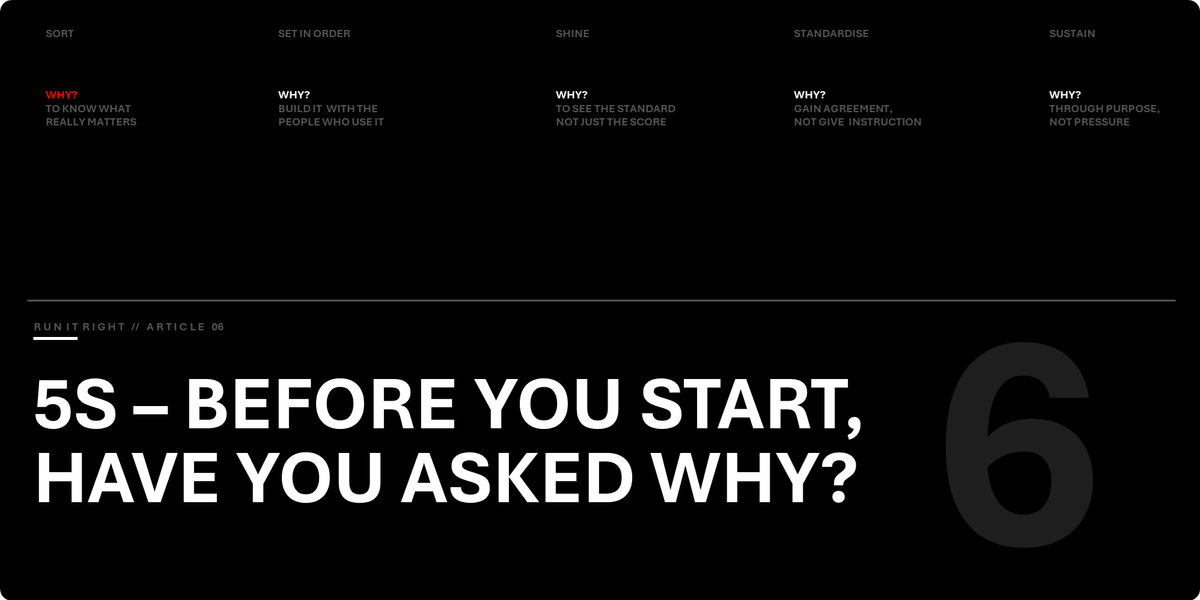
What made the shadow board worth having in the first place was not the board. It was the agreement behind it. The team had decided together which tools belonged on it, where each one should sit, and what it meant when one was missing before the changeover started. That agreement was what made the standard real. The board was just how you could see it.
When the colour coding arrived without that same conversation, it added a rule without adding an agreement. Nobody had sat with the team and asked what problem the colour coding was solving for them. It was solving a problem for the system. Not for the people doing the changeover.
That is the distinction that most 5S programmes miss, and miss early.
The question is never what standard should we create. The question is what problem does this person have, and what would make it easier to see when that problem is about to happen.
If the answer to that question is a shadow board, build a shadow board. If it is a colour, use a colour. If it is a line on the floor, paint a line. But the standard has to come from the problem, not from the method. And the person closest to the problem has to be part of building it, because they are the ones who will tell you whether it actually helps.
When they help build it, they protect it. Not because they were told to. Because it is theirs.
When a standard is imposed on them, they comply with it until the audit pressure drops. Then it drifts. Then it fails. Then someone runs another 5S event and wonders why the last one did not stick.
I went back to the site with the tension six months after my first visit.
I asked the team leader what had happened to the 5S programme.
He said something I have thought about many times since.
We kept the things that helped us. We stopped doing the things that didn't.
He was not being difficult. He was not describing a failure of discipline. He was describing a rational response to a system that had asked his team to maintain standards that did not make their work easier, and audit them in ways that did not reflect what actually mattered on the line.
The standards that helped them were still there. Still being kept. Without an audit. Without a chase. Without a conversation about scores.
The standards that did not help them were gone.
He was right to let them go. The mistake was not that they stopped. The mistake was that those standards were built in the first place.
The shadow board on the changeover line is still there.
Not because of the audit. Not because of the colour coding. Because the team that designed it knows what it is for. They know which tools are on it and why those tools and not others. They know what it means when one is missing before the changeover starts. They know the difference between a tool that has been borrowed and a tool that has been lost, and they know what to do about each one.
The standard is alive because the purpose is alive.
That is the only kind of 5S that lasts.
The same drift that kills a 5S programme kills every improvement programme. The system that holds improvement is not a method. It is a set of routines, confirmed regularly, by people who know what they are for.
The question is not whether your team has done the same thing. The question is whether you know which standards they are still keeping, and why.
If you do not know, that is the answer.
 Damon Reid