Integrated Planning Process
A practical guide to building one plan that the whole site works from, managing changes across functions when reality diverges, and eliminating the causes of those changes over time.
One plan. One version of the truth. When it changes, everyone adjusts together. When it misses, everyone asks why, and the answer changes something.
I have been to sites where the weekly schedule was built on Monday and looked nothing like the plan by Wednesday. Not because of a crisis. Because of a hundred small decisions, each one reasonable in isolation, that added up to a plan nobody was following.
A changeover was pushed because the line was running well and the numbers looked good. A maintenance slot was given back to production because a batch came in late. A material that was running low was not flagged until the line stopped. Each decision made sense at the time. None of them were made with the full picture in front of the right people.
The deeper problem was not that the schedule changed. Schedules change. The problem was that when it changed, different functions found out at different times, made different adjustments, and ended up working to different versions of the plan. Production was running to what the line leader had been told that morning. Maintenance was working to what the planner had sent on Monday. Procurement was managing to last week's forecast. Three functions. Three plans. None of them the same.
The Integrated Schedule exists to solve that problem. Not by making the plan unchangeable, by ensuring that when it changes, everyone knows, the decision is made by the right people, and the revised plan is the one the whole site works from. One version of the truth, visible to every function, updated together.
And when the plan misses, when what was supposed to happen did not, the system does not just replan. It asks why. Not to assign blame, but to understand the cause. A breakdown. A material shortage. A quality hold. A demand change. Each cause has a different owner and a different fix. Without that understanding, the same causes repeat, the schedule keeps changing for the same reasons, and the gap between the plan and the operation becomes a permanent feature of how the site runs.
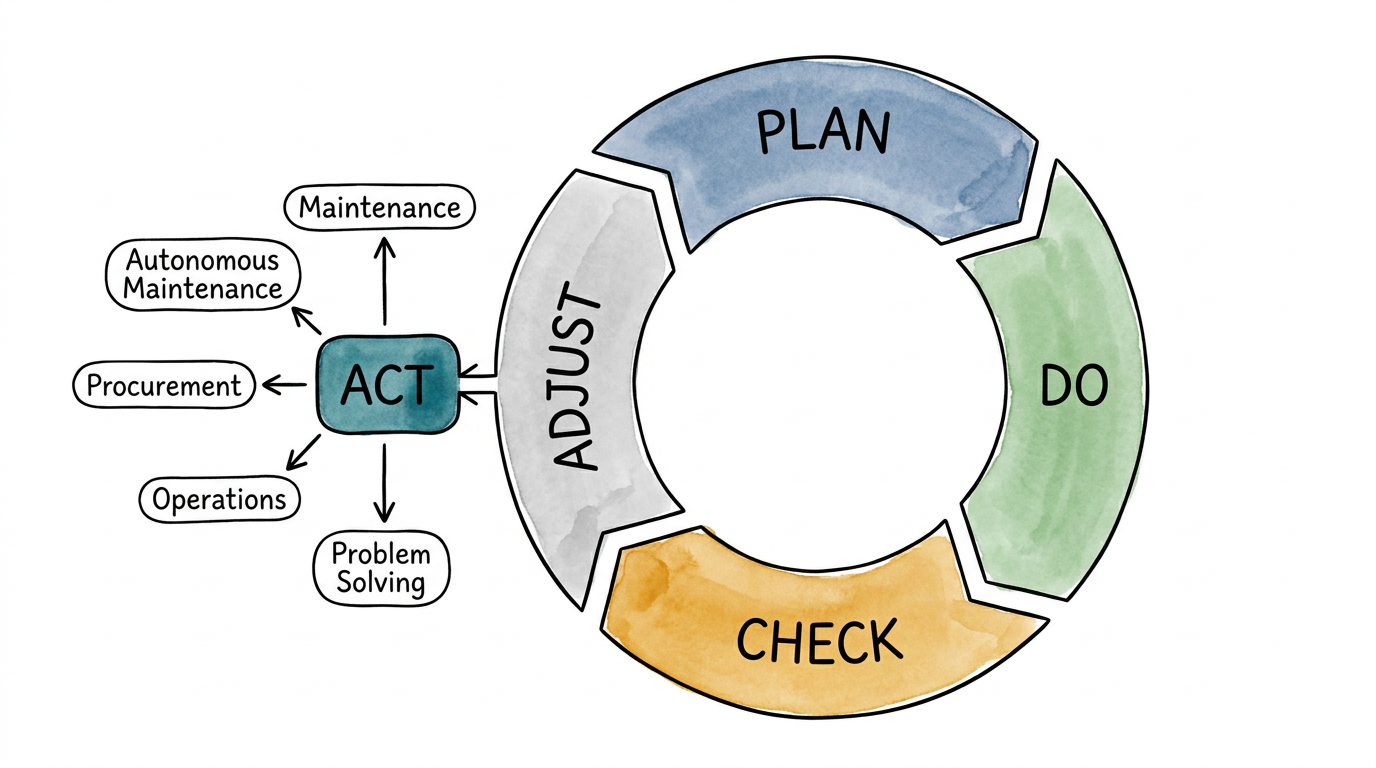
The Integrated Schedule is the plan. The daily review is the PDCA cycle that keeps it current and aligned. The miss analysis is what makes it improve over time.
- Plan — the Integrated Schedule: one plan, built around what is needed, covering production, maintenance, and procurement.
- Do — the operation runs to it.
- Check — the daily review asks both questions at every tier: did we do what we said, do we have what we need.
- Adjust — when the plan changes, the decision is made by the right people with the full picture visible, and the revised plan is the one every function works from.
- Act — when the plan misses, the cause is investigated and eliminated so it does not repeat.
The two questions
Everything in this guide exists to answer two questions accurately and in time to act.
Did we do what we said we would do?
If yes, confirm and move on. If no, understand why. Not to assign blame, to understand what the system failed to provide. Was the resource not available? Was the material not there? Was the equipment not ready? The answer determines what needs to change before it happens again.
Do we have what we need to do what we need to do next?
If yes, confirm the plan and protect it. If no, act now. Move things around. Find more resource. Find more time. Find an alternative. The question is not whether there is a problem. It is whether the problem is visible early enough to do something about it.
These two questions are asked at every tier, every day. The data, the boards, the meeting structure, all of it exists to answer them accurately and in time to act.
The first question looks back. The second looks forward. Together they are the PDCA cycle applied to the schedule: Plan, the Integrated Schedule. Do, the operation runs to it. Check, the daily review asks both questions. Adjust, the response is made and the plan is updated across the site. Act, the cause of the miss is investigated and eliminated so it does not repeat.
One plan, one shared vision
The Integrated Schedule is not a production schedule with maintenance and procurement bolted on. It is one plan that every function works from, visible to everyone, updated together when it changes.
This matters because the most common planning failure is not a bad schedule. It is three functions working to three different versions of the same schedule.
When the plan changes, and it will change, the change is made once, in the right place, by the right people, and the revised plan is the one every function works from. Not communicated separately to each function. Not discovered by each function when they arrive at the point of conflict. Updated in the shared plan, visible to all, before the next shift starts.
This is what makes the fixed window and the tier structure work. The fixed window is not just about protecting the schedule from individual decisions. It is about ensuring that when a change is necessary, it is made with the full picture visible, production, maintenance, and procurement in the same conversation, so that the impact is understood and the revised plan is coherent across all three.
A change that is made by one function without the others knowing is not a plan change. It is a divergence. And divergences compound.
Before you build the schedule
Know your constraint
The constraint is the line, machine, or resource that limits the rate of the whole operation. Schedule it first. Everything else is built around it.
When the constraint is planned to meet what is needed next, and the rest of the schedule is sequenced to support it, the operation produces what is needed in the order it is needed. When the constraint is planned to maximise output or minimise changeovers, the operation produces what is easiest, and the customer waits for what they actually need.
If you do not know what your constraint is, find out before you build the schedule. A schedule built around the wrong priority will produce the wrong output, reliably.
Know your sequence
The order in which products are made matters as much as the volume. A schedule that produces the right total quantity in the wrong sequence creates the same stockout and excess inventory problems as a schedule that produces the wrong quantity.
Sequence is not just about demand. It is also about the operation. Moving from Product A to Product B may require a brief clean and a short ramp-up. Moving from Product A to Product C may require a full clean, a line reset, and a two-hour qualification run. A packaging change that maintains the same product dimensions may have a significantly shorter changeover than a format change. The scheduler's job is to understand these constraints and build them into the optimal sequence, not to ignore them in favour of the simplest plan.
Know your data
The schedule is only as good as the data it is built on. Run rates, cycle times, batch formulas, yields, and material quantities are the foundation of every plan. When that data is wrong, the schedule built on it is wrong, and no amount of daily review fixes a plan that started from a false picture.
If your planning system is being supplemented by a spreadsheet with "real" run rates, that is the signal. The spreadsheet is not the problem. It is the evidence that the master data in the system does not reflect what the operation actually does. Fix the source, not the workaround.
Building the Integrated Schedule
The Integrated Schedule covers three things in one picture. Production, maintenance, and procurement. Not three separate schedules reconciled weekly. One schedule, reviewed daily.
Production
The production schedule is built around what is actually needed, the demand signal from the business, sequenced to meet that need in the right order, with the constraint scheduled first.
It covers:
- What is being made, on which line, in which sequence
- The changeover and cleaning time between each run
- The ramp-up time after each changeover
- The planned output rate for each run, based on validated master data
- The shift pattern and available hours
The schedule is built for the fixed window period and the forward horizon beyond it. Inside the fixed window, it is protected. Outside it, it is a plan that can be adjusted as new information arrives.
Maintenance
Maintenance slots are built into the production schedule, not negotiated separately after the schedule is set.
For each planned maintenance task, the schedule shows:
- The equipment being maintained
- The access window required
- The resource and parts confirmed
- The impact on production if the slot is deferred
A maintenance slot that is not on the production schedule is not planned. It is hoped for. When a production pressure arrives, a late batch, a breakdown on another line, the unprotected slot will lose. Every time.
The maintenance schedule is confirmed at Tier 2 before it is locked. Resource, parts, and access are confirmed before the slot is committed. A slot that cannot be resourced is not a slot. It is a gap in the plan.
Procurement
Material requirements are generated from the production schedule with lead times applied. Not from last month's actuals. Not from a standing order. From the forward schedule, with the lead time for each material built in, so that the order is placed when it needs to be placed, not when the need becomes urgent.
For each critical material, the schedule shows:
- The quantity required and when it is needed
- The current stock level against the safety stock target
- The order status and expected delivery date
- The low-stock threshold and whether it has been breached
A procurement failure is almost always a planning failure. The material was needed. The lead time was known. The order was placed too late because the signal was not visible early enough. The Integrated Schedule makes the signal visible the day it becomes actionable, not the day the line stops.
The fixed window
The fixed window is the period within which the schedule is protected from external change.
Inside the window, no changes without a formal exception process and a named decision-maker.
Outside the window: normal planning and adjustment.
The length of the window is set by the site and corporate together, typically one to four weeks for production, longer for procurement where lead times demand it. The window is not a bureaucratic rule. It is the mechanism that makes the schedule believable.
A schedule that can be changed by anyone, at any time, for any reason, is not a schedule. It is a starting point for negotiation. The people who are supposed to execute it know it will change. They stop planning around it. They start managing around it instead. And the gap between what the schedule says and what the operation does grows, quietly, until the schedule is a formality rather than a plan.
Managing exceptions inside the window
Exceptions will happen. A breakdown. A late delivery. A quality hold. The fixed window does not prevent exceptions, it requires them to be managed deliberately.
When a change is needed inside the window:
- The request is named, what needs to change, why, and what the impact is
- A decision-maker is identified, the person with the authority to approve the change
- The impact is assessed, what does this change displace, and what is the consequence
- The decision is made and recorded, approved or rejected, with a reason
A change that is made without this process is not an exception. It is a breach of the schedule. Over time, unmanaged breaches destroy the credibility of the fixed window, and with it, the credibility of the schedule.
Low stock and out of stock
Low-stock and out-of-stock thresholds are defined for every critical material and finished good.
Low stock is a warning. The stock level has fallen below the threshold. There is still time to act, but only if the signal is visible and acted on.
Out of stock is a failure. The buffer has been consumed. The line is at risk or already stopped. The response is now reactive, expensive, and disruptive.
The system is designed to act on the warning, not the failure.
Setting the thresholds
Thresholds are not arbitrary minimums. They are set against defined safety stock targets, the calculated buffer that reflects:
- Demand variability: how much does daily or weekly demand fluctuate?
- Lead time: how long does it take to replenish this material or produce this product?
- Consequence: what is the cost of running out, a line stop, a customer failure, a regulatory hold?
A threshold set too low gives no time to act. A threshold set too high ties up cash and space without reason. Both are planning failures.
Safety stock targets are reviewed on a defined cycle. Demand patterns change. Lead times change. The consequence of a stockout changes. A target that was right twelve months ago may not be right today. The review is a recurring responsibility of the Planning pillar, not a one-time exercise.
When a threshold is breached
When a low-stock threshold is breached, it surfaces in the daily review the same day. A named owner is assigned before the meeting ends. A response plan is in place before the next review.
The response plan answers three questions:
- What is the current stock level and how long will it last at the current rate?
- What is the fastest path to replenishment, expedite, substitute, reschedule production?
- What is the risk to the customer if replenishment takes longer than expected?
The answer to the third question determines the urgency of the first two.
The daily review — tier by tier
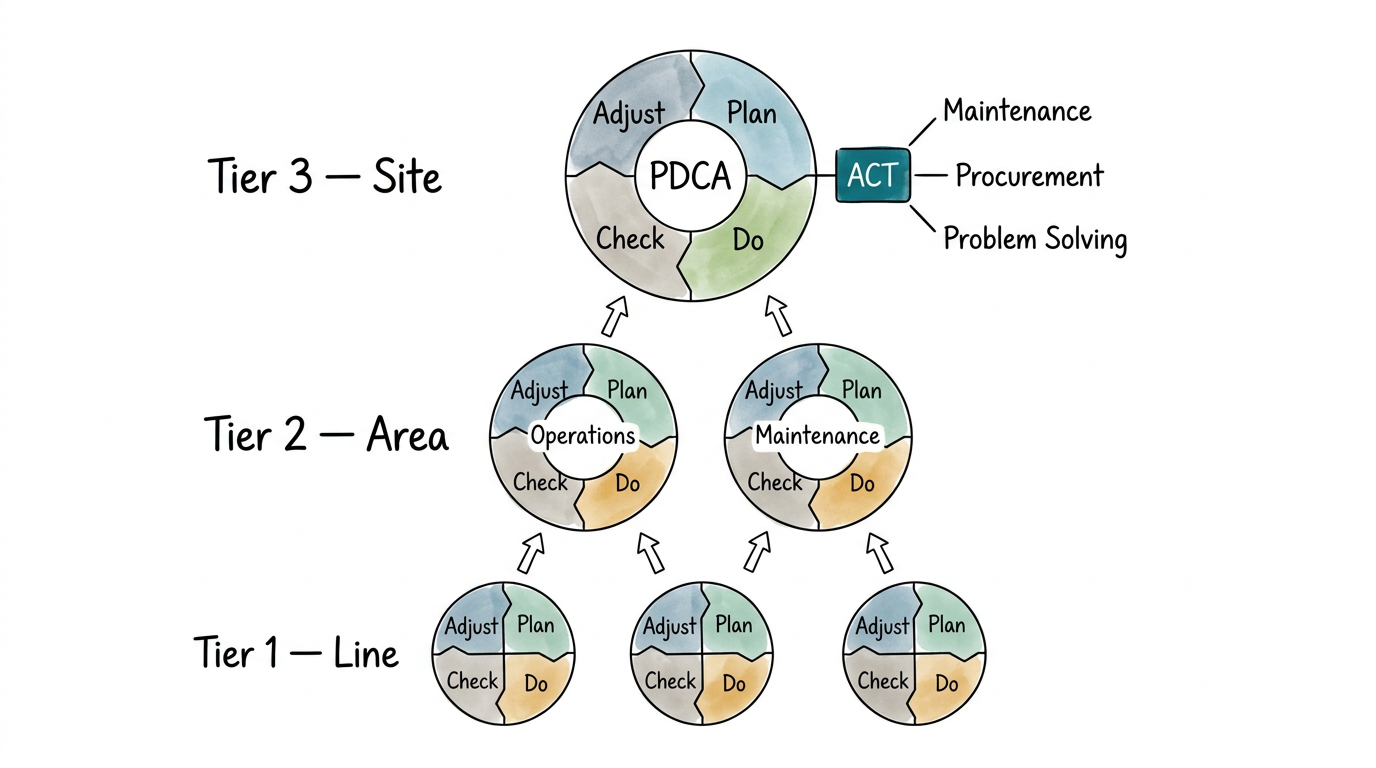
The Integrated Schedule sits inside the Tiered Accountability Meeting system. It is not a separate set of meetings. It is the schedule-specific content that each tier reviews as part of its standard agenda.
Tier 1 — at the line
One Tier 1 per line. Operations and the maintenance person responsible for that area both attend.
Operations reviews:
- What was planned for this line, what was completed, what is open
- What is planned for this shift and the next, is it resourced and ready
- Any low-stock signals for materials this line uses
Maintenance reviews:
- Planned work for this area, slot availability, access confirmed, parts and resource in place
- Any abnormalities from the operating team that require a maintenance response
Both answer both questions before the meeting ends. What can be resolved at the line is resolved here. What cannot is escalated to Tier 2, named, with an owner, before the meeting ends.
A production delay that puts a maintenance slot at risk is named in this meeting. Not discovered when maintenance arrives and the line is still running.
Tier 2 — consolidating the picture
Tier 2 runs as two parallel meetings, each consolidating the outputs from their Tier 1s.
Operations Tier 2 brings together the summary from each line:
- Equipment performance and availability
- People and materials
- Which lines did what they said they would do, and which did not, with a clear reason for each gap
- Low-stock signals with a named owner and response plan confirmed
- Items that cannot be resolved within operations, brought to Tier 3 with a proposed path forward, not a list of problems, a position
Maintenance Tier 2 consolidates the maintenance schedule position across areas:
- Completed, open, moved, and any requests to change planned work
- Any request to change planned maintenance that affects production access, resource, or the forward schedule, identified here and brought to Tier 3 for a decision
- Arrives at Tier 3 with a clear position: what is confirmed, what needs a decision, and what the recommendation is
Neither Tier 2 resolves what the other owns. Both feed into Tier 3.
Tier 3 — resolving what Tier 2 could not
Leaders come together with the consolidated picture from both Tier 2 meetings, plus procurement's view of material availability and supply risk.
- Operations presents the site production position
- Maintenance presents their consolidated schedule position, including any unresolved requests to change planned work
- Procurement presents material availability, lead time risks, and any supply constraints against the forward schedule
Cross-functional conflicts, between what production needs, what maintenance has planned, and what procurement can deliver, are resolved here, in the room, with named owners and a revised plan before the meeting ends.
The site's confirmed position agreed at Tier 3. Not an estimate. Not last month's actuals. A plan, built on the current schedule, confirmed by the people who own it.
What cannot be resolved at Tier 3 is escalated above site, through your S&OP or IBP cycle, named, with an owner and a timeline.
When the plan misses, root cause analysis on schedule changes
Every schedule miss is data. The question is whether the organisation uses it.
A miss that is replanned without investigation is a miss that will happen again. The cause is still there. The schedule will be disrupted by the same thing next week, or next month, or in the same week next quarter. The team will replan again. The cause will remain. Over time, the gap between the plan and the operation becomes a permanent feature of how the site runs, not because the planning is poor, but because the causes of disruption have never been addressed.
The Integrated Schedule treats schedule misses the same way the Problem Solving pillar treats recurring defects. The miss is not just an operational event to be managed. It is a problem to be understood and eliminated.
Classifying the miss
Not every miss requires the same depth of investigation. The first step is classification, understanding what kind of miss it was.
Unplanned equipment failure. The line stopped because of a breakdown that was not anticipated. The cause sits in the Maintenance pillar, was this a recurring failure that should have been investigated? Was planned maintenance deferred? Was the lubrication standard not being followed? The investigation is a Breakdown Elimination or Problem Solving investigation, owned by the Maintenance function, with the finding fed back to the planning system.
Material unavailability. The line could not run because the material was not there. The cause sits in the procurement and planning process, was the low-stock threshold set correctly? Was the signal acted on in time? Was the lead time built into the schedule? The investigation asks whether the planning system failed to surface the signal, or whether the signal was surfaced and not acted on.
Quality hold. The product could not be released or the line could not run because of a quality issue. The cause sits in the Quality pillar, was this a recurring defect? Was the process running to standard? The investigation is a Problem Solving investigation, owned by the Quality function, with the finding fed back to the planning system.
Demand change. The business changed what it needed, and the schedule changed with it. This is not a failure, it is the system working. But if demand changes are frequent, the question is whether the S&OP or IBP process is providing a stable enough signal, or whether the demand variability itself needs to be addressed upstream.
Capacity constraint. The schedule was built on a capacity assumption that turned out to be wrong, a run rate that was not achievable, a changeover that took longer than planned, a yield that was lower than expected. The cause sits in the master data, the data needs to be corrected, and the schedule rebuilt on the corrected foundation.
Planning error. The schedule was built incorrectly, the wrong sequence, the wrong quantity, the wrong timing. The cause sits in the planning process itself, was the constraint correctly identified? Was the sequence optimised? Was the fixed window held? The investigation asks what in the planning process produced the error and what needs to change.
Recording and tracking misses
Every schedule miss is recorded at the point it is identified, in the daily review, at the tier where it surfaces. The record includes:
- What was planned
- What actually happened
- The classification of the miss
- The named owner of the investigation
- The timeline for the finding
The record is not a blame log. It is a data set. Over time, it shows which causes are recurring, which functions own the most frequent causes, and where the planning system is most vulnerable to disruption.
A Pareto of schedule misses by cause, reviewed monthly, is one of the most useful planning tools available. It tells you where to focus the improvement effort, not on the schedule itself, but on the causes that keep disrupting it.
Closing the loop
The investigation finding is fed back to the planning system. Not filed. Fed back.
If the cause was a recurring equipment failure, the Breakdown Elimination finding changes the planned maintenance standard, and the planning system updates the maintenance schedule to reflect the new interval.
If the cause was a master data error, the data is corrected, and the schedule is rebuilt on the corrected foundation.
If the cause was a procurement signal that was not acted on in time, the threshold is reviewed, and the escalation process is tightened.
If the cause was a demand change that was not visible early enough, the S&OP interface is reviewed, and the frequency or format of the demand signal is adjusted.
The loop is closed when the cause has been addressed and the planning system has been updated to reflect the fix. A miss whose cause has been found but not acted on is a miss that is being accepted.
Master data, the foundation the schedule runs on
The schedule is only as good as the data it is built on. Master data review is a Planning pillar responsibility, not because the Planning function owns the data, but because it owns the process that keeps it current.
What master data covers
- Run rates — the actual output rate for each product on each line, validated against recent performance
- Cycle times — the time to produce one unit or one batch, including setup
- Changeover and cleaning times — the actual time required to move from one product to the next, including ramp-up
- Yields — the proportion of input material that becomes finished product, at the current process standard
- Batch formulas and material quantities — the materials required for each product, at the quantities the process actually uses
The review process
On a defined cycle, at minimum every six months, more frequently in a changing operation, the key parameters are reviewed against actual performance.
The review asks two questions:
- Does what the system says match what the operation actually does?
- Does what the system says still reflect what the process is designed to do?
When the answer to either is no, the data is updated, the change is approved, and the schedule is rebuilt on the corrected foundation. The approval requires sign-off from the functions who own the data, Operations, Engineering, Procurement, and is recorded. A change to master data without a record is a change nobody can trace when the next discrepancy appears.
When actual results diverge consistently from the planned rate, that is a signal the data needs updating, not that the team is underperforming.
The connection to the wider business
The Integrated Schedule does not exist in isolation. It is the site's input to the business's planning cycle, and the quality of that input determines whether the business can plan around the site or has to plan around its uncertainty.
Sales and Operations Planning (S&OP) is the process by which a business aligns its demand signal, what customers need, with its supply capability, what the operation can produce. It runs on a defined cycle, typically monthly, and produces a single agreed plan that covers demand, supply, inventory, and financial performance across a defined horizon, usually twelve to eighteen months.
Integrated Business Planning (IBP) is the more developed form of the same process. It extends the horizon, deepens the financial integration, and connects the operational plan more explicitly to the strategic objectives of the business. IBP is S&OP with a longer view and a closer connection to the decisions that shape the business over time.
Both processes ask the same fundamental question: can the business deliver what the customer needs, at the cost the business requires, with the supply capability it has? The site's answer to that question is its confirmed schedule.
What the site provides
The site's input to the S&OP or IBP cycle is not a forecast. It is not last month's actuals. It is a confirmed schedule, the plan the site can commit to, built on validated master data, reviewed daily, and held inside a fixed window.
The site provides:
- Confirmed capacity — what the site can produce in the planning horizon, by product and by line, based on the current schedule and the current constraint
- Confirmed supply — what the site will produce in the near-term window, by product and by date, based on the fixed schedule
- Known risks — what could prevent the site from delivering the confirmed plan, and what the mitigation is
- Inventory position — current stock levels against safety stock targets, and the direction of travel
A site that submits an estimate rather than a confirmed schedule is not participating in the S&OP or IBP cycle. It is reporting into it. The business will plan around the uncertainty, not around the site.
What the site receives
The S&OP or IBP cycle is not a one-way process. The site receives:
- The demand signal — what the business needs the site to produce, by product and by period, over the planning horizon
- Inventory targets — the stock levels the business needs the site to hold, by product, to meet the service level commitments the business has made
- Constraint decisions — where the business has decided to invest, which products to prioritise, which markets to serve, and what that means for the site's schedule
The demand signal is the input the site's schedule is built around. If the site is not receiving a clear, current demand signal, or if the signal it receives is not connected to the schedule it builds, the site is planning in isolation. The schedule will produce what the site thinks is needed, not what the business actually needs.
The site's role in the cycle
The S&OP or IBP cycle runs on a defined cadence, typically monthly, with weekly updates in the near-term horizon. The site's role at each stage is specific.
Weekly: The site confirms its near-term schedule position, what was produced last week, what is planned for the next two to four weeks, and any risks to the fixed window. This is not a new meeting. It is the Tier 3 output, formatted for the business.
Monthly: The site confirms its medium-term capacity position, what it can produce over the next twelve to eighteen months, by product and by period, based on the current constraint and the planned maintenance and capital programme. This is the input the business uses to make supply decisions: which site produces which product, where investment is needed, where risk sits.
The site does not send an estimate. It sends a plan, built on the same schedule it runs every day, confirmed by the same people who own it, reviewed by the same process that holds it.
When the demand signal and the site's capacity do not align
The S&OP or IBP cycle will surface mismatches between what the business needs and what the site can provide. That is the point of the process. A mismatch that is visible in the planning cycle is a problem that can be managed. A mismatch that is invisible until the site misses its commitment is a crisis.
When the demand signal exceeds the site's confirmed capacity:
- The constraint is identified and named
- The options are assessed: additional shifts, overtime, outsourcing, demand deferral, product prioritisation
- A decision is made at the right level, not by the site alone, but by the business, with the site's input
- The revised plan is confirmed and the schedule is updated
When the site's capacity exceeds the demand signal:
- The excess capacity is visible and can be used deliberately, for inventory build ahead of a planned shutdown, for a new product introduction, for a campaign that reduces changeover frequency
- The schedule is built to use the capacity for what the business needs, not for what is easiest to make
In both cases, the decision is made in the planning cycle, not discovered in the weekly review.
What this gives you
Common pitfalls
Key links
The Integrated Schedule sits inside the Planning pillar. The pillar page covers the full context, the losses the schedule is designed to prevent, the capabilities it builds, and the phases of implementation.
The daily review of the Integrated Schedule happens inside the Tiered Accountability Meeting system. The TAM guide covers the meeting structure, the escalation logic, and what good looks like at each tier.
Maintenance slots in the Integrated Schedule connect directly to the Maintenance pillar's planned maintenance system. A slot that is not on the production schedule is not planned.
The schedule is built on master data. When that data is wrong, the schedule is wrong. Breakdown Elimination and the Process Improvement Process are the tools for finding and fixing the causes of data drift.
Leaders Standard Work is how the two questions become a daily discipline rather than an occasional review.
Process Confirmation is how the schedule standard, the fixed window, the threshold response, the master data review cycle, is confirmed to be in place and being followed.